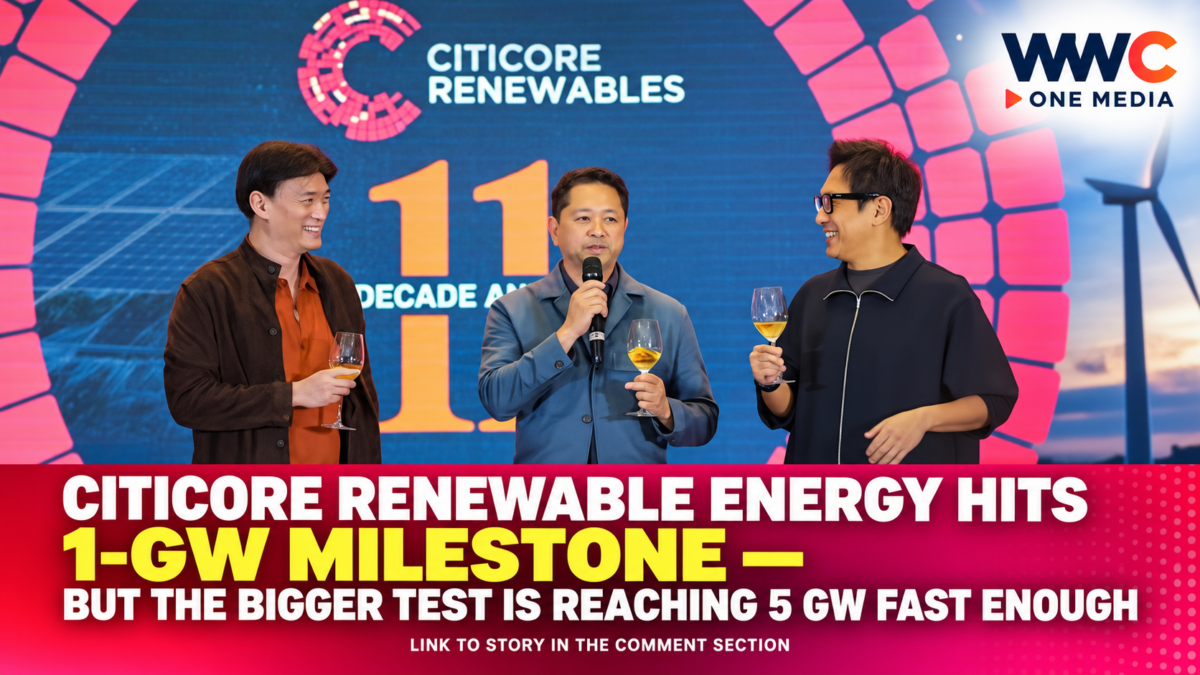
MANILA, Philippines — Citicore Renewable Energy Corp. has crossed the 1-gigawatt mark in installed renewable-energy capacity, giving the Edgar Saavedra-led company a major milestone as it races toward an even more ambitious goal: building a 5-GW clean-energy portfolio in the Philippines.
CREC announced the milestone as it marked its 11th anniversary, celebrating with employees, regulators, financial institutions and business partners on September 25.
The company said it has now completed 21 solar sites nationwide, putting it significantly closer to becoming one of the country’s largest renewable-power producers.
But reaching 1 GW is only the beginning.
CREC Chairman Edgar Saavedra said the company’s larger vision is to reach 5 GW of renewable-energy capacity, meaning it still has to multiply its current installed base several times over while dealing with challenges involving financing, transmission access, project execution and the integration of increasingly large volumes of solar power into the grid.
From 285 MW to 1 GW in roughly two years
The speed of CREC’s expansion becomes clearer when compared with where the company stood only two years ago.
In 2024, CREC had around 285 megawatts of gross installed capacity from 10 solar facilities.
At the time, President and CEO Oliver Tan said the company intended to add around 1 GW of renewable capacity every year as it worked toward its original target of approximately 5 GW by 2028.
That made CREC one of the Philippine renewable-energy industry’s most aggressive developers.
The company subsequently accelerated construction across multiple provinces, backed by billions of pesos in investment and financing.
By its October 2026 anniversary announcement, CREC said its installed renewable portfolio had officially reached the 1-GW threshold.
That means the company’s installed base has expanded by more than three times from the 285 MW reported in 2024.
The next expansion is even bigger
CREC is not slowing down after crossing 1 GW.
Earlier this year, the company said it was allocating roughly $2 billion, or around ₱119 billion at the exchange rate used at the time, in 2026 capital expenditures as it pursued its next major wave of projects.
The spending was intended largely for projects awarded under the government’s Fourth Green Energy Auction, or GEA-4.
CREC emerged as one of the largest winners in that auction round, securing more than 1,200 MW of renewable-energy capacity, including solar projects paired with battery storage.
Projects are being developed in areas including Isabela, Batangas, Quezon and Negros Occidental.
Tan said in January that at least 10 projects were expected to be activated as part of CREC’s push to substantially complete its second and third gigawatts.
If that rollout stays on schedule, CREC could move from 1 GW to several gigawatts in a relatively short period.
GEA-2 projects are already built
One of the biggest developments in the company’s latest update involves projects awarded under the government’s Green Energy Auction 2 program.
Tan said all CREC projects won under GEA-2 have already been completed, with only energization and commissioning remaining.
That distinction is important.
A solar farm can be physically constructed but still require grid testing, regulatory approvals and commissioning before it begins delivering electricity commercially.
Once those projects are fully connected, however, CREC’s operational generating capacity could rise further.
The company argues that its progress demonstrates that the government’s auction system can successfully convert renewable-energy commitments into actual projects.
Negros solar project became one of CREC’s newest additions
One example of CREC’s expanding portfolio came in April, when it energized a 69-MW solar project in Negros Occidental.
BusinessWorld reported that the facility was the first of six solar plants totaling around 484 MW that CREC planned to energize during 2026.
The Negros project also incorporated CREC’s AgroSolar program.
Instead of removing agricultural activity entirely from land used for solar development, the initiative allows crops to be grown in spaces around and beneath solar-panel arrays.
CREC argues that the approach demonstrates how energy infrastructure and agricultural activity can coexist.
That model is becoming increasingly important as solar developers face questions over land use in a country where agricultural space is itself economically and socially valuable.
CREC is also turning to batteries
Solar power has one major limitation: generation falls sharply when sunlight disappears.
That makes battery storage increasingly important as more solar projects connect to the Philippine grid.
CREC’s newer expansion strategy therefore goes beyond standalone solar facilities.
The company’s GEA-4 pipeline includes projects combining solar generation with battery energy storage systems, allowing electricity generated during periods of strong sunlight to be stored and released later.
Battery storage can also help stabilize the grid as renewable penetration increases.
The Department of Energy’s latest long-term power plan acknowledges this need.
Its power-development scenarios include roughly 20,000 MW of battery energy storage capacity over the longer term to support the integration of variable renewable energy such as solar and wind.
That makes storage increasingly central to the country’s clean-energy strategy rather than simply an optional add-on.
CREC’s growth is being financed by some of the country’s largest banks
Building gigawatts of power capacity requires enormous amounts of capital.
CREC credited 14 financial institutions for supporting its expansion.
The list includes major Philippine lenders such as:
BDO Unibank,
Bank of the Philippine Islands,
Rizal Commercial Banking Corp.,
Philippine National Bank,
Land Bank of the Philippines,
Development Bank of the Philippines,
and Security Bank.
International institutions including Bank of China and HSBC were also cited among its financing partners.
That level of bank participation highlights one of the biggest changes taking place in Philippine energy finance.
Renewable-energy development is no longer primarily a niche environmental investment.
Large solar projects are increasingly being financed as mainstream infrastructure.
CREC raised ₱5.3 billion from the stock market
Public investors have also helped finance the company’s expansion.
CREC listed on the Philippine Stock Exchange in June 2024, raising approximately ₱5.3 billion through its initial public offering.
Its shares were priced at ₱2.70 each during the IPO.
The listing was explicitly tied to the company’s plan to scale toward 5 GW of renewable-energy capacity.
Among its institutional backers was the United Kingdom government’s MOBILIST program, which invested $12.5 million in CREC as part of efforts to mobilize private capital toward sustainable infrastructure.
That means the company’s expansion is being funded through a combination of equity markets, bank loans and project financing.
The growth is beginning to appear in CREC’s financial results
CREC’s rapid expansion is also beginning to translate into higher electricity sales.
For the first nine months of 2025, consolidated revenue rose to approximately ₱3.82 billion, with electricity sales increasing 14% as the company expanded its customer base.
CREC said electricity sales contributed an additional ₱410.65 million compared with the previous period.
For the full year, CREC later reported ₱5.32 billion in consolidated revenue and around ₱1.15 billion in net income, according to BusinessWorld.
Net income rose approximately 14%.
Those numbers are particularly important because new projects being connected in 2026 could provide a larger contribution to revenue and profit in succeeding years.
Tan has previously said the financial impact of newly energized facilities would become more visible as additional projects begin commercial operations.
But 1 GW is still far from 5 GW
The milestone sounds enormous—and it is.
One gigawatt equals 1,000 megawatts of installed capacity.
But measured against CREC’s own ambition, the company is only partway through its expansion.
Its previously stated target was approximately 5 GW by 2028, while the latest anniversary statement described its vision as achieving 5 GW within five years.
That difference in wording makes the project’s timing worth watching.
What remains consistent is the scale of the ambition.
CREC wants to become one of the country’s largest renewable-energy producers by repeatedly adding gigawatt-sized batches of projects.
To do that, it must continue securing land, financing, equipment, transmission connections and regulatory approvals at a pace rarely seen in Philippine power development.
The Philippines itself needs a much bigger renewable-energy buildout
CREC’s expansion is taking place against an even larger national challenge.
The Department of Energy wants renewable energy to account for at least 35% of Philippine power generation by 2030 and 50% by 2040.
Meeting those targets will require enormous amounts of new generation capacity.
In February 2026, the DOE announced a 10-year Green Energy Auction roadmap targeting at least 25 GW of additional renewable capacity through 2035.
Projects under the plan are expected to include solar, wind, floating solar, rooftop solar, battery-backed solar, biomass, geothermal and hydropower.
The scale puts CREC’s 1-GW milestone in perspective.
It is significant for one private developer—but the Philippines needs dozens of similarly large developments if it is going to transform its electricity system.
More renewable capacity does not automatically guarantee cheaper power
There is also an important distinction consumers should understand.
Building more solar capacity can increase power supply and reduce exposure to volatile imported fossil-fuel prices.
But adding renewables does not automatically translate into immediately lower electricity bills.
Power prices are affected by many other factors, including:
generation contracts,
transmission costs,
distribution charges,
taxes,
grid congestion,
reserve requirements,
and the cost of balancing intermittent renewable power.
Solar projects also require adequate transmission infrastructure.
A completed solar facility cannot contribute its full output if transmission lines are unavailable or congested.
That means the renewable-energy race is also becoming a grid-development race.
The grid may become the bigger bottleneck
The Philippines’ planned renewable expansion presents the National Grid Corp. of the Philippines and regulators with an increasingly difficult task.
Large amounts of solar and wind generation can be developed faster than major transmission projects.
The DOE’s Power Development Plan says the country’s supply capacity may ultimately need to increase five to six times by 2050, depending on the energy-transition scenario.
That expansion must be accompanied by sufficient transmission, storage and flexible generation.
Otherwise, billions of pesos worth of renewable assets risk becoming constrained by an electricity network unable to absorb all of their output.
For CREC, that makes energization and transmission access almost as important as construction itself.
Citicore is also betting that solar farms can serve communities
Beyond electricity production, CREC has attempted to position its projects as community-development platforms.
Its AgroSolar Initiative allows agricultural production around solar installations.
The company also runs technical-skills training and local-employment programs.
Environmental initiatives include reforestation and coastal cleanups.
Its EcoLoop program, meanwhile, focuses on repurposing retired solar panels.
These initiatives matter because renewable projects increasingly face scrutiny over their effects on land, communities and local livelihoods.
The energy transition will require more than simply installing panels.
Developers will also need community acceptance.
The next four gigawatts will be harder than the first
Citicore Renewable Energy’s first gigawatt represents a major corporate milestone.
The company has moved from a relatively small solar portfolio to one of the country’s most aggressive renewable-development pipelines.
It has raised money from the stock market.
It has secured billions in bank financing.
It has won large government auction allocations.
And it has begun pairing solar projects with battery storage and agricultural initiatives.
But CREC’s biggest challenge starts now.
Moving from hundreds of megawatts to 1 GW proved the company could scale.
Moving from 1 GW toward 5 GW will test whether it can keep financing, constructing and connecting massive projects quickly enough while the Philippine power system itself struggles to keep pace.
And that is why CREC’s 1-GW celebration is less a finish line than the starting point of an even bigger renewable-energy race.