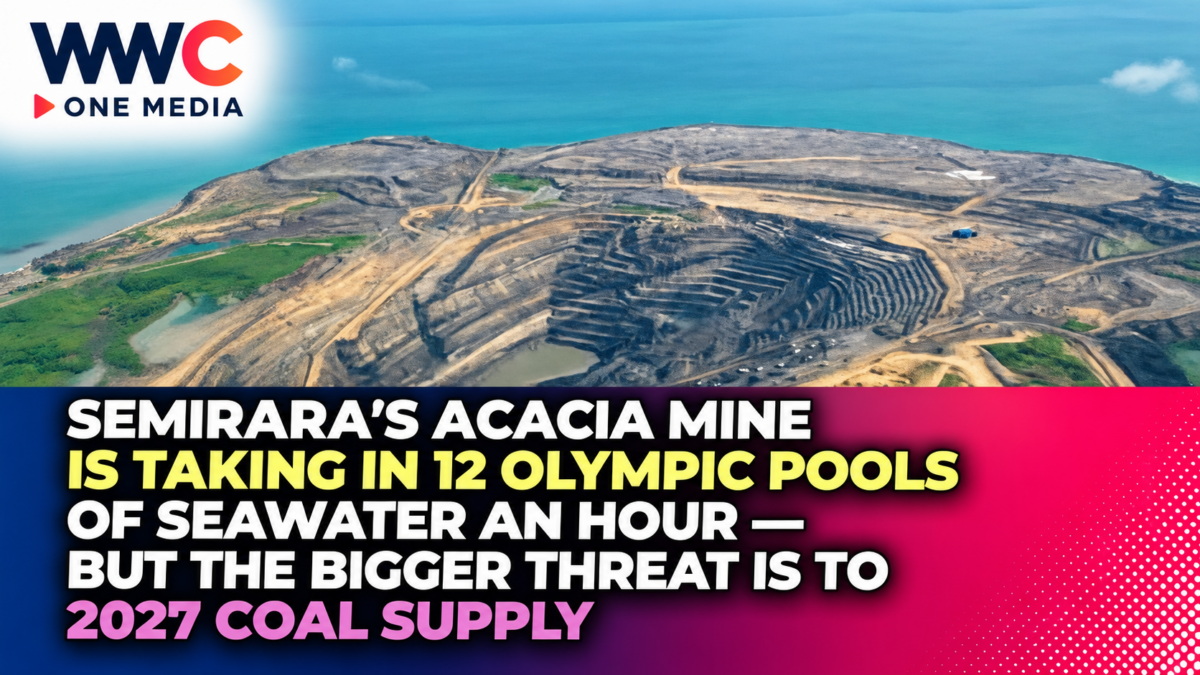
ANTIQUE — Semirara Mining and Power Corp. is battling worsening seawater inflows at its Acacia coal mine in Antique, forcing it to partially suspend critical mining work, cut another 996 jobs and warn that its 2027 coal production could take a major hit.
The Consunji-led company disclosed that seawater is now entering Acacia at approximately 30,000 cubic meters per hour.
That is enough water to fill around 12 Olympic-size swimming pools every hour.
More importantly, the volume has now exceeded the mine’s current pumping capacity, increasing the risk that sections of Acacia could become flooded and inaccessible.
SMPC said the worsening conditions have already constrained operations and forced a partial suspension of stripping activities, the massive earth-moving work required to remove soil and rock before miners can reach coal underneath.
That is why the impact may not be fully visible this year.
The biggest production consequences could arrive in 2027.
Semirara Is Still Keeping Its 2026 Target
Despite the flooding problem, SMPC says it is maintaining its 2026 coal production target at 12 million metric tons.
But that target is already much lower than last year.
The Philippine Star reported that Semirara produced a record 19.9 million metric tons in 2025, meaning the current 12-million-ton target represents a sharp year-on-year reduction.
The company had already been dealing with:
higher stripping requirements,
limited access at Acacia,
and uncertainty surrounding the government’s coal-contract bidding process.
Now the seawater problem has become another major operational constraint.
2027 Is Where the Real Risk Appears
SMPC says the disrupted stripping work will affect coal output next year because Acacia had been expected to supply most of the company’s 2027 production.
That is the crucial point.
Mining companies cannot simply decide in January how much coal they want to produce and begin extracting it immediately.
Months of preparatory work are required.
Stripping removes millions of tons of overburden before the coal seam becomes accessible.
If that work stops today, the shortage appears later.
So the current flooding problem is effectively creating a production bottleneck for 2027.
The Mine Is 350 Meters Below Sea Level
Acacia is an unusually challenging operation.
Earlier this year, SMPC said the mine extends roughly 350 meters below sea level, which makes continuous pumping essential to keeping it operational.
Even before the latest deterioration, the company was already pumping around 30,000 cubic meters of seawater every hour just to maintain access.
SMPC has repeatedly described the pumping system as Acacia’s “lifeline.”
If pumping stops for an extended period, the company has warned that the mine could become completely flooded and potentially lose access to a large portion of its coal reserves.
That makes Acacia fundamentally different from an ordinary open-pit mine.
The company is not merely removing groundwater.
It is effectively fighting continuous seawater intrusion.
More Than Half of the Water Is Flowing Toward the Pit Bottom
The October 2 PSE filing added an important detail.
SMPC said more than half of the 30,000 cubic meters per hour is being directed toward the bottom of the Acacia pit.
That makes the situation more serious because the pit bottom is precisely where mining access needs to be maintained.
The company also disclosed that on September 20, dumped and in-situ materials from North Block 1 Dam 2 collapsed, redirecting substantial runoff toward Acacia.
That event added further water pressure to a system already operating near or beyond its limits.
The Pumping System Can No Longer Keep Up
This is the operational turning point.
Previously, SMPC could pump out roughly the same volume of water entering the mine.
Now the company says inflows have moved beyond available pumping capacity.
Once water enters faster than it can be removed, several risks increase:
pit flooding,
slope instability,
equipment disruption,
loss of mining access,
and additional safety concerns.
The company must either add significant pumping capacity or reduce operations in vulnerable areas.
For now, it is doing the latter.
Long-Term Fixes Will Cost Serious Money
SMPC says managing the seawater problem sustainably will require substantial capital investment.
That includes spending on:
larger pumping systems,
additional power infrastructure,
water-management systems,
and other supporting equipment.
Mining pumps at this scale are not ordinary industrial equipment.
They need reliable electrical supply.
Backup systems.
Pipelines.
Maintenance capacity.
And in Acacia’s case, they must operate continuously in an extremely demanding environment.
The company therefore faces a major investment decision.
But Semirara’s Contract Expires in July 2027
This is where the business problem becomes much more complicated.
SMPC’s existing Coal Operating Contract No. 5 expires on July 14, 2027.
That leaves the company asking a difficult question:
How much capital should it spend today on a mine if it does not yet have certainty that it will continue operating the coal blocks after July 2027?
The company says the unresolved government bidding process is complicating investment planning.
That means Acacia’s flooding problem is no longer simply geological.
It is also regulatory.
DOE Scrapped the Previous Coal Auction
The Department of Energy had planned to auction the Semirara coal blocks as part of its 2026 bidding round.
But the DOE scrapped that process in September after legal and operational concerns were raised over the proposed bidding rules.
The disputed round included 10 coal blocks currently operated by Semirara.
SMPC had objected to some proposed rules and warned that they could impair existing contractual rights and create regulatory uncertainty.
The government is expected to restart the bidding process under revised rules.
But timing matters.
Every month without clarity reduces the amount of time available for a new operator—or Semirara itself—to invest in long-term mine infrastructure before the current contract expires.
DOE Inspectors Visited Acacia
The Department of Energy conducted an onsite inspection at Acacia from September 24 to September 26.
SMPC says it continues to coordinate with the agency regarding:
the flooding,
operating limitations,
and longer-term options for the mine.
The government therefore has direct visibility into the technical problem.
This is important because any future coal-bidding decision must account not only for the value of the reserves but also for the enormous engineering challenge involved in accessing them.
Acacia Holds a Huge Share of Semirara’s Remaining Coal
Earlier this year, SMPC said Acacia contains roughly half of Semirara Island’s recoverable coal reserves.
That figure explains why simply abandoning the pit would be strategically significant.
The company cannot easily replace that resource base.
Losing access to Acacia would potentially remove a major part of Semirara’s future coal supply.
That would affect not only the mining business but potentially the company’s power-generation operations and domestic coal customers as well.
Semirara Is the Philippines’ Largest Coal Producer
SMPC is the country’s dominant domestic coal producer.
It operates both mining and power-generation businesses, making it vertically integrated.
Its subsidiaries run major baseload power plants supplied partly by Semirara coal.
That means lower mine production can have consequences beyond the company’s mining income.
Coal availability affects:
power plants,
industrial users,
cement producers,
and other domestic customers capable of using Semirara’s coal specifications.
If local production falls substantially, some users may need more imported coal.
That Could Increase Exposure to Global Coal Prices
Domestic coal production helps reduce dependence on imports.
If Semirara output declines, buyers may need to source additional fuel from countries such as:
Indonesia,
Australia,
or other international suppliers.
Imported coal introduces additional exposure to:
global benchmark prices,
shipping costs,
foreign exchange,
and geopolitical disruptions.
That does not automatically mean Philippine electricity prices will spike if Semirara produces less.
Power prices depend on many other factors.
But lower domestic coal availability can increase fuel-cost uncertainty.
Semirara’s Coal Business Was Already Under Pressure
SMPC’s second-quarter results showed how quickly coal conditions had deteriorated.
Coal production fell 55% year on year to 2.5 million metric tons, from 5.6 million tons a year earlier.
Shipments declined 13% to 4 million metric tons.
The company said operations were affected by:
new stripping work at Narra,
limited production at Acacia,
and higher fuel costs.
The coal segment contributed only ₱191 million, or 4% of consolidated second-quarter earnings.
Fortunately for SMPC, stronger power-generation results helped offset the weakness.
Power Earnings Have Become More Important
SMPC’s integrated business model provides a cushion when coal mining struggles.
In the second quarter, total power sales rose 9% to a record 1,563 gigawatt-hours, while average selling prices increased sharply.
That means the company can benefit from electricity-market conditions even when mine production falls.
But the model also has limits.
Its power plants still need fuel.
And the strategic advantage of vertical integration weakens if its own coal supply becomes constrained.
Almost 1,000 More Employees Are Affected
The operational slowdown has already had a human cost.
SMPC’s latest supplemental redundancy program covers 996 employees.
The company says it is aligning manpower with reduced operational requirements at the mine.
SMPC acknowledged the impact on employees and their families and said it would support them during the transition.
These are not theoretical future consequences.
The employment impact is happening now.
This Is the Second Major Job-Cut Program in Two Months
The 996 positions come on top of 462 mine-site employees previously identified for redundancy in August.
That brings the two announced programs to a combined 1,458 positions, although implementation timing and any redeployment could affect the eventual number actually leaving the company.
At the end of July, SMPC employed 4,045 workers, more than 2,000 of whom came from host communities.
That means the workforce reductions are highly significant for Semirara Island.
The Local Economy Depends Heavily on the Mine
Semirara is not just another industrial facility.
For decades, mining has been one of the largest sources of:
employment,
local business,
tax revenue,
transport activity,
and community investment
on Semirara Island.
That means a production slowdown can ripple through the local economy.
Families lose wages.
Suppliers receive fewer orders.
Local shops see lower spending.
Transport and service businesses can weaken.
That is why the job cuts matter beyond SMPC’s payroll.
SMPC Has Promised Assistance to Affected Workers
During the earlier August redundancy program, the company said affected employees would receive separation benefits required under labor law and company policy.
It also announced an Employee Assistance Program offering:
redeployment within the DMCI Group,
financial literacy training,
skills retraining,
livelihood support,
relocation assistance,
and job-placement services in mining and energy.
SMPC said it would continue supporting employees affected by the supplemental program as well.
The effectiveness of those programs will be particularly important in an island economy where alternative large employers may be limited.
Why Not Just Install More Pumps Immediately?
On the surface, the answer seems obvious.
If the mine is filling with water faster than pumps can remove it, install more pumps.
But mining economics are more complicated.
Additional pumping requires:
capital equipment,
power capacity,
engineering work,
maintenance,
and time.
SMPC must assess whether those investments can be recovered through future coal production.
That calculation depends heavily on how long the company will be allowed to operate the mine.
A billion-peso investment makes more sense with 10 or 15 years of production ahead.
It is much harder to justify with less than one year of guaranteed contract life.
Contract Certainty Has Become a Technical Issue
This is what makes the Semirara case unusual.
Normally, mining-contract negotiations and water-management engineering would be separate issues.
Here they are directly connected.
SMPC needs regulatory certainty before committing long-term money.
Acacia needs long-term money before the water problem worsens.
And the water problem is not waiting for the regulatory process.
That creates a race against time.
The Current Contract Covers a 55-Square-Kilometer Area
SMPC’s existing coal operating contract covers about 55 square kilometers on Semirara Island.
The mine has been operating under the contract for decades.
Semirara is therefore one of the most mature and strategically significant coal operations in the Philippines.
That history makes the upcoming contract transition unusually important.
A new operator would have to understand decades of:
mine engineering,
water management,
geology,
equipment,
and community operations.
That complexity may also affect how competitive bidding unfolds.
Acacia Was Supposed to Be the Future
The company had already expanded environmental approvals to include Acacia alongside the Narra mine.
In 2025, SMPC obtained an expanded Environmental Compliance Certificate increasing the approved mining area and allowing annual coal production of up to 20 million metric tons through 2027.
Acacia was expected to play an increasingly important role as coal extraction progressed.
That is why the current flooding problem has such major implications.
It is affecting the mine that was supposed to carry more of the future production burden.
Narra Cannot Automatically Replace Acacia
SMPC also operates the Narra mine.
But shifting all production there is not necessarily feasible.
Each mining block has:
different coal reserves,
different stripping ratios,
different coal quality,
and different geological conditions.
Production plans are developed years in advance.
If Acacia becomes inaccessible, the company cannot simply move equipment to Narra and produce the same amount immediately.
That is why 2027 output is now at risk even though other resources remain available.
The Company Has Not Yet Given a New 2027 Target
This is another important accuracy point.
SMPC has warned that Acacia disruption will affect its 2027 production.
But it has not publicly announced a specific revised 2027 coal-production target in the latest disclosure.
So any exact estimate of how many millions of tons may be lost would be speculative.
What is confirmed is that Acacia was expected to supply most of next year’s output.
That alone makes the risk material.
Even the 2026 Guidance Has Shifted During the Year
At its second-quarter briefing, SMPC discussed a 2026 target of roughly 12 million to 13 million metric tons, dependent partly on safe access at Acacia.
The latest October statement says the company is maintaining a target of 12 million metric tons.
That suggests management is operating toward the lower end of its earlier guidance as conditions remain difficult.
It is another sign of how operational uncertainty has increased.
The Water Problem Could Become Self-Reinforcing
Mining floods can create a dangerous cycle.
More water means:
less access.
Less access means:
less stripping.
Less stripping means:
less future coal exposure.
And if production falls, the economic justification for additional capital spending can weaken.
That makes early intervention critical.
Once a deep pit is fully flooded, dewatering it can become vastly more difficult and expensive.
SMPC has previously warned that if Acacia becomes completely flooded, it may no longer be operable.
Seawater Is Especially Difficult
Fresh groundwater intrusion is challenging enough.
Seawater adds additional problems.
Saltwater can accelerate:
corrosion,
pump wear,
pipeline degradation,
electrical-equipment damage,
and maintenance requirements.
That can increase operating costs over time.
The deeper the mine goes below sea level, the more critical continuous water control becomes.
At 350 meters below sea level, Acacia has virtually no margin for prolonged pump failure.
A Power Failure Could Become a Mining Emergency
Because Acacia depends on continuous pumping, electricity reliability is fundamental.
Pumps at this scale require enormous and uninterrupted power supply.
That means water management itself becomes an energy operation.
Backup generation and redundant systems are needed to prevent a power interruption from turning into a flooding event.
The more pumping capacity SMPC adds, the more electrical infrastructure it may also need.
That increases the investment requirement further.
DOE Must Balance Energy Security and Contract Rules
The government now faces competing priorities.
It wants a competitive and legally defensible bidding process.
But it also wants continuity in domestic coal production.
Moving too slowly on bidding can discourage investment in Acacia.
Moving too quickly without resolving legal issues could create litigation or undermine competition.
The challenge is finding a process that delivers regulatory certainty before the mine’s physical condition deteriorates further.
Semirara Still Matters to Philippine Energy Security
Earlier this year, SMPC said Semirara coal supports a substantial portion of baseload electricity generation in the Philippines.
The exact national share can vary depending on generation conditions and fuel use, but there is no question the mine remains strategically important.
The Philippines imports most of its coal.
Domestic Semirara production provides an alternative supply source.
That is particularly valuable during periods of high international prices or shipping disruptions.
The Philippines Is Still Highly Dependent on Coal
Even as renewable energy expands, coal remains one of the largest sources of Philippine electricity generation.
That creates an uncomfortable policy reality.
The country wants to accelerate:
solar,
wind,
battery storage,
and other cleaner technologies.
But existing coal plants continue providing large amounts of baseload power.
A sudden shortage of domestic coal would therefore need to be managed carefully while the energy transition continues.
A 2027 Shortfall Would Not Necessarily Mean Blackouts
It is important not to overstate the risk.
Lower Semirara coal output does not automatically mean blackouts.
Power generators can:
import additional coal,
switch supply contracts,
draw from inventories,
or source alternative fuel grades where technically compatible.
The Philippine electricity system also relies on:
natural gas,
hydro,
geothermal,
renewables,
and other generation.
But replacing domestic coal can be more expensive and less predictable.
That is where the economic impact may appear first.
Imported Coal Can Be More Volatile
Indonesia is a major coal supplier to the Philippines.
International coal prices move with:
global demand,
weather,
Chinese and Indian consumption,
shipping rates,
and geopolitical events.
Foreign-exchange movements add another layer because coal imports are generally priced in dollars.
Domestic Semirara coal reduces some of those risks.
If local production falls sharply, buyers become more exposed to international markets.
Semirara’s Power Business Could Also Be Affected
SMPC’s vertically integrated model gives its power subsidiaries access to fuel from the mining operation.
If coal production tightens, the company must decide how to allocate available supply among:
its own power plants,
domestic customers,
and exports.
That could change sales strategy.
SMPC has historically sold coal both domestically and internationally.
A constrained production environment may push the company to prioritize higher-value or strategically important customers.
Exports Could Be One of the First Pressure Valves
If domestic demand becomes more important, Semirara could theoretically reduce exports to preserve local supply.
That would help Philippine customers.
But it could reduce mining revenue if export prices are attractive.
Management therefore faces a tradeoff between:
commercial optimization
and
domestic supply priorities.
No specific 2027 allocation plan has yet been announced.
The Job Cuts Show Management Is Preparing for Lower Activity
Companies do not eliminate almost 1,000 additional positions merely because of a temporary rain event.
The supplemental redundancy program signals that SMPC expects operating requirements at Acacia to remain lower for a meaningful period.
That does not prove the mine will be abandoned.
But it shows management is adapting its cost structure to a more constrained operating environment.
That is significant for investors.
Investors Will Watch Capital Spending Next
The next major signal may come from SMPC’s capital expenditure plans.
If management begins ordering:
major new pumps,
power infrastructure,
and water-management systems,
that would suggest confidence in a longer-term operating solution.
If capital remains limited while the contract situation remains unresolved, the risk to Acacia could increase.
That makes regulatory progress nearly as important as water-flow data.
The Bidding Rules Could Determine Whether Acacia Survives
This is the unusual conclusion.
The future of a flooded coal mine may partly depend on government procurement rules.
If SMPC obtains sufficient certainty to operate the blocks for another long period, the company has stronger incentives to invest.
If another operator wins, that company would need to decide how much it is willing to spend saving Acacia.
If bidding is delayed too long, the mine itself may deteriorate before the commercial question is resolved.
The geology will not wait for bureaucracy.
There Is Also Environmental Risk
Mine-water management is not only a production issue.
Large volumes of water must be:
pumped,
managed,
treated where necessary,
and discharged safely.
Infrastructure failures can create environmental consequences.
The collapse of material at North Block 1 Dam 2 is therefore relevant not just because it redirected runoff toward the pit but because it underscores the engineering complexity of operating a deep coastal mine.
Regulators will need to scrutinize both operational and environmental safety as remediation continues.
The 12-Olympic-Pools Comparison Shows the Scale
Thirty thousand cubic meters is difficult to visualize.
The Olympic-pool comparison makes it easier.
Approximately:
12 pools every hour
means around:
288 Olympic pools every day.
If the inflow remained constant for 24 hours, that would equal roughly 720,000 cubic meters of water.
That is why pumping capacity is existential for Acacia.
This is not ordinary seepage.
It is an industrial-scale water-management challenge.
And Only Part of That Water Needs to Beat the Pumps to Cause Trouble
The system does not need to fail completely.
If inflow exceeds pumping capacity even by a relatively small percentage for a prolonged period, water levels can gradually rise.
Over days or weeks, that can reduce access and force more equipment away from lower parts of the pit.
That is why the latest disclosure matters.
Crossing the threshold where inflow exceeds existing pump capacity fundamentally changes the operational risk.
Semirara Has Dealt With Serious Mine Incidents Before
The company has decades of experience managing one of the country’s largest open-pit coal operations.
That experience is valuable.
But deep mining near the sea always carries inherent geological and hydrological risk.
Every expansion into deeper sections increases engineering complexity.
Acacia is now demonstrating how difficult that can become.
The Bigger Issue Is No Longer Just Coal Price
Mining companies often worry most about commodity prices.
Semirara currently faces a different kind of problem.
Even if coal prices are attractive, the company cannot sell coal it cannot physically access.
So the key variables now include:
water,
pumping capacity,
contract duration,
capital spending,
and regulatory timing.
That is a much more complex risk profile than simply watching international coal benchmarks.
The 996 Job Cuts May Not Be the Final Economic Impact
The immediate layoffs are measurable.
The secondary effects are harder to quantify.
Lower production can affect:
contractors,
equipment suppliers,
transport companies,
local stores,
municipal revenues,
and household spending.
Semirara Island has grown economically around mining activity.
Any prolonged slowdown can therefore have wider social consequences.
That should be part of the debate over the mine’s future.
The Government Also Has to Think About Transition
Coal reserves are finite.
Even if Acacia is stabilized, Semirara will not produce forever.
The government and company therefore need a long-term economic transition plan for host communities.
That could involve:
renewable energy,
tourism,
new industrial activity,
skills retraining,
and broader DMCI investments.
The current redundancy programs make that question more urgent.
2027 Could Become a Turning Point
Several major events converge next year.
SMPC’s existing contract expires in July.
Acacia was expected to supply most coal output.
Stripping work has now been disrupted.
The government needs to complete a new bidding framework.
And significant pumping investment may be necessary.
That makes 2027 potentially one of the most consequential years in Semirara’s recent history.
For Now, 2026 Output Is Still Intact
The company’s message is not that production has collapsed.
SMPC still believes it can produce 12 million metric tons this year.
That gives management time.
Inventory, ongoing Narra production and remaining accessible areas can still support current-year operations.
But the window to protect 2027 supply is narrowing.
The Bigger Threat Is Underground—And on the Calendar
The dramatic number is the seawater:
30,000 cubic meters every hour.
The human number is the workforce:
996 additional positions affected.
The business number is:
12 million metric tons of 2026 production still targeted.
But the number that may matter most is the date:
July 14, 2027.
That is when SMPC’s current coal operating contract expires.
Until the government resolves what happens afterward, committing huge sums to save Acacia remains harder.
And until the pumps can consistently beat the seawater, the mine’s remaining coal becomes harder to reach.
That creates a dangerous combination:
a mine requiring long-term investment at exactly the moment its long-term operating rights remain uncertain.
The water is rising now.
The biggest production consequences may arrive next year.