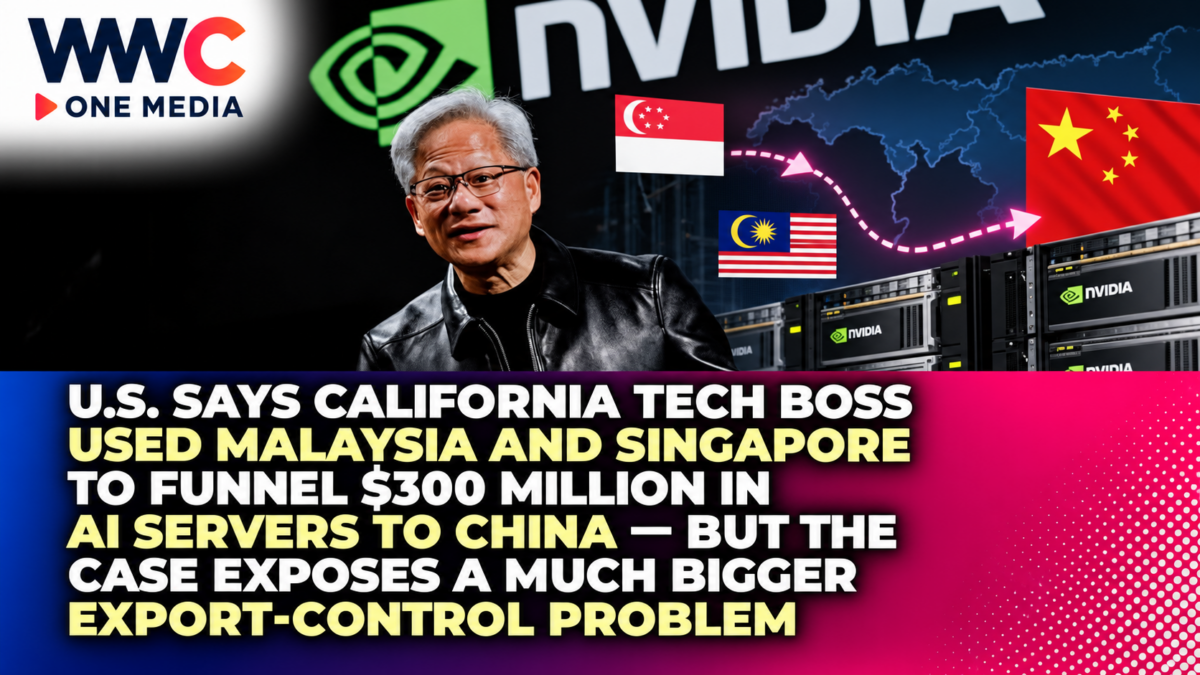
LOS ANGELES — A California technology-company owner has been arrested in what U.S. prosecutors describe as a massive scheme to evade Washington’s AI export controls, allegedly using Malaysia and Singapore as intermediate destinations to funnel more than $300 million worth of high-end computer servers containing restricted U.S.-made graphics processors into China.
Federal prosecutors say Greg Lui, 38, also known as Yiu Kong Lui, owner of City of Industry-based Earthmade Computer Inc., was arrested on October 1 after a federal grand jury returned a three-count indictment against him on September 29.
Lui is charged with:
conspiracy to violate the Export Control Reform Act and Export Administration Regulations,
outbound smuggling,
and
conspiracy to commit money laundering.
If convicted on all counts, he could face statutory maximum sentences of:
20 years on the export-control conspiracy count,
10 years on the smuggling count,
and
20 years on the money-laundering conspiracy count.
But the allegations remain unproven.
An indictment is an accusation, and Lui is legally presumed innocent unless prosecutors prove the charges beyond a reasonable doubt.
Prosecutors Say the Scheme Was Worth More Than $300 Million
According to the Justice Department, Lui and alleged co-conspirators used Earthmade between 2023 and 2024 to acquire high-end computer servers containing export-controlled graphics processing units.
The government says the hardware was legally sensitive because the GPUs could be used for sophisticated artificial-intelligence computing and could contribute to the military capabilities of foreign countries.
Direct exports of the restricted servers to China required authorization from the U.S. Department of Commerce.
Prosecutors allege that Lui and others tried to get around those controls by declaring that the equipment was being sold to legitimate customers in countries where the U.S. licensing restrictions did not apply in the same way.
Those destinations allegedly included:
Malaysia
and
Singapore.
Once the hardware reached those countries, prosecutors say it was redirected to China.
That is the core of the alleged scheme.
The Alleged Loophole Was Not About Hiding the Servers
The government’s theory is more sophisticated than simply sneaking computer hardware across a border.
According to the indictment, the defendants allegedly manipulated the paper trail.
U.S. manufacturers were allegedly given documents stating that the servers were destined for acceptable end users in Malaysia or Singapore.
Freight-forwarding companies then moved the equipment overseas.
After arrival, prosecutors say the servers were re-exported to China.
In other words, the alleged deception centered on:
who the real customer was
and
where the equipment would ultimately end up.
That distinction is central to modern export-control enforcement.
A shipment can appear perfectly ordinary at departure while still violating U.S. law if the declared buyer is merely a front for a restricted end user elsewhere.
One 27-Server Deal Was Worth $7.6 Million
The indictment gives a detailed example.
In January 2024, prosecutors say Lui emailed a co-conspirator about a Malaysian transshipment company seeking to purchase 70 servers containing export-restricted GPUs.
Later that month, Earthmade submitted a purchase order to a U.S. manufacturer for 27 servers worth approximately $7.614 million.
Those servers were shipped from the Los Angeles area to Kuala Lumpur, Malaysia.
The shipping paperwork itself indicated that the systems contained GPUs that could not legally be sent onward to China without a license.
Then came the detail that prosecutors say exposes the alleged diversion.
In March 2024, a co-conspirator reportedly emailed a Malaysian government official stating that all 27 servers had in fact been transshipped to a China-based buyer.
That transaction is now a key part of the federal case.
The Servers Reportedly Included Nvidia A100 and H100 Chips
The Justice Department’s public announcement did not name the GPU manufacturer.
But the Los Angeles Times, citing the federal indictment, reported that some of the hardware contained Nvidia A100 and H100 processors.
Those chips are not Nvidia’s newest generation.
But they remain extremely powerful AI processors.
The H100 in particular became one of the foundational chips used during the rapid expansion of generative AI.
Large clusters of H100s can be used for:
training language models,
scientific computing,
image generation,
and other high-performance workloads.
The same computational capacity also explains why Washington treats advanced AI accelerators as strategically sensitive technology.
Why the U.S. Restricts Advanced Chips to China
Washington has steadily tightened controls on advanced semiconductor exports to China over the past several years.
U.S. officials argue that cutting-edge GPUs can be used not only for commercial AI development but for military and intelligence applications.
That could include:
autonomous systems,
cyber capabilities,
advanced surveillance,
weapons research,
and large-scale military simulation.
The Justice Department said the regulations at issue in Lui’s case were designed to protect U.S. national-security and foreign-policy interests because high-end GPUs can contribute significantly to the military potential of other countries.
China strongly opposes many of Washington’s technology restrictions and argues that they are designed to suppress its economic development.
That broader geopolitical confrontation is what makes individual smuggling cases increasingly important.
Earthmade Allegedly Received $176 Million From Two Malaysian Companies
Federal prosecutors say the money trail was enormous.
Between January and October 2024, Earthmade allegedly received more than $176 million from two Malaysia-based shipment companies connected to the scheme.
That figure does not necessarily mean all $176 million represented illegal profit.
The indictment describes it as money received by Earthmade as part of the alleged transactions.
But the amount illustrates the scale federal investigators believe they uncovered.
This was not allegedly one employee trying to hide a handful of chips in luggage.
The government is describing a commercial-scale supply chain involving:
hardware suppliers,
freight forwarders,
foreign companies,
bank transfers,
and onward shipments.
Why Malaysia Became Central to the Story
Malaysia has emerged as one of Southeast Asia’s most important semiconductor, electronics and data-center markets.
That legitimate technology trade makes the country commercially attractive.
It can also make it an attractive transshipment point for anyone trying to disguise the true destination of advanced hardware.
U.S. authorities have become increasingly concerned that sophisticated AI equipment could be legally shipped to third countries and then diverted to China.
Malaysia itself responded to those concerns last year.
In July 2025, the Malaysian government began requiring a Strategic Trade Permit for the export, transshipment or transit of high-performance AI chips of U.S. origin.
The move was explicitly designed to close regulatory gaps.
Malaysia’s New Controls Came After the Alleged Lui Transactions
The timing is important.
Much of the activity alleged in the Lui indictment occurred in 2023 and 2024.
Malaysia’s tighter permit requirement for U.S.-origin high-performance AI chips took effect in July 2025.
That means Kuala Lumpur subsequently strengthened controls in precisely the area prosecutors now say was exploited.
Malaysia requires companies to notify authorities in advance when dealing with certain sensitive goods if they know—or have reasonable grounds to believe—the technology may be diverted to restricted activities.
The Malaysian government has also publicly said it will not tolerate attempts to circumvent export controls or engage in illicit strategic trade.
Malaysia Has Already Seized AI Hardware
The issue is not theoretical.
In June 2026, Malaysian customs authorities intercepted 72 server units containing advanced AI chips worth about 52.9 million ringgit, or roughly $13 million, at Kuala Lumpur International Airport.
Authorities said the shipment had been falsely declared as ordinary computer components and was intended for re-export to another Asian destination without the required permit.
That seizure demonstrated how seriously Malaysia is now treating advanced semiconductor movements.
It also highlighted the difficulty regulators face.
Modern AI servers are commercial products.
They can be moved through ordinary logistics networks.
The illegal element may be hidden in paperwork rather than physically obvious from the shipment itself.
Singapore Is Another Major Technology Hub
Singapore also appears in the federal allegations.
The city-state is one of Asia’s most important:
data-center markets,
cloud-computing hubs,
electronics trading centers,
and logistics gateways.
That makes Singapore critical to legitimate AI infrastructure.
But the same scale of commerce means export-control authorities must carefully monitor re-export and transshipment activity.
Singapore Customs maintains a strategic-goods control system requiring permits for covered exports, transshipments and transit activity under specified circumstances.
The fact that Singapore is mentioned in the U.S. indictment does not mean the Singapore government or legitimate Singapore technology industry was involved in wrongdoing.
The allegation is that the country was used as a transit or declared destination by individuals trying to disguise the servers’ true end users.
That distinction is important.
The Case Does Not Accuse Malaysia or Singapore as Governments
This needs to be made explicit.
The U.S. case is against Greg Lui and alleged co-conspirators.
It does not accuse Malaysia or Singapore of conspiring to evade U.S. controls.
Nor does it suggest that legitimate companies operating in those countries generally participate in illegal trade.
In fact, Malaysia has strengthened its own controls and has been cooperating with both the United States and Singapore regarding trade involving restricted U.S.-origin AI chips.
So the accurate framing is:
Malaysia and Singapore were allegedly used as routing points.
Not:
Malaysia and Singapore helped smuggle the technology.
Southeast Asia Is Caught Between Two Technology Superpowers
The case illustrates a much bigger regional challenge.
Southeast Asia wants investment from both the United States and China.
Countries such as Malaysia and Singapore are attracting billions of dollars into:
AI data centers,
cloud infrastructure,
semiconductor production,
and advanced electronics.
At the same time, Washington wants guarantees that technology shipped to those markets will not simply be redirected to restricted Chinese buyers.
That places Southeast Asian governments in a difficult position.
They want to remain open technology hubs.
But they also need to prove they are not becoming back doors for export-control evasion.
AI Data Centers Make the Problem Harder
The issue is becoming even more complicated because Chinese companies can gain computing power without physically importing chips into China.
For example, Tencent has reportedly agreed to lease access to roughly 100,000 advanced AI chips through Oracle data centers in Southeast Asia, under a multiyear arrangement valued at around $7 billion.
In that model, the chips remain physically outside China.
Chinese companies access the computing resources remotely.
That raises a different question for U.S. policymakers:
If you prevent the physical chip from crossing the border but the same computing capability can be rented overseas, how effective are hardware export controls by themselves?
The Lui indictment deals with alleged physical diversion.
Cloud access creates an entirely different enforcement challenge.
Washington Is Expanding From Chip Controls to Computing Controls
That is why the semiconductor conflict is evolving.
Early restrictions focused mainly on preventing China from importing certain chips.
Policymakers are increasingly examining:
cloud access,
data-center ownership,
remote computing,
server leasing,
and third-country AI infrastructure.
The strategic asset is no longer merely the chip.
It is computing power.
Who controls it?
Who can access it?
Where is it physically located?
And can restrictions follow the technology after it leaves the factory?
Those questions are becoming central to the U.S.-China AI competition.
This Is Not the First Major U.S. AI-Smuggling Case
The Lui case follows several other federal prosecutions involving allegedly restricted AI technology.
In March, the Justice Department charged three men in another case involving high-performance U.S.-made servers allegedly diverted to China through false paperwork, dummy equipment and complex transshipment arrangements.
Days later, prosecutors announced a separate case accusing three people of trying to illegally send controlled AI chips to China through Thailand.
Those cases show a pattern.
As Washington makes direct exports harder, alleged smugglers increasingly rely on:
third countries,
shell companies,
fake end users,
freight forwarders,
and layered transactions.
The enforcement battle is therefore becoming more sophisticated.
Another 2026 Case Was Even Bigger
Federal prosecutors earlier this year accused defendants connected with Super Micro Computer-related operations of participating in a scheme involving billions of dollars worth of advanced servers allegedly diverted toward China through overseas intermediaries.
That case remains separate from the charges against Lui.
But together they illustrate how profitable the market for restricted AI hardware has become.
When individual servers can cost hundreds of thousands of dollars, a relatively small number of shipments can quickly reach hundreds of millions—or even billions—of dollars.
Why Chinese Buyers Still Want Nvidia Chips
China has invested heavily in domestic semiconductor development.
Companies such as Huawei are building increasingly capable AI accelerators.
But advanced U.S.-designed hardware remains highly desirable.
Nvidia’s ecosystem offers more than the processor itself.
It includes:
CUDA software,
developer tools,
networking,
libraries,
and an enormous global base of AI software optimized for Nvidia hardware.
That creates a strong commercial incentive for Chinese AI companies to obtain access even when direct sales are restricted.
Export controls therefore create scarcity.
Scarcity can create unusually high prices.
And unusually high prices create incentives for diversion.
Smuggling Becomes More Profitable When Supply Is Restricted
This is a basic economic problem.
If a product is freely available, there is little reason to create an elaborate black-market supply chain.
If access is restricted while demand remains enormous, intermediaries can potentially charge substantial premiums.
That is why U.S. officials increasingly focus not only on manufacturers but on:
distributors,
brokers,
logistics companies,
resellers,
and banks.
All can become part of a diversion chain.
Manufacturers Face Difficult Compliance Decisions
Hardware manufacturers are expected to conduct export compliance.
That often means asking customers questions about:
final destination,
end user,
intended application,
and resale restrictions.
But a manufacturer cannot physically follow every server after delivery.
If a customer submits apparently legitimate documents showing a Malaysian buyer, the supplier may have limited visibility into what happens months later.
The Lui indictment alleges that false documentation was deliberately used to exploit that system.
That raises the question of whether technology companies will be expected to perform far more extensive customer verification in the future.
Serial Numbers Could Become More Important
One obvious enforcement tool is hardware traceability.
High-value servers and GPUs contain:
serial numbers,
firmware identifiers,
network interfaces,
and other technical information.
Those identifiers can potentially help companies and governments trace equipment after it enters global commerce.
Future compliance systems may increasingly resemble financial anti-money-laundering controls.
Banks monitor suspicious transactions.
Chipmakers may eventually monitor suspicious hardware movements.
Software Could Also Reveal Where Chips End Up
Advanced GPUs are rarely completely isolated machines.
They connect to:
drivers,
software updates,
networking equipment,
support services,
and cloud-management platforms.
That creates opportunities to detect whether controlled hardware is operating in unexpected locations.
But that approach would raise difficult questions involving:
privacy,
sovereignty,
cybersecurity,
and remote control of hardware.
Governments may want traceability.
Customers may not want manufacturers monitoring where their servers operate.
That conflict is likely to become more important.
The Money-Laundering Charge Raises the Stakes
Lui is not charged only with export violations.
Prosecutors also accuse him of conspiracy to commit money laundering.
That reflects the financial side of the alleged scheme.
When prohibited commerce generates large payments, prosecutors can investigate whether financial transactions were structured to conceal the source, purpose or destination of the money.
Money-laundering charges can also expose defendants to significant prison sentences and asset forfeiture.
Federal prosecutors say a separate assistant U.S. attorney is handling potential civil and criminal forfeiture of seized property in the case.
The FBI, Commerce Department and Pentagon Investigators Are Involved
The investigation is being conducted jointly by:
the Commerce Department’s Bureau of Industry and Security Office of Export Enforcement,
the Defense Criminal Investigative Service,
and
the FBI’s Counterintelligence and Espionage Division.
That combination tells you how Washington views these cases.
This is not treated simply as customs fraud.
The U.S. government considers advanced AI hardware a national-security asset.
The involvement of defense and counterintelligence agencies underscores that shift.
AI Chips Are Becoming Strategic Goods Like Weapons Technology
For decades, export-control debates centered around items such as:
missiles,
military electronics,
nuclear technology,
and advanced aerospace systems.
AI accelerators now increasingly sit in the same strategic category.
The chips themselves are commercially sold.
But the computing power they provide can be used for both civilian and military purposes.
That makes them classic dual-use technology.
A single H100 can run ordinary commercial AI.
Thousands working together can form the computational foundation for extraordinarily powerful systems.
Scale changes the strategic importance.
Washington’s Challenge Is That Chips Are Small Compared With Their Value
Controlling an aircraft engine is relatively straightforward.
It is large.
Heavy.
Difficult to conceal.
AI computing is different.
Hundreds of millions of dollars in computational capacity can be packed into racks of servers.
That makes physical movement far easier.
As chips become even more powerful, the value-to-weight ratio increases.
One shipment can represent enormous strategic capability.
Malaysia’s June Seizure Shows the Scale
Malaysia’s interception of 72 server units worth roughly $13 million gives a sense of the problem.
Seventy-two servers may fit into a limited amount of cargo space.
Yet collectively they can contain the hardware necessary for significant AI workloads.
That is very different from intercepting conventional industrial machinery.
The most valuable component may be measured in kilograms, not tons.
The $300 Million Figure Shows How Large the Alleged Network Became
If prosecutors prove that more than $300 million worth of controlled servers were diverted, the Lui case would represent one of the most significant recent U.S. export-control prosecutions involving AI hardware.
But that figure should still be described carefully.
It is the value alleged by federal prosecutors.
It has not yet been established through a trial.
Nor has Lui been convicted.
That distinction matters particularly in a criminal case this large.
Lui’s Defense Has Not Yet Been Tested in Court
The government’s indictment tells prosecutors’ version of events.
Lui and his attorneys will have opportunities to challenge:
the evidence,
the interpretation of transactions,
knowledge and intent,
and other elements required for conviction.
Export-control crimes generally require more than showing that restricted goods reached an unauthorized destination.
Prosecutors often need to establish that defendants knowingly or willfully participated in the illegal activity.
The indictment alleges Lui knew the equipment’s true buyers were in China.
That allegation will be central to the case.
The January Email Could Become Important Evidence
Prosecutors specifically highlighted a January 2024 email in which Lui allegedly discussed a Malaysian transshipment company buying 70 restricted servers.
Attached to that communication was an export-compliance form acknowledging that the equipment could not legally be resold or transshipped to restricted destinations without authorization.
If authenticated and interpreted as prosecutors claim, that document could be important because it may address the question of knowledge.
The government is effectively saying:
Lui knew the restrictions existed.
The defense may offer a different interpretation.
That dispute will be for the court.
The Bigger Problem for Washington Is Not One Defendant
Even if Lui is convicted, the broader export-control challenge remains.
Demand for advanced AI computing in China is huge.
Southeast Asia has become one of the world’s fastest-growing data-center regions.
Cross-border electronics trade is enormous.
And the same logistics networks carry both legal and potentially diverted equipment.
That gives enforcement agencies an extraordinarily difficult task.
They are trying to distinguish legitimate regional AI investment from attempts to route restricted technology around Washington’s rules.
Too Much Enforcement Could Hurt Southeast Asia
There is also a risk for countries such as Malaysia and Singapore.
If Washington concludes that third-country diversion is widespread, it could impose tougher licensing requirements on shipments to Southeast Asia.
That could hurt legitimate buyers.
Data-center operators may face:
longer approval times,
higher compliance costs,
and greater uncertainty over hardware availability.
That is one reason Malaysia has moved aggressively to strengthen its own monitoring.
It wants to show Washington that the country can remain a trusted technology hub without becoming a diversion channel.
Malaysia Has Billions at Stake
Malaysia has attracted huge investments from global technology companies into data centers and cloud infrastructure.
That growth depends partly on access to advanced U.S.-origin chips.
If American regulators become uncomfortable with Malaysia’s ability to monitor those systems, the consequences could extend well beyond individual smuggling prosecutions.
The country therefore has a strong economic incentive to enforce strategic-trade rules.
Its July 2025 permit system reflects that calculation.
Singapore Faces the Same Strategic Test
Singapore’s position is similar.
It wants to remain a neutral, trusted global hub.
Its attractiveness depends on confidence that:
trade rules are enforced,
financial flows are transparent,
and international companies can operate without becoming entangled in sanctions evasion.
The government therefore has strong reasons to prevent Singapore from becoming a transit point for prohibited technology.
The strategic-goods regime already provides mechanisms to regulate sensitive exports and transshipments.
The U.S.-China AI War Is Becoming a Supply-Chain War
The geopolitical competition over artificial intelligence is no longer limited to research laboratories.
It now reaches:
ports,
airports,
banks,
server distributors,
customs authorities,
data centers,
cloud providers,
and freight companies.
That is what the Lui case illustrates so clearly.
A GPU designed in the United States might be:
assembled into a server,
sold by a California company,
shipped to Malaysia,
rerouted through another logistics provider,
and eventually installed in China.
Every step creates another enforcement problem.
The Next Battle May Be Over Who Owns the Data Center
Physical diversion is only one challenge.
Suppose a Chinese company legally rents servers in Kuala Lumpur.
The chips never enter China.
But Chinese engineers remotely use them to train AI systems.
Does that violate the spirit of U.S. controls?
Should access itself require a license?
What happens if the same data center hosts customers from dozens of countries?
Those questions are likely to dominate the next phase of export-control policy.
The More Valuable AI Becomes, the Harder Controls Will Be to Enforce
Advanced AI chips have become one of the most valuable commodities in the technology world.
Demand is enormous.
Supply remains relatively concentrated.
The strategic importance is growing.
Those three conditions create powerful incentives to find workarounds.
Every new restriction encourages companies and governments to develop alternatives.
Some alternatives are legal.
Others may not be.
That dynamic guarantees a continuing enforcement battle.
China Is Also Racing to Reduce Its Dependence on U.S. Chips
Washington’s restrictions are intended partly to slow China’s access to cutting-edge AI hardware.
But they also give China a strong incentive to develop domestic substitutes.
Huawei and other Chinese companies are investing heavily in advanced accelerators and semiconductor manufacturing.
If domestic alternatives become sufficiently competitive, the strategic leverage provided by U.S. export controls could eventually weaken.
That creates another dilemma for Washington:
restrictions can slow competitors,
but they can also accelerate technological independence.
For Nvidia, There Is a Commercial Cost Too
Nvidia has repeatedly argued that restrictions on legitimate sales to China can reduce U.S. companies’ access to one of the world’s largest technology markets.
At the same time, Nvidia must comply with U.S. export law.
That leaves semiconductor companies caught between:
commercial demand,
national-security policy,
and growing pressure to ensure hardware is not illegally diverted.
The Lui case demonstrates how difficult those responsibilities can become once products leave authorized distribution channels.
The Bigger Question Is Whether Washington Can Control Computing Power Globally
The $300 million allegation makes for a dramatic headline.
But the deeper question is far larger.
The U.S. currently dominates much of the technology needed for leading-edge AI.
Washington is trying to use that dominance strategically.
But the world’s technology supply chain is global.
Chips move through multiple countries.
Servers can be resold.
Cloud access crosses borders instantly.
AI companies can rent computing power instead of owning it.
And international demand creates financial incentives to circumvent restrictions.
That means the U.S. is trying to regulate something extraordinarily difficult:
not simply where a chip is sold, but who ultimately gets access to the computing power inside it.
Malaysia and Singapore Are Now on the Front Line
For Malaysia and Singapore, the lesson is equally important.
Both countries want to become leading AI and data-center hubs.
That opportunity could bring billions of dollars in investment.
But it also places them directly between Washington and Beijing.
They will increasingly be expected to prove that advanced technology entering their markets remains where it is supposed to remain.
Malaysia has already tightened its laws.
Singapore already operates strategic-goods controls.
The Lui indictment shows why those systems matter.
One Case Could Influence Future Export Rules
If prosecutors demonstrate that hundreds of millions of dollars of restricted hardware passed through Southeast Asian intermediaries, policymakers in Washington may push for even stricter rules.
Possible responses could include:
more end-user checks,
additional licensing requirements,
closer financial monitoring,
serial-number tracking,
and tougher requirements for resellers and freight companies.
The consequence could affect legitimate technology buyers across the region.
That is why this criminal case could eventually matter far beyond Greg Lui.
The Alleged $300 Million Scheme Is Really a Warning
For U.S. authorities, the message is clear:
advanced AI hardware is now being treated as strategic national-security technology.
For technology suppliers:
knowing your customer may no longer be enough.
You may need to know your customer’s customer.
For Southeast Asian governments:
building AI infrastructure means accepting greater scrutiny over where U.S.-origin chips go next.
And for China:
Washington intends to keep tightening enforcement around the computing power it considers strategically sensitive.
The courtroom will determine whether prosecutors can prove the allegations against Lui.
But the geopolitical conclusion is already much clearer:
the battle over AI chips is no longer just about who can design the fastest processor.
It is increasingly about who controls every step of the route from the factory to the final server rack.