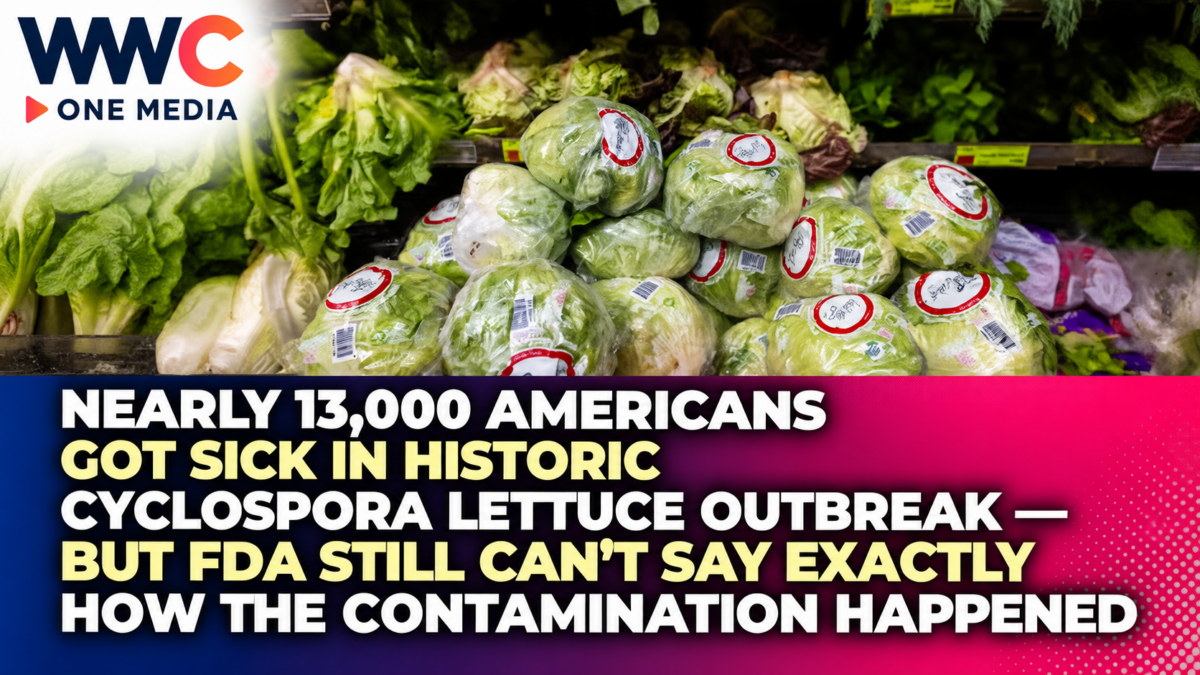
WASHINGTON — U.S. food-safety regulators have closed their investigation into the largest documented multistate Cyclospora outbreak in the country, strongly linking nearly 13,000 illnesses to processed iceberg lettuce supplied by Taylor Farms de Mexico while leaving one critical question unanswered: exactly how the parasite entered the food supply.
The U.S. Food and Drug Administration announced on October 2 that its outbreak investigation had concluded after months of traceback work, farm inspections, environmental sampling and coordination with Mexican authorities.
The final numbers were extraordinary:
12,883 illnesses
570 hospitalizations
2 deaths
across
21 U.S. states.
Illnesses began as early as June 14 and continued through August 17. The two reported deaths were in Michigan.
The U.S. Centers for Disease Control and Prevention declared the outbreak over on September 11 after infection rates dropped dramatically and the implicated lettuce was no longer available in stores or restaurants.
But the end of the outbreak did not mean investigators had solved every part of the mystery.
FDA Found a Strong Link to Taylor Farms de Mexico Lettuce
CDC said epidemiological and traceback evidence showed that processed iceberg lettuce from Taylor Farms de Mexico, a Taylor Farms processor in central Mexico, was contaminated with Cyclospora and made people sick.
That conclusion was based on several converging lines of evidence.
Patients repeatedly reported exposure to processed iceberg lettuce.
Traceback investigators followed supply chains toward Taylor Farms de Mexico.
The implicated product was distributed through restaurants and retail channels across a large portion of the United States.
And federal investigators eventually traced lettuce back to multiple farms and a processing facility in Mexico.
The outbreak initially drew particular attention because many early patients reported eating at Taco Bell.
But as the investigation expanded, regulators determined that the common link was broader than a single restaurant chain.
The focus shifted to processed iceberg lettuce supplied through Taylor Farms de Mexico.
Taylor Farms Recalled the Lettuce in July
On July 17, Taylor Farms de Mexico voluntarily removed all iceberg lettuce sourced from central Mexico from the U.S. market.
The recall included certain retail products such as:
Marketside Iceberg Salad
and
Marketside Shredded Lettuce
sold at Walmart with specified July and August best-by dates.
Additional recalled products had also been distributed to food-service customers.
By the time the FDA formally closed its investigation in October, all of those best-by dates had passed and regulators said the affected lettuce should no longer be available for purchase.
That means the specific recalled products are not considered a current food-safety threat.
The Outbreak Grew at Stunning Speed
The scale of the outbreak became clearer almost week by week.
On July 24, CDC was reporting 1,947 confirmed illnesses.
By August 5, the number had climbed to 6,358.
By August 13:
9,481.
By August 20:
10,930.
By August 27:
11,458.
And by the CDC’s final September 11 update:
12,883 confirmed illnesses.
The true number was probably even higher.
CDC said many people with Cyclospora recover without seeking medical care and therefore are never tested or counted.
At the Peak, More Than 1,000 People Got Sick in a Single Day
The epidemic curve shows how quickly the contamination spread through the food system.
On July 10 alone, more than 1,200 illnesses were recorded among cases included in CDC’s timeline.
Other days in early July also exceeded 1,000 infections.
By August, however, infections had collapsed to fewer than two per day on average.
That sharp decline after the July recall was one of the strongest indications that removing the implicated lettuce had stopped ongoing exposure.
FDA Inspectors Went to Mexico
After the epidemiological evidence pointed toward central Mexico, the FDA sent investigators to farms and the Taylor Farms de Mexico processing operation in coordination with Mexican authorities.
They collected samples from:
water,
soil,
sediment,
lettuce,
and other parts of the agricultural and processing environment.
Those inspections produced one of the most consequential findings in the investigation.
Two Environmental Samples Tested Positive for Cyclospora
FDA said two samples collected during its Mexican inspections tested positive for the parasite.
One came from a tank containing outgoing wastewater from the Taylor Farms de Mexico processing facility.
The other came from a drainage ditch at an iceberg-lettuce grower identified through traceback work.
Those discoveries strengthened investigators’ concern about the production environment.
But they still did not answer every question.
The Positive Samples Do Not Prove the Exact Contamination Point
This is where the science becomes more complicated.
Finding Cyclospora in wastewater at a processing facility does not automatically prove that contaminated wastewater touched the lettuce.
Finding the parasite in a drainage ditch near a grower does not automatically prove the ditch contaminated the crop.
FDA therefore stopped short of saying it had identified the precise mechanism that caused the outbreak.
Reuters reported that investigators were still working to genetically characterize environmental samples and compare them with parasites obtained from sick patients.
That distinction is critical.
The FDA found strong evidence connecting the outbreak with Taylor Farms de Mexico lettuce.
It did not conclusively identify the exact contamination pathway.
Mexico Is Pushing Back on the Strongest Interpretation
Mexico’s Health Ministry emphasized this uncertainty after the FDA closed the investigation.
Mexican officials said the U.S. investigation did not conclusively establish where or how the lettuce became contaminated.
That does not overturn the CDC and FDA’s epidemiological conclusion linking illnesses to Taylor Farms de Mexico iceberg lettuce.
It does highlight the difference between two questions:
What food caused the outbreak?
and
What precise event contaminated that food?
U.S. authorities say the first question has been answered with strong evidence.
The second has not.
Taylor Farms Says the Implicated Grower Is No Longer Supplying It
According to Associated Press reporting, Taylor Farms said the environmental contamination was traced to an independent grower that is no longer part of its supplier program.
The company’s central Mexico processing operation also remained closed while additional safety measures were being implemented, AP reported.
That response is important because growers and processors occupy different parts of the supply chain.
Lettuce may pass through:
fields,
harvesting crews,
wash systems,
processing lines,
packaging facilities,
cold storage,
and distribution centers.
Contamination can theoretically occur at multiple points.
There Was an Earlier False-Positive Test
The investigation had already been complicated by laboratory uncertainty.
On July 18, FDA initially reported that a lettuce sample had tested positive for Cyclospora.
The next day, the agency withdrew that finding.
After laboratory experts re-reviewed the data, FDA concluded that the result did not represent true amplification and should be treated as a false positive.
That early reversal illustrates how technically difficult Cyclospora testing can be.
FDA stressed at the time that the false positive did not change the broader epidemiological and traceback evidence linking the outbreak to Taylor Farms lettuce.
The Later Environmental Positives Were Different
The two environmental positives announced at the end of the investigation came from samples taken during onsite inspections in Mexico.
One involved wastewater.
The second involved a grower’s drainage ditch.
Those were not the same as the July lettuce sample that FDA later withdrew.
Keeping those events separate is important.
An early suspected product sample was false.
Later environmental testing produced confirmed Cyclospora detections.
What Exactly Is Cyclospora?
Cyclospora cayetanensis is a microscopic parasite that causes an intestinal illness called cyclosporiasis.
FDA says Cyclospora is believed to infect humans and is generally spread when food or water becomes contaminated with infected human fecal matter.
Common symptoms include:
watery diarrhea,
frequent bowel movements,
loss of appetite,
weight loss,
stomach cramps,
bloating,
gas,
nausea,
and fatigue.
Symptoms often begin about a week after infection.
Without treatment, illness can last days, weeks or even longer.
Cyclospora Is Different From Many Other Foodborne Pathogens
Unlike bacteria such as Salmonella or E. coli, Cyclospora is a parasite with an unusual transmission cycle.
FDA notes that Cyclospora passed in human feces is not immediately infectious.
The parasite needs time—typically days to weeks in the environment—to mature before it can infect another person.
That makes direct person-to-person transmission less likely.
Instead, large outbreaks are often associated with contaminated:
fresh produce,
water,
or agricultural environments.
That is one reason investigators pay close attention to irrigation, sanitation and wastewater conditions.
Fresh Produce Is Particularly Vulnerable
Lettuce presents a difficult food-safety challenge because it is usually eaten raw.
Cooking can kill many pathogens.
Salad greens generally do not receive that protection.
Once contamination occurs, commercial washing may reduce microbes but cannot always guarantee complete removal.
That makes prevention on the farm and in processing especially important.
Clean irrigation water.
Safe sanitation.
Worker hygiene.
Wastewater control.
Equipment sanitation.
All become critical barriers.
Iceberg Lettuce Has a Huge Distribution Network
One contaminated production stream can spread widely because modern fresh-produce supply chains are enormous.
A central processor can supply:
restaurant chains,
food-service distributors,
grocery stores,
and institutional buyers
across dozens of states.
FDA confirmed that recalled products were distributed to at least 31 states, with possible distribution reaching additional jurisdictions including Washington, D.C. and Puerto Rico.
That geographic reach helps explain how one contamination event can turn into a national outbreak.
Taco Bell Became the Early Face of the Outbreak
In the early phase, Taco Bell received much of the public attention because a large number of patients reported eating there.
At one stage, nearly 2,000 confirmed cases were associated with people reporting Taco Bell exposure.
But Taco Bell was not identified as the origin of the parasite.
The restaurant chain was one of the places where implicated lettuce was served.
That distinction matters for both public health and fairness.
A restaurant can become part of an outbreak because a contaminated ingredient entered its supply chain even when the contamination happened long before the product reached the restaurant.
The Same Issue Affected Other Restaurants
Reuters reported that the outbreak also hurt consumer confidence and foot traffic at restaurant brands including Sweetgreen and Chipotle, as customers became increasingly cautious about lettuce and fresh produce.
This is one reason foodborne outbreaks can have economic effects far beyond the company directly linked to the contaminated ingredient.
Consumers do not always distinguish between:
one grower,
one processor,
one restaurant,
and an entire food category.
Fear can spread much faster than technical explanations.
Two Deaths Make This More Than a Routine Recall
Cyclospora outbreaks often receive less attention than deadly E. coli or Listeria events because cyclosporiasis is frequently treatable.
But this outbreak was different in scale.
CDC reported:
570 hospitalizations
and
two deaths in Michigan.
CDC did not say that every person counted suffered the same severity of illness.
But the numbers show how a pathogen commonly associated with gastrointestinal symptoms can create a significant public-health burden when thousands of people are exposed.
FDA Says the Outbreak Is Over
The immediate consumer message is reassuring.
The recalled products’ best-by dates have passed.
They should no longer be available.
CDC says the outbreak ended September 11.
FDA formally closed the outbreak investigation October 2.
So consumers do not need to avoid all iceberg lettuce because of this specific event.
The warning applied to the recalled Taylor Farms de Mexico products involved in the 2026 outbreak.
But FDA Says Its Work Is ‘Far From Over’
Closing the outbreak investigation does not mean regulators are walking away.
On October 2, FDA announced a 10-part prevention program aimed at reducing future Cyclospora outbreaks before the 2027 growing season.
The measures include:
stronger surveillance,
increased monitoring of produce categories historically associated with Cyclospora,
additional outreach to growers,
new prevention research,
and updates to FDA’s Cyclospora Prevention, Response and Research Action Plan.
FDA also plans to publish a detailed outbreak investigation report containing findings and recommendations.
Surveillance Is Likely to Increase
One of FDA’s clearest commitments is greater testing and surveillance.
That matters because Cyclospora outbreaks can be difficult to detect early.
People may not immediately seek medical attention.
Doctors may not always order specific Cyclospora testing.
Cases can be spread across multiple states.
And the parasite’s incubation period can delay identification of the common food source.
Better surveillance can shorten the time between:
first illnesses,
outbreak detection,
traceback,
and recall.
In a fast-moving fresh-produce supply chain, every day matters.
Traceback Speed Is a Major Weakness
The outbreak also exposed one of the recurring weaknesses in U.S. food safety.
Fresh produce can move from field to restaurant in days.
Government traceback investigations can take considerably longer.
By the time regulators identify the precise supplier, much of the food may already have been eaten.
CDC said most illnesses in this outbreak began before Taylor Farms initiated the July 17 recall.
That shows why faster supply-chain records are becoming so important.
Food-Safety Experts Want Faster Access to Supplier Records
Experts quoted by Reuters argued that investigators need faster access to supply-chain records and better proactive inspection of farms and processing facilities.
That is particularly important when produce is imported.
Investigators may need to coordinate across:
U.S. federal agencies,
state health departments,
foreign regulators,
growers,
processors,
distributors,
and restaurant companies.
Every additional layer can slow the investigation.
Foreign Inspections Are Another Major Issue
The outbreak also renewed scrutiny over U.S. inspections of overseas food suppliers.
Associated Press noted that federal foreign inspections had faced disruption during and after the COVID-19 pandemic, creating concerns about oversight gaps.
Imported fresh produce is a major part of the American food supply.
That means U.S. regulators increasingly depend on effective cooperation with foreign governments.
Mexico is especially important because it supplies enormous volumes of fruits and vegetables to U.S. consumers.
Mexico and the U.S. Need Each Other on Food Safety
The response to this outbreak therefore cannot simply become a political fight between Washington and Mexico.
Mexico is one of America’s most important agricultural suppliers.
U.S. consumers depend heavily on Mexican-grown:
lettuce,
tomatoes,
berries,
avocados,
peppers,
and many other products.
Mexican growers depend heavily on the U.S. market.
Both countries therefore have a strong economic incentive to prevent contamination.
A major outbreak damages:
patients,
growers,
processors,
restaurants,
retailers,
and public trust.
Mexico’s Disagreement Is About Certainty, Not Whether the Outbreak Happened
This distinction deserves emphasis.
Mexico is not claiming that the U.S. Cyclospora outbreak did not occur.
Nor does its statement erase the epidemiological evidence linking illnesses to Taylor Farms de Mexico lettuce.
Mexico’s objection is narrower.
Its government says FDA did not definitively establish the exact contamination source or mechanism.
That is consistent with FDA’s own acknowledgement that the precise route of contamination remains unresolved.
So the two sides are closer in factual position than some headlines may suggest.
Genetic Testing Could Still Provide More Clarity
FDA and public-health researchers have been using Cyclospora genotyping to determine whether parasites found in different patients are genetically related.
CDC said genotyping of samples from sick people showed that the parasites involved in this outbreak were genetically related, supporting the conclusion that patients shared a common source.
Testing environmental samples could potentially add another layer.
If Cyclospora found at a farm or facility closely matches the outbreak strain, the evidence connecting that environment to illnesses becomes significantly stronger.
But genetic matching in Cyclospora is technically more difficult than some bacterial outbreak investigations.
That Is Why FDA Is Being Careful
Food-safety agencies face a difficult balance.
Move too slowly and more people can become sick.
Move too aggressively without strong evidence and a company or agricultural region can suffer enormous financial damage.
The Taylor Farms investigation shows that tension clearly.
FDA issued warnings and supported the recall based on overwhelming epidemiological and traceback evidence.
Yet it also corrected its own earlier false-positive laboratory result when scientists determined it was unreliable.
That correction is not necessarily evidence of failure.
It is how scientific quality control is supposed to work.
Taylor Farms Has a Reputation to Rebuild
For Taylor Farms, the regulatory investigation may be closed, but the commercial consequences are likely to last longer.
The company operates one of North America’s largest fresh-produce supply networks.
Trust is therefore essential.
Restaurants and retailers need confidence that:
growers are properly audited,
water sources are safe,
processing facilities are sanitary,
and traceback records are reliable.
Taylor Farms’ decision to remove an implicated independent grower from its supplier program is one response.
The harder task is demonstrating that similar contamination will not happen again.
Wastewater May Become a Major Focus
The positive wastewater sample at the Taylor Farms de Mexico facility is especially notable because Cyclospora is spread through human fecal contamination.
That does not prove wastewater contaminated lettuce.
But it reinforces why wastewater management is such an important part of produce safety.
Regulators will likely pay closer attention to:
sanitation systems,
water reuse,
drainage,
worker facilities,
and possible cross-connections between contaminated water and agricultural water.
The Grower’s Drainage Ditch Raises Similar Questions
The second positive sample came from a drainage ditch at an iceberg-lettuce grower.
Again, a positive drainage ditch does not establish that ditch water reached the crop.
But investigators will want to understand:
where the water came from,
where it flowed,
whether flooding occurred,
whether irrigation systems were nearby,
and whether human wastewater could have entered the agricultural environment.
These are precisely the kinds of environmental pathways that future prevention efforts will target.
Climate and Water Stress Could Make Produce Safety Harder
Fresh-produce regions increasingly operate under pressure from:
drought,
water shortages,
flooding,
extreme heat,
and changing precipitation patterns.
Those stresses can make water management more complicated.
Growers may rely on multiple water sources.
Heavy rainfall can move contaminated material into agricultural environments.
Drought can increase reliance on recycled or lower-quality water.
That does not mean climate change caused this outbreak.
There is no evidence establishing that.
But it illustrates why water safety will become increasingly important in produce-growing regions.
Restaurants Will Tighten Supplier Requirements
Large restaurant companies are unlikely to treat this as someone else’s problem.
Even when contamination happens upstream, the restaurant brand often becomes what consumers remember.
That creates a strong incentive for chains to demand:
more supplier audits,
faster traceability,
stronger water testing,
and clearer contingency plans.
Major restaurant companies can exert enormous pressure on agricultural suppliers because of the volume they purchase.
That may ultimately accelerate food-safety improvements faster than regulation alone.
Retailers Face the Same Pressure
Walmart products were among the recalled retail items.
Large supermarkets similarly need confidence that their supply chains can identify and isolate problems quickly.
The faster a company can determine:
which farm,
which processing line,
which production date,
and which distribution center
handled a product, the narrower a recall can become.
That reduces both consumer risk and economic waste.
Massive Recalls Are Expensive
When traceback is uncertain, companies sometimes recall more product than was actually contaminated.
That may be necessary for safety.
But it can create enormous losses.
Farmers lose crops.
Processors discard inventory.
Restaurants change menus.
Retailers empty shelves.
Consumers lose confidence.
Better traceability allows regulators to target recalls more precisely.
That is one of the major lessons emerging from modern foodborne outbreaks.
The Outbreak May Drive More Technology Into Agriculture
Food-supply tracing is increasingly becoming digital.
Systems can record:
field location,
harvest date,
processing lot,
shipping container,
warehouse,
distributor,
and final customer.
If those records are standardized and accessible quickly, investigators can reconstruct a supply chain in hours instead of weeks.
That could be transformative during future outbreaks.
The challenge is that U.S. food supply chains include thousands of companies ranging from giant corporations to small family farms.
The Public Also Has a Role
Consumers cannot eliminate Cyclospora risk entirely by washing lettuce.
That is why farm-level prevention is crucial.
But ordinary food-safety practices still matter.
FDA advises consumers to clean surfaces and containers that came into contact with recalled produce and to seek medical care if they develop symptoms consistent with cyclosporiasis.
For this specific outbreak, however, the recalled lettuce is no longer on the market.
Anyone With Persistent Symptoms Should Seek Medical Advice
Cyclospora can cause prolonged diarrhea and dehydration.
People who develop persistent gastrointestinal symptoms should consult a healthcare professional, especially if they recently consumed food linked to an outbreak.
Specific testing may be needed because Cyclospora is not always detected in routine stool examinations.
Treatment decisions should be made by a healthcare professional.
The Outbreak Is Over — The Prevention Fight Is Not
That is ultimately the most important message.
The contaminated lettuce is gone.
The outbreak is over.
The recall has expired.
The immediate public-health emergency has ended.
But nearly 13,000 confirmed cases expose a systemic weakness that cannot simply disappear with the last bag of lettuce.
FDA now has to determine what needs to change before the next central Mexico lettuce season begins.
FDA’s 10-Point Plan Is the Next Test
The agency says its prevention push will run through the start of the 2027 growing season.
It plans to increase surveillance, strengthen outreach to growers, improve prevention strategies and update its Cyclospora action plan.
That creates a measurable standard.
If similar large outbreaks keep happening, regulators will face difficult questions about whether those reforms were strong enough.
Nearly 13,000 Cases Changed the Scale of the Problem
Cyclospora was once viewed by many consumers as a relatively obscure foodborne parasite.
This outbreak changed that perception.
12,883 confirmed cases.
570 hospitalizations.
Two deaths.
Twenty-one states.
Those numbers make prevention a national food-safety issue.
But the Biggest Mystery Remains
U.S. investigators know what food was strongly linked to the outbreak.
They know where much of it was processed.
They know which farms were part of the traceback.
They found Cyclospora in two environmental locations associated with that supply chain.
Yet they still cannot say exactly how the parasite reached the lettuce that ultimately reached American consumers.
That unresolved question is not a minor footnote.
It determines what needs to be fixed.
Because if regulators cannot identify the exact contamination pathway, preventing the next outbreak becomes much harder.
And that is why the most important phase of this investigation may actually begin after the official investigation has ended.