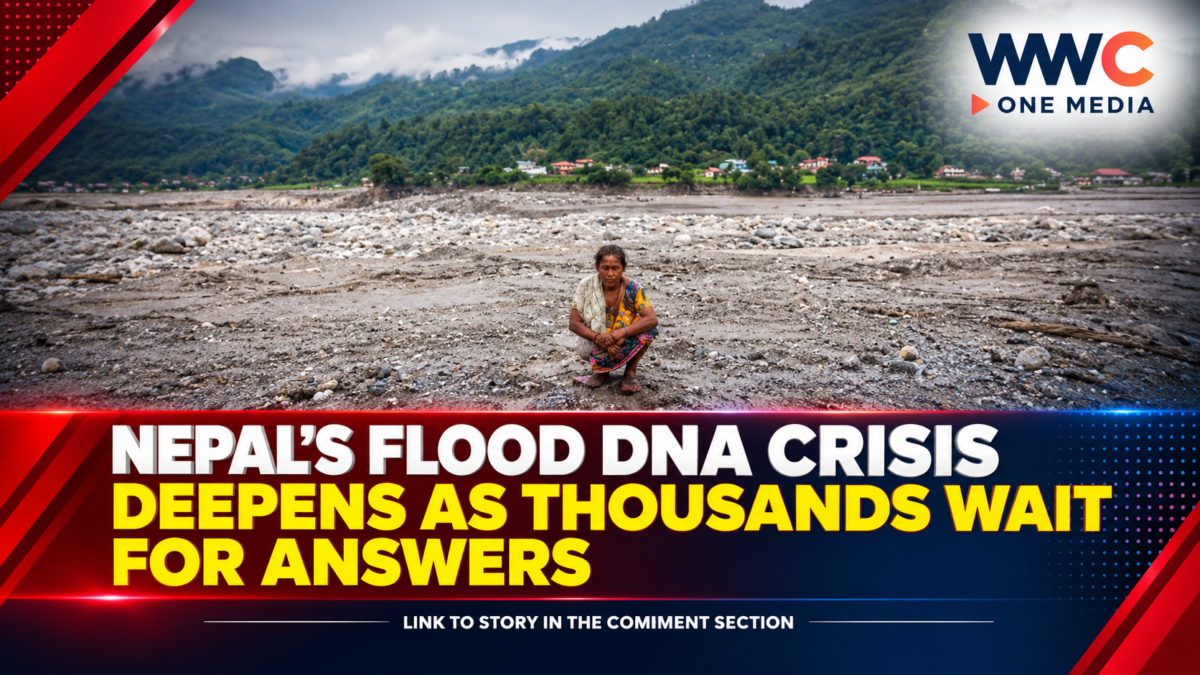
NUWAKOT, Nepal — More than a month after a catastrophic Himalayan flood swept through northern Nepal, families are still waiting for answers as authorities turn to DNA testing to identify hundreds of recovered victims.
The disaster, triggered by a glacial and rock collapse near the Nepal-China border on Aug. 26, sent massive amounts of water and debris through communities along affected river valleys. The scale of the disaster has now created a forensic challenge unlike anything Nepal’s laboratories have previously faced.
Nepali authorities have recovered 1,454 bodies, but about one-third are partial remains. As of Oct. 2, only 112 victims had been identified and returned to their families, while another 5,285 people remained missing in Nepal.
Across the border in China, authorities have reported another 43 deaths and 519 missing people, bringing the combined number of deaths and missing people from the disaster to nearly 7,300.
Thousands of DNA Samples, Limited Capacity
Nepal’s two forensic laboratories in Kathmandu are now handling thousands of samples.
A total of 3,685 forensic samples are undergoing DNA testing, including more than 1,300 collected from recovered bodies. Blood samples can be processed relatively quickly, while samples obtained from bones and teeth require considerably more time and expertise.
The workload is extraordinary compared with the country’s normal caseload.
Officials say Nepal’s forensic laboratories would typically analyze roughly 1,000 to 1,500 samples in an entire year, often for paternity cases, criminal investigations and other routine work. They are now processing thousands of samples connected to a single disaster.
Why DNA Is Critical
Identifying the victims has become particularly difficult because floodwaters carried remains far from where people were last seen, while prolonged exposure to water and the elements can make visual identification extremely difficult.
DNA provides another path.
Authorities collect genetic material from recovered remains and compare it with DNA obtained from relatives of people reported missing. A match can then help establish a victim’s identity and allow the remains to be returned to the family.
The process can also involve fingerprints and dental records when those forms of identification are available.
But DNA testing cannot solve the problem by itself. A reference sample from a relative is needed for comparison when no usable DNA from the missing person is available.
International Teams Join Nepal’s Effort
Nepal is receiving assistance from several countries as its forensic system struggles with the unprecedented workload.
Teams and technical support have come from India, China, South Korea, Japan, Singapore and the United States, according to earlier reporting. International specialists have provided equipment, expertise and additional forensic capacity.
Reuters reported in September that Nepal had already collected DNA samples from more than 1,200 unidentified bodies and nearly 1,900 relatives of missing people, yet only a small proportion of recovered victims had been identified at that stage.
Families Remain in Limbo
For families, the forensic operation is about more than numbers.
People whose relatives remain missing are waiting for confirmation of what happened, while some families have already held symbolic funerals without recovering their loved ones. Authorities have temporarily buried many unidentified victims with identifying numbers and records so that remains can potentially be retrieved if a DNA match is established later.
Experts warn that matching thousands of samples could take weeks, particularly because Nepal’s forensic system is working with limited manpower and technical capacity.
The tragedy has therefore entered a new phase: the search is no longer only about finding those swept away by the floods. It is also about giving families the definitive answers they have been waiting for.
For Nepal’s forensic teams, every DNA match could mean one more family finally knows the fate of a missing loved one.
WWC ONE MEDIA G,A