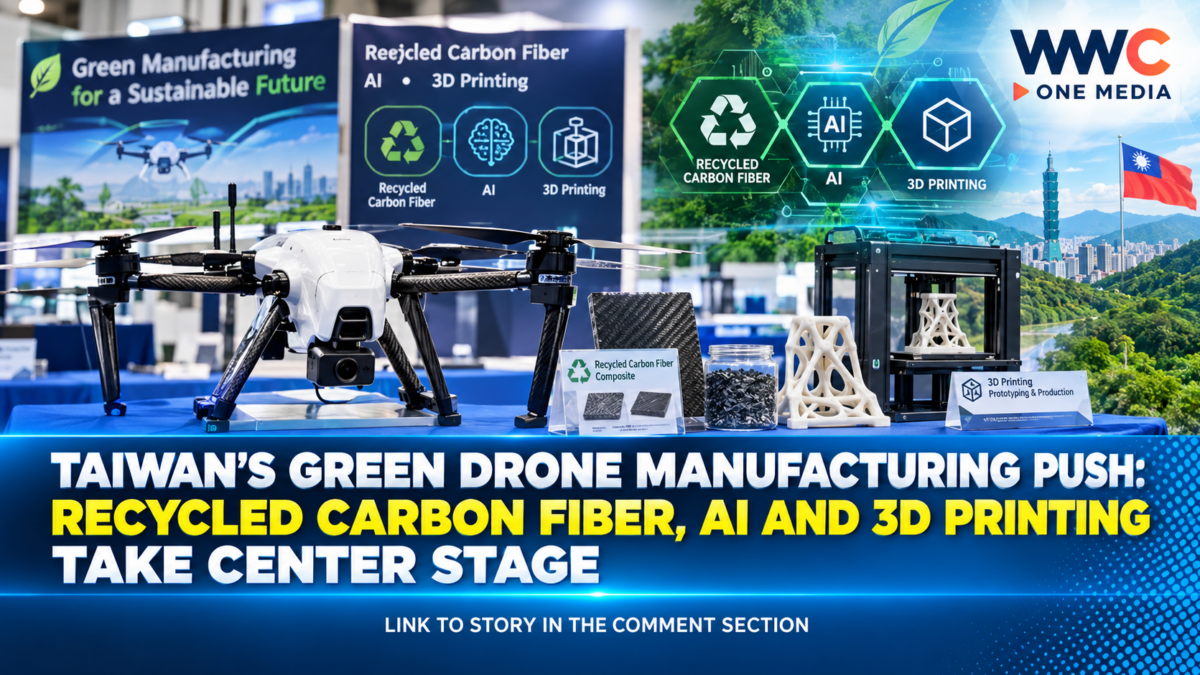
TAICHUNG, Taiwan — Taiwan is bringing sustainability deeper into its growing drone industry, with Swancor Holding showcasing a new approach that combines recycled composite materials, 3D printing and intelligent flight systems.
At the 2026 Taichung AI & Smart Manufacturing Show, running Oct. 1–4, Swancor subsidiaries Swancor Regener and Aeraxa Aerospace Technology are demonstrating how reclaimed carbon fiber can be transformed into lightweight drone structures and other high-value components.
The technology is designed to address two challenges at once: developing lighter, more capable unmanned aircraft while reducing the environmental burden associated with composite-material production.
From Recycled Carbon Fiber to Drone Parts
Aeraxa is showcasing drone structural components produced through 3D printing with reclaimed carbon fiber. These structures can then be integrated with flight-control computers, AI edge-computing systems, cameras, power-management components and satellite communications.
According to CNA, Aeraxa’s modular system can also accommodate technologies such as EO/IR cameras, LiDAR and surveying equipment, allowing the platform to be adapted for inspection, mapping and logistics applications.
Swancor says the modular approach is intended to shorten development and integration timelines, potentially making it easier to move drone designs from development toward commercial production.
The Bigger Shift: Building a Circular Drone Supply Chain
The initiative goes beyond the aircraft itself.
Swancor Regener is displaying recycled carbon fiber, recycled glass fiber, recyclable epoxy materials and other composite products. The company says its recycling technologies can achieve material recovery rates of more than 95%.
The company is also showcasing robotic arms incorporating its lower-carbon composite materials, along with drone propellers made using reclaimed carbon and glass fibers.
Swancor Regener’s technologies include EzCiclo, a recyclable epoxy resin, and CleaVER, a chemical degradation process designed to recover fibers from thermoset composites. The company says it has obtained GRS certification for 100% recycled carbon fiber.
Why It Matters for Taiwan’s Drone Industry
The development comes as Taiwan expands its capabilities across drones, aerospace components, advanced manufacturing and low-carbon technologies.
Aeraxa, established by Swancor in 2025, focuses on carbon-fiber composite structures and aerospace manufacturing. The company says it has entered the supply chain of U.S. drone makers and has pursued aerospace and information-security certifications as it scales its manufacturing capabilities.
The Taichung exhibition therefore offers more than a look at another drone design. It highlights a broader manufacturing strategy: use advanced materials, digital production and modular systems to make unmanned platforms lighter, faster to develop and potentially easier to recycle.
As Taiwan’s drone sector continues to develop, the question may no longer be simply how advanced a drone can become—but how efficiently and sustainably it can be built.
WWC ONE MEDIA G,A