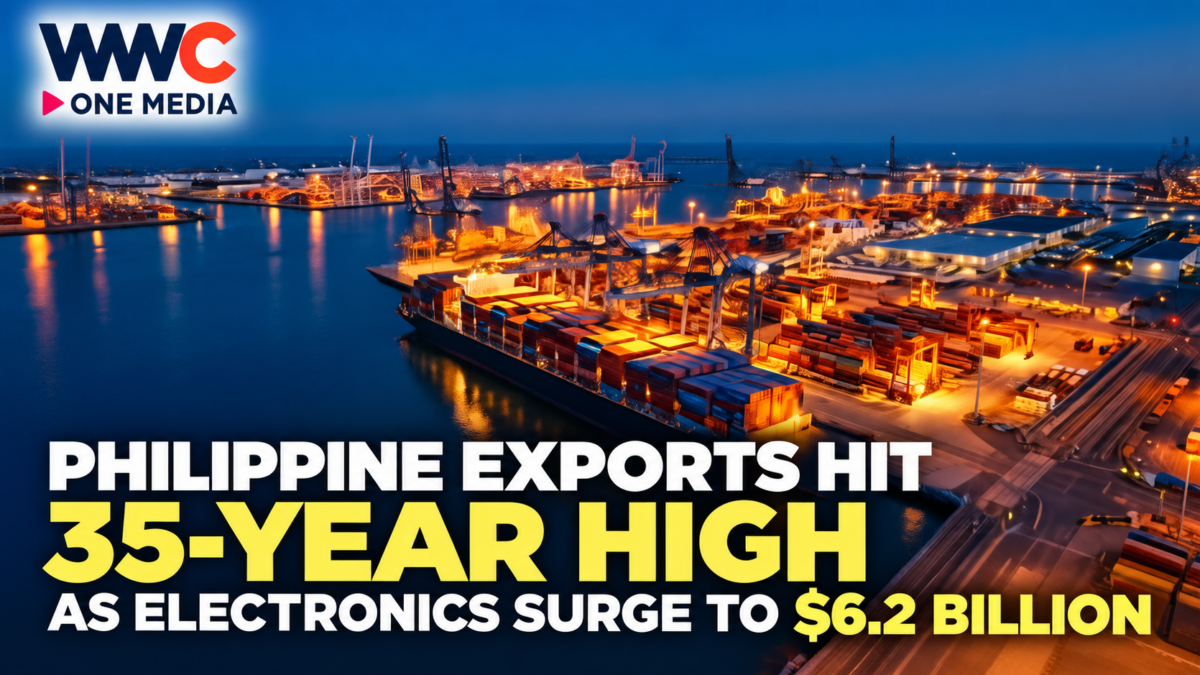
MANILA — Philippine exports surged to a record $9.11 billion in August 2026, the highest monthly level in at least 35 years, as electronics shipments exploded and global demand for semiconductors tied to artificial intelligence, cloud computing and advanced electronics lifted one of the country’s most important industries.
The Philippine Statistics Authority said merchandise exports jumped 27.8% year on year from:
$7.13 billion in August 2025
to
$9.11 billion in August 2026.
It was the highest monthly export value recorded since the PSA’s current trade series began in 1991.
The biggest reason was unmistakable:
electronics.
Electronic products generated:
$6.20 billion
in August alone.
That accounted for:
68.1% of all Philippine exports.
The category also recorded the largest increase from a year earlier, adding roughly:
$2.32 billion
to export sales.
For a country that has spent decades trying to move deeper into global semiconductor and electronics supply chains, August offered one of the strongest signs yet that the latest global technology boom is reaching Philippine factories.
EXPORTS JUMPED ALMOST 28% IN ONE YEAR
August’s export growth accelerated sharply from the previous month.
In July, Philippine exports grew:
10.9% year on year.
By August, the growth rate had reached:
27.8%.
That pushed exports to:
$9.11 billion
from:
$8.16 billion in July.
Seasonally adjusted PSA data tell the same story.
After accounting for recurring seasonal patterns, exports reached:
$8.89 billion
in August.
That was up:
13.4% from July.
Seasonally adjusted manufactured exports jumped:
15.8% month on month.
Those numbers suggest the surge was not simply the result of the calendar.
ELECTRONICS NOW ACCOUNT FOR MORE THAN TWO-THIRDS OF EXPORTS
The dominance of electronics has become extraordinary.
Of every $100 worth of goods exported by the Philippines in August, roughly:
$68 came from electronic products.
The sector’s $6.20 billion in shipments dwarfed every other export category.
The next-largest groups were:
Other mineral products — $393.54 million
and
Gold — $321.27 million.
Manufactured goods overall generated:
$7.69 billion
or
84.4% of total exports.
The Philippines is therefore increasingly dependent on the health of global manufacturing and semiconductor demand.
When electronics boom, exports can rise rapidly.
When the global chip cycle weakens, the country can feel the slowdown just as quickly.
THE GLOBAL AI BOOM IS HELPING DRIVE CHIP DEMAND
The Philippines is benefiting from a much wider technology cycle sweeping across Asia.
Artificial-intelligence companies and cloud-computing giants are spending enormous sums on:
Data centers
Servers
Networking equipment
Advanced processors
and
Memory chips.
That investment creates demand across the electronics supply chain.
Even countries that do not manufacture the world’s most advanced AI processors can benefit through:
Assembly
Testing
Packaging
Power management components
Sensors
and other semiconductor-related products.
The Philippines has long specialized in semiconductor assembly, testing and electronics manufacturing services.
That gives the country exposure to the current global investment surge.
SOUTH KOREA IS SEEING AN EVEN BIGGER CHIP BOOM
The regional numbers show how powerful AI demand has become.
South Korean exports reached a record $120.9 billion in September, according to Reuters.
Semiconductor exports alone surged:
262.8%
to a record:
$60.3 billion.
South Korea’s export boom has been driven heavily by demand for chips used in AI infrastructure, especially high-bandwidth memory and advanced computing systems.
That performance highlights the scale of the broader technology cycle now supporting exporters across Asia.
SINGAPORE’S ELECTRONICS EXPORTS ALSO EXPLODED
Singapore experienced a similarly dramatic jump.
Its non-oil domestic exports increased:
46.2% year on year in August.
Electronics exports surged:
131.8%.
Enterprise Singapore subsequently raised its 2026 export-growth forecast.
The simultaneous strength across:
Singapore
South Korea
Taiwan
and now
the Philippines
suggests the Philippine export surge is part of a larger regional technology upswing rather than an isolated one-month event.
BUT THE PHILIPPINES IS IN A DIFFERENT PART OF THE CHIP SUPPLY CHAIN
There is an important distinction.
South Korea and Taiwan dominate production of some of the world’s most technologically advanced semiconductors and memory chips.
The Philippines has historically been stronger in the later stages of semiconductor production.
These include:
Assembly
Packaging
Testing
and
Electronics manufacturing services.
Those activities are still strategically important.
But they generally capture less value than advanced chip design and leading-edge wafer fabrication.
That means record electronics exports do not automatically mean the Philippines has become a global semiconductor technology leader.
The larger challenge is moving higher up the value chain.
THE GOVERNMENT WANTS MUCH FASTER SEMICONDUCTOR GROWTH
The Department of Trade and Industry’s Philippine Export Development Plan identifies semiconductors and computers as priority industries.
Under the government’s more ambitious export scenario, semiconductor exports are targeted to grow by roughly:
14.8% in 2026
and around:
15% annually in subsequent years.
Computer-related exports have similarly aggressive targets.
August’s performance suggests actual momentum could be strong enough to support those ambitions if global technology demand remains healthy.
But sustaining double-digit growth over multiple years will require more than strong external demand.
INVESTMENT IS THE NEXT BIG CHALLENGE
The Philippines competes for semiconductor investment against:
Malaysia
Vietnam
Thailand
Singapore
Taiwan
and other Asian manufacturing hubs.
Global semiconductor firms consider several factors when deciding where to expand.
These include:
Electricity reliability
Power costs
Engineering talent
Tax incentives
Logistics
Political stability
and
Supply-chain infrastructure.
The Philippines already has a substantial electronics workforce.
But infrastructure and energy costs remain recurring concerns.
That means the export boom creates an opportunity—but also pressure to improve the environment for future investment.
THE UNITED STATES REMAINS THE BIGGEST BUYER
The United States was the Philippines’ largest export destination in August.
Shipments reached:
$2.17 billion.
That represented:
23.8% of total Philippine exports.
Hong Kong ranked second with:
$1.57 billion
or
17.3%.
China followed with:
$1.05 billion
or
11.5%.
Japan received:
$704.49 million.
Taiwan received:
$516.01 million.
The distribution shows how deeply Philippine manufacturing is integrated into both:
U.S.-linked supply chains
and
East Asian production networks.
EAST ASIA ALONE TOOK ALMOST 45% OF EXPORTS
By region, East Asia received:
$4.07 billion
in Philippine exports.
That represented:
44.7% of the total.
Northern America received:
$2.23 billion
or
24.4%.
Southeast Asia accounted for:
$1.32 billion
or
14.4%.
Nearly:
87.2% of all Philippine exports
went to Asia-Pacific Economic Cooperation economies.
That concentration provides access to some of the world’s largest manufacturing and consumer markets.
But it also makes the Philippines sensitive to trade tensions across the Pacific.
U.S.-CHINA CHIP RESTRICTIONS REMAIN A RISK
The semiconductor boom is unfolding during increasingly complicated trade restrictions.
The United States continues to impose controls on certain advanced chips and semiconductor technologies flowing to China.
Reuters reported that rules covering advanced computing products and high-bandwidth memory remain highly complex and subject to continuing policy changes.
That creates both risk and opportunity for Southeast Asia.
Companies may move parts of their supply chains to countries such as the Philippines to diversify production.
But Philippine manufacturers also need strict compliance systems to ensure exports do not violate U.S. restrictions.
A prolonged U.S.-China technology conflict could therefore reshape where new semiconductor factories and supply-chain investments are built.
JANUARY-AUGUST EXPORTS ALSO HIT A RECORD
The strong August result was not just a one-month spike.
From January through August, Philippine exports totaled:
$64.04 billion.
That was up:
14.8%
from:
$55.80 billion
during the same period in 2025.
The PSA said the eight-month export total was also the highest recorded since the current series began in 1991.
That strengthens the argument that the export recovery has become broader and more sustained.
ELECTRONICS WERE ALREADY LEADING IN THE FIRST HALF
The trend was visible earlier in the year.
During the first six months of 2026, electronic exports totaled:
$26.12 billion.
That represented:
55.8% of total exports.
Electronics also recorded the largest year-on-year increase among commodity groups, adding approximately:
$4.51 billion.
By August, their share had expanded to more than two-thirds of monthly exports.
That shows how quickly the sector has accelerated.
GOLD EXPORTS ALSO INCREASED
Electronics were not the only category improving.
Gold exports reached:
$321.27 million
in August.
That was an increase of around:
$41.83 million
from the previous year.
Other electronic equipment and parts also posted a year-on-year increase of roughly:
$32.09 million.
Still, no other major commodity came close to matching the electronics contribution.
That concentration is both a strength and a vulnerability.
THE TRADE DEFICIT SHRANK TO A 15-MONTH LOW
The export surge also helped narrow the country’s monthly trade deficit.
Imports reached:
$12.96 billion
in August.
Exports were:
$9.11 billion.
That produced a deficit of:
$3.85 billion.
The deficit was:
3.5% smaller
than a year earlier and the lowest since May 2025.
This is positive because the Philippines has historically imported significantly more goods than it exports.
A smaller trade deficit can reduce pressure on:
Foreign-exchange demand
The peso
and
The current account.
BUT IMPORTS ARE GROWING FAST TOO
The headline improvement comes with an important warning.
Imports increased:
16.6% year on year
in August.
They reached:
$12.96 billion
from:
$11.12 billion
a year earlier.
From January through August, imports totaled:
$105.60 billion.
That was up:
19.1%.
And just like exports, the eight-month import total was the highest recorded since 1991.
That means both sides of Philippine trade are expanding rapidly.
THE YEAR-TO-DATE TRADE DEFICIT ACTUALLY WIDENED
Despite the improved August result, the broader deficit remains substantial.
From January through August, the Philippine trade gap widened to approximately:
$41.56 billion
from:
$32.90 billion
a year earlier.
That is an increase of around:
26%.
So the record export performance has not yet been strong enough to offset rapidly rising imports over the full year.
This is a critical point.
A single month’s narrower deficit does not mean the country’s structural trade imbalance has disappeared.
ELECTRONICS ARE ALSO DRIVING IMPORTS
There is another reason to be cautious.
The Philippines imports huge quantities of electronic components used in its own manufacturing sector.
Electronic-product imports reached:
$4.51 billion
in August.
That represented:
34.8% of all imports.
The category posted the largest annual increase among imports:
$1.71 billion.
This reflects the structure of the Philippine electronics industry.
Companies often import:
Semiconductor wafers
Components
Machinery
and
Intermediate materials
then process, assemble or test them locally before exporting finished or semi-finished products.
So rising electronics imports can sometimes be a leading indicator of stronger future exports.
CHINABANK SAYS THE IMPROVEMENT MAY BE HARD TO SUSTAIN
Chinabank Research noted that strong electronics and semiconductor demand helped narrow the August deficit.
But it warned that the improvement might be difficult to maintain because electronics-related imports are also rising.
That is a fair warning.
A strong export sector still depends heavily on imported components and capital goods.
If imports continue growing faster than exports, the trade gap could widen again even during an electronics boom.
RAW MATERIALS REMAIN THE BIGGEST IMPORT CATEGORY
Imports of raw materials and intermediate goods totaled:
$5.14 billion
in August.
That represented:
39.7% of all imports.
Capital goods added:
$3.60 billion
or
27.8%.
Consumer goods accounted for:
$2.31 billion
or
17.8%.
The large share of intermediate and capital goods suggests much of the import increase is tied to production and investment rather than simply consumer spending.
That could support future economic growth if those imports are being used to expand manufacturing capacity.
CHINA REMAINS THE BIGGEST SOURCE OF IMPORTS
China supplied:
$2.94 billion
of Philippine imports in August.
That was:
22.7% of the total.
South Korea followed closely with:
$2.73 billion
or
21.1%.
Japan supplied:
$939.85 million.
Indonesia supplied:
$893.22 million.
The United States supplied:
$717.56 million.
The figures again show the Philippines sitting deeply inside East Asian manufacturing networks.
THE PESO CAN BENEFIT FROM STRONGER EXPORT RECEIPTS
Record export earnings can help support the peso by bringing more U.S. dollars into the country.
Exporters receive foreign currency for goods sold overseas.
Those dollars can later enter the domestic financial system.
But the benefit depends on what happens on the import side.
If companies and consumers need even more dollars to pay for:
Oil
Machinery
Food
Electronics
and
Other imported goods,
the overall currency effect can still be negative.
That is why economists track the trade balance rather than exports alone.
PHILIPPINE MANUFACTURING STILL FACES HEADWINDS
Record exports do not mean the entire manufacturing economy is booming.
Reuters reported that Philippine factory activity contracted in September even as several other Asian manufacturing centers benefited from stronger AI-related demand.
That contrast matters.
Electronics exports can perform strongly while other parts of the manufacturing economy remain soft.
The challenge for policymakers is spreading export growth beyond a handful of sectors.
AGRICULTURAL EXPORTS WERE MUCH SMALLER
Agro-based exports totaled:
$455.26 million
in August.
That was only:
5% of total merchandise exports.
Seasonally adjusted agro-based exports actually fell:
8.5% month on month.
This illustrates the enormous difference between electronics and agriculture in the Philippine export structure.
Programs aimed at expanding:
Bananas
Coconut products
Processed food
Pineapple
and other agricultural exports remain important.
But these sectors currently generate only a fraction of electronics revenues.
DIVERSIFICATION STILL MATTERS
Heavy dependence on electronics creates risk.
Semiconductors are cyclical.
Global demand can rise dramatically during technology booms and then contract sharply.
The Philippines has experienced this before.
A downturn in global electronics demand can quickly weaken:
Exports
Factory output
and
Employment.
Long-term export resilience therefore requires broader strength in areas such as:
Agribusiness
Minerals processing
Machinery
Automotive components
Medical devices
and other high-value manufactured goods.
THE BIGGER STORY: THE PHILIPPINES IS RIDING THE AI CHIP BOOM — BUT IT NEEDS TO CLIMB HIGHER IN THE VALUE CHAIN
The August export numbers are undeniably strong.
$9.11 billion in exports.
27.8% annual growth.
$6.20 billion from electronics.
And the highest monthly export value in the PSA’s 35-year series.
Global demand for semiconductors and electronics is giving Philippine manufacturing a powerful tailwind.
But the same numbers reveal the bigger challenge.
More than two-thirds of Philippine exports came from one category.
The country still imports enormous amounts of electronic components.
And despite August’s narrower gap, the year-to-date trade deficit remains above:
$41 billion.
So the next phase cannot simply be about exporting more chips and components.
It needs to be about capturing more value from every product shipped.
That means attracting:
More advanced semiconductor manufacturing
Chip design
Research and development
Higher-value packaging
and
Next-generation electronics investment.
The Philippines has now shown it can benefit from the global AI hardware boom.
The bigger question is whether it can use that boom to move from being an essential assembly and testing hub into a much higher-value part of the semiconductor economy.
August delivered a record export number — but the real breakthrough will come if the Philippines can turn today’s electronics surge into a permanently stronger manufacturing base.