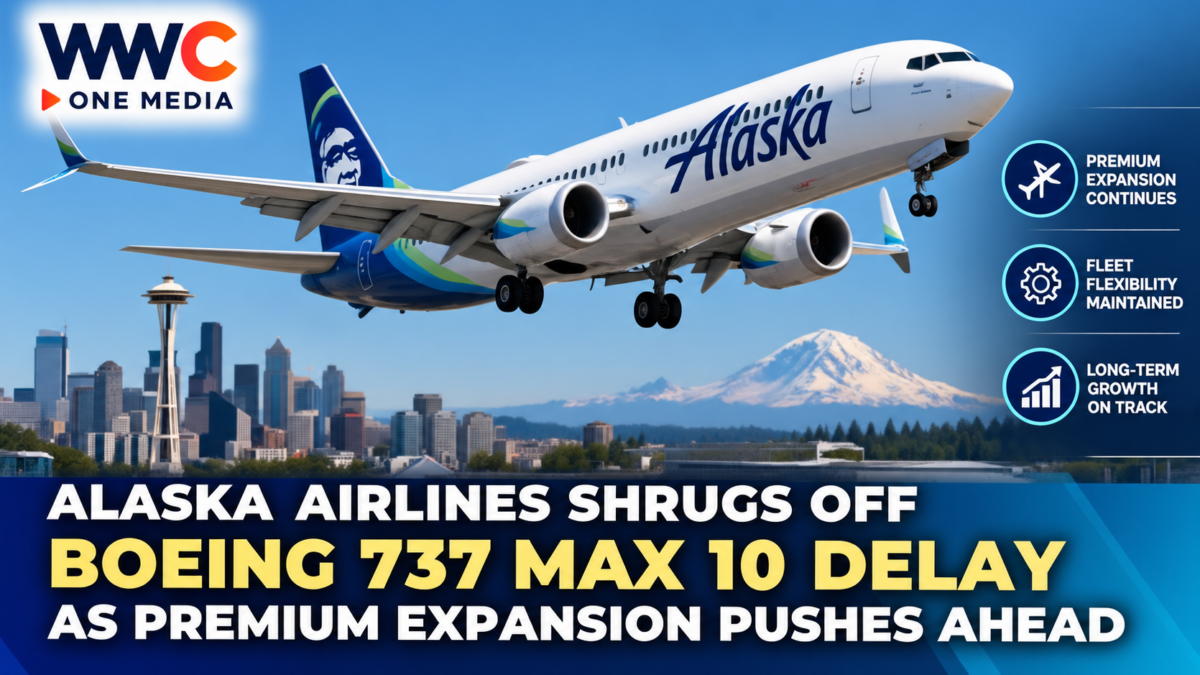
SEATTLE — Alaska Airlines CEO Ben Minicucci is refusing to let another Boeing 737 MAX 10 certification delay derail the carrier’s ambitious expansion plans, saying he is “not overly concerned” about the latest software problem even as Alaska prepares to put lie-flat business-class suites on the biggest version of Boeing’s bestselling narrowbody jet.
The latest setback emerged just as the long-delayed MAX 10 appeared close to finally receiving U.S. regulatory approval.
The Federal Aviation Administration paused certification after Boeing disclosed an issue involving updated flight-management software that could cause automated vertical navigation guidance to disengage under a specific missed-approach scenario.
The announcement sent Boeing shares sharply lower and raised new questions for airlines that have built future fleet plans around the MAX 10.
But Minicucci took a much calmer position.
He told CNBC that Alaska remains in close contact with both Boeing and the FAA and that he did not expect the issue to significantly disrupt the airline’s strategy unless the delay stretched for several months.
That assessment has since gained support.
On October 2, the FAA concluded after a formal review that the software problem does not pose a flight-safety risk, because pilots remain in control and receive clear cockpit indications when the automated function disengages.
The finding removes one of the biggest immediate obstacles to certification.
THE MAX 10 DELAY CAME AT THE WORST POSSIBLE MOMENT
Alaska had just unveiled one of the largest premium-cabin investments in its history when news of the delay broke.
The airline announced a broad overhaul of both Alaska Airlines and Hawaiian Airlines featuring:
Lie-flat business-class suites
A new premium economy product
Larger lounges
Premium airport check-in
and
More international flying.
The centerpiece for Alaska’s narrowbody fleet is especially unusual.
The airline plans to install 12 lie-flat Aurora Suites on at least 25 Boeing 737 MAX 10 aircraft beginning in 2028.
That will allow Alaska to offer fully flat beds on selected U.S. transcontinental flights for the first time.
The MAX 10 therefore is not simply another replacement aircraft.
It is becoming central to Alaska’s attempt to compete for higher-paying travelers.
MINICUCCI SAYS HE IS “NOT OVERLY CONCERNED”
Minicucci told CNBC on September 29 that the software issue did not yet change Alaska’s long-term plans.
His position was essentially:
if the certification pause lasts days or weeks, Alaska can absorb it.
If it stretches into several months, the airline may eventually have to adjust the timing of its premium MAX 10 rollout.
That distinction matters.
Alaska is not waiting until 2028 to receive its first MAX 10.
The airline had previously expected its first aircraft in spring 2027, with passenger service potentially beginning between April and mid-May.
Alaska Chief Operating Officer Jason Berry told Reuters before the software issue emerged that the airline expected:
22 MAX 10 deliveries in 2027
and
30 more in 2028.
Those delivery plans are much more sensitive to certification timing than the later Aurora Suite launch.
FAA HAS NOW RULED THE GLITCH IS NOT A SAFETY THREAT
The outlook improved significantly on October 2.
The FAA’s Corrective Action Review Board determined that the software anomaly does not create an unsafe flight condition.
The glitch involves the aircraft’s flight-management computer during a rare sequence involving a missed approach.
If pilots modify the programmed missed-approach path while certain automated functions are active, the aircraft’s vertical-navigation mode can disengage.
Pilots remain in control.
Cockpit displays indicate the change.
The FAA determined trained crews can manage the condition safely.
Boeing is still developing a software update and interim procedures, but the regulator’s decision means a lengthy safety redesign is no longer expected.
THIS SOFTWARE PROBLEM IS NOT MCAS
Because the aircraft carries the MAX name, any Boeing software issue inevitably raises memories of the two fatal 737 MAX crashes in 2018 and 2019.
But the current problem is technically very different.
The earlier crashes involving Lion Air Flight 610 and Ethiopian Airlines Flight 302 were linked to Boeing’s MCAS flight-control system, which could command aircraft nose-down movement based on faulty sensor data.
A total of 346 people were killed.
The current software issue does not automatically take control away from pilots.
Instead, it can remove one layer of automated vertical guidance during a very specific missed-approach sequence.
FAA Administrator Bryan Bedford stressed that distinction when discussing the issue.
That difference is critical for accurate reporting.
WESTJET FIRST FLAGGED THE PROBLEM IN 2024
Another important detail emerged after the initial delay.
Canadian airline WestJet first reported the software anomaly to Boeing during an entry-into-service validation flight in 2024.
The airline provided flight data after its pilots observed the unexpected behavior.
The software version involved is known as U14.1.
WestJet said it had not experienced related in-service safety problems and believed normal pilot procedures were sufficient to manage the condition.
The FAA later reviewed the issue more formally as Boeing approached MAX 10 certification.
That sequence explains why a problem first noticed two years ago suddenly became a major certification obstacle in late 2026.
ALASKA’S CURRENT 737s ARE NOT AFFECTED
Alaska said its existing aircraft do not use the affected software version.
That means the problem does not require grounding the airline’s current 737 fleet.
United Airlines similarly said its operating MAX aircraft were not affected.
The problem mattered most because the MAX 10 certification program depended on the newer software configuration.
For Alaska, therefore, this was primarily a future fleet planning issue, not an immediate operational safety crisis.
BOEING HAS AROUND 1,500 MAX 10 ORDERS
The stakes extend far beyond Alaska.
Boeing has roughly 1,500 orders for the 737 MAX 10, making the aircraft one of the most commercially important jets in the company’s backlog.
Customers include:
United Airlines
Alaska Airlines
Ryanair
Delta Air Lines
and other major carriers.
The MAX 10 is the largest member of Boeing’s 737 MAX family.
Its greater capacity allows airlines to spread operating costs across more passengers while retaining the economics of a single-aisle aircraft.
That makes it Boeing’s main answer to Airbus’ hugely successful A321neo.
ALASKA HAS ORDERED 105 MAX 10s
Alaska has become one of Boeing’s most important MAX 10 customers.
In January 2026, Alaska placed the largest aircraft order in its history, including:
105 firm Boeing 737 MAX 10 orders
plus
options for another 35.
The order extends Alaska’s Boeing delivery pipeline well into the next decade.
The MAX 10 will be used partly to add capacity on routes where Alaska wants more seats without adding more flights.
That is particularly useful at congested airports where additional takeoff and landing slots may be limited.
THE MAX 10 WILL ALSO BECOME A PREMIUM AIRCRAFT
Alaska is not planning to configure every MAX 10 the same way.
At least 25 aircraft will receive a special premium transcontinental layout.
Those planes will feature:
12 Aurora lie-flat suites
plus
Premium Reserve seats
and regular economy seating.
Alaska says roughly 45% or more of the seats on those specially configured aircraft will fall into premium categories.
That is a dramatic departure from the traditional image of the Boeing 737 as primarily an economy-class domestic workhorse.
ALASKA WANTS LIE-FLAT SEATS ON TRANSCONTINENTAL ROUTES
The premium MAX 10s will target high-value U.S. markets.
Alaska has highlighted transcontinental flying involving cities such as:
New York
Seattle
and major California markets.
New York is especially important.
Alaska executives said the airline currently operates about 24 daily departures there but has underperformed competitors in premium demand because it lacked the right product.
A lie-flat business-class seat could help close that gap.
That would put Alaska into more direct competition with premium transcontinental offerings from:
Delta
United
American
and
JetBlue.
THE NEW PRODUCT IS CALLED AURORA
Alaska calls its premium experience:
Aurora.
The name is inspired by the northern lights and the airline’s Pacific Northwest identity.
Aurora Suites will include:
Fully lie-flat beds
Privacy doors
Premium dining
Dedicated airport services
and access to upgraded lounges.
Alaska will also install Aurora Suites on its Boeing 787 Dreamliners.
The airline plans:
34 suites on 787-9 aircraft
and
40 on future 787-10s.
The MAX 10 version will bring that experience to selected domestic routes.
PREMIUM REVENUE IS BECOMING CRITICAL TO ALASKA
The reason behind the investment is financial.
Premium travel has become one of the strongest revenue categories in the airline industry.
Affluent passengers and corporate travelers are often willing to pay significantly more for:
First class
Business class
Premium economy
Airport lounges
and
Extra-legroom seating.
Alaska says premium revenue currently represents about 36% of total revenue.
It wants that figure to rise above:
40% by 2030.
The airline expects new premium products to contribute meaningfully to profit growth.
ALASKA IS ALSO LAUNCHING “PREMIUM RESERVE”
Alaska is not only upgrading its most expensive seats.
It is also introducing a new premium economy cabin called:
Premium Reserve.
The product will debut beginning in 2028 across:
Boeing 787s
selected MAX 10s
and
Hawaiian Airlines Airbus A330s.
Premium Reserve will offer more space and upgraded service compared with regular economy.
This fills an important gap between standard economy and fully lie-flat business class.
Large international airlines have increasingly found premium economy highly profitable because customers pay significantly more without requiring the enormous space of business-class seats.
HAWAIIAN AIRLINES IS PART OF THE SAME STRATEGY
Alaska’s premium transformation accelerated after its $1.9 billion acquisition of Hawaiian Airlines in 2024.
The deal gave Alaska something it historically lacked:
a widebody fleet capable of flying deep into Asia, Europe and the South Pacific.
Hawaiian brought Airbus A330 aircraft.
Alaska is also adding Boeing 787 Dreamliners.
The combined airline can therefore operate both:
Domestic narrowbody networks
and
Long-haul international routes.
That changes Alaska from a primarily West Coast domestic airline into something closer to a global carrier.
ALASKA WANTS AT LEAST 15 LONG-HAUL DESTINATIONS FROM SEATTLE
The airline plans to dramatically expand international flying from Seattle.
By 2030, Alaska wants at least:
15 long-haul intercontinental destinations
from its Seattle hub.
New routes include planned service to:
Paris
and
Athens
in 2027.
The airline is also expanding into Asia.
That puts Alaska into more direct competition with Delta, which has spent years building Seattle into a major international gateway.
DELTA IS THE BIG COMPETITOR IN SEATTLE
Alaska remains the dominant domestic airline in Seattle.
But Delta has developed a stronger international network there.
Reuters reported that Alaska wants to become Seattle’s largest international carrier as well.
That competition helps explain the premium investment.
Delta already offers:
Lie-flat business class
Premium economy
Large lounges
and extensive international connections.
Alaska cannot credibly compete for high-value international and corporate customers without comparable products.
ALASKA HAS A REVENUE PROBLEM IT WANTS PREMIUM TO FIX
Alaska has historically operated very efficiently.
Reuters reported that the airline’s unit costs are roughly 17% lower than those of major competitors including Delta, United and American.
But its revenue per available seat mile is also approximately:
20% lower.
In other words:
Alaska is relatively efficient at operating airplanes.
But it does not earn as much revenue from each seat as larger competitors.
Premium cabins are designed to narrow that gap.
HIGH FUEL PRICES MAKE THAT EVEN MORE URGENT
The airline’s strategy is becoming more important because fuel costs have risen sharply.
Higher jet-fuel prices hurt every airline, but especially carriers earning less revenue per seat.
Alaska has already withdrawn some earlier earnings expectations because of fuel-price volatility.
Premium revenue provides a buffer.
A business-class passenger paying several times the price of an economy ticket can generate significantly more revenue without requiring several times the operating cost.
That is why almost every major airline is racing to increase premium seating.
THE MAX 10 FITS THE STRATEGY WELL
The MAX 10 has advantages for premium domestic flying.
It is larger than the MAX 8 and MAX 9.
That gives Alaska enough cabin space to install expensive lie-flat seats while still carrying enough economy passengers to make the aircraft commercially viable.
It also burns less fuel than older-generation narrowbody aircraft.
For high-demand transcontinental routes, Alaska believes that combination can produce stronger economics.
A certification delay therefore matters because it affects one of the most strategically important aircraft in its future fleet.
RYANAIR WAS ALSO CALM ABOUT THE DELAY
Alaska was not the only customer that avoided panic.
Ryanair CEO Michael O’Leary said on September 29 that he expected the certification delay to last:
“days, not weeks or months.”
Ryanair is another major MAX 10 customer and expects to receive its first 15 aircraft in spring 2027.
O’Leary’s optimism now looks more plausible following the FAA’s October 2 finding that the software anomaly is not a safety threat.
THE FAA STILL HAS FINAL AUTHORITY
Despite airline optimism, neither Alaska nor Ryanair decides when the aircraft enters service.
The FAA does.
That distinction has become especially important following the earlier MAX crisis.
U.S. regulators have taken a much more cautious approach toward Boeing certification programs.
The FAA has repeatedly refused to commit publicly to Boeing’s preferred schedules.
Certification only occurs after regulators determine all required standards have been met.
The October 2 ruling removes an important obstacle.
It does not itself constitute final MAX 10 certification.
BOEING NEEDS THE MAX 10 BADLY
Boeing’s competitive position also depends heavily on the aircraft.
Airbus has dominated the upper end of the single-aisle market with the:
A321neo
and
A321XLR.
Those aircraft are extremely popular with airlines seeking high seating capacity and long range without moving to a widebody jet.
The MAX 10 is Boeing’s closest direct competitor.
Every year of delay gives Airbus more opportunities to lock airlines into A321-family orders.
That makes completing certification one of Boeing CEO Kelly Ortberg’s major priorities.
CERTIFICATION HAS ALREADY BEEN DELAYED FOR YEARS
The MAX 10 originally was expected to enter service much earlier.
The program was delayed after:
The original 737 MAX grounding
Stricter FAA reviews
Engine anti-ice redesign requirements
Cockpit-system reviews
and other certification work.
Earlier in September, Ortberg said approval was coming:
“very soon.”
Then the software problem emerged.
The latest FAA ruling now puts the aircraft back on a potentially shorter path toward approval.
ALASKA’S STRATEGY DOES NOT DEPEND ON ONE MONTH
That is partly why Minicucci remained calm.
The airline’s specially configured premium MAX 10 fleet is not scheduled to begin flying until 2028.
A modest certification delay in late 2026 therefore does not necessarily disrupt that product launch.
But Boeing still needs enough time to:
Certify the aircraft
Deliver sufficient jets
Install Alaska’s interiors
Complete airline-specific approvals
and
Train crews.
The buffer is real.
It is not unlimited.
THE BIGGER STORY: THE MAX 10 IS BECOMING MORE THAN JUST AN AIRPLANE FOR ALASKA
Alaska Airlines’ reaction to the latest certification scare tells a larger story about the company itself.
Only a few years ago, Alaska was primarily known as a highly efficient West Coast airline.
Now it is trying to become:
A global carrier
A premium airline
and
A much stronger competitor to Delta, United and American.
The MAX 10 is central to that transformation.
It will carry more passengers.
Selected aircraft will offer fully flat suites.
It will help Alaska compete in premium transcontinental markets.
And it will work alongside Hawaiian’s widebodies and Alaska’s Dreamliners as part of a much larger international network.
The FAA’s latest decision has reduced the immediate risk that one software problem will derail that strategy.
But years of Boeing certification delays have already taught airlines an important lesson:
building a future fleet around an aircraft is one thing — getting that aircraft delivered exactly when you need it is another.