
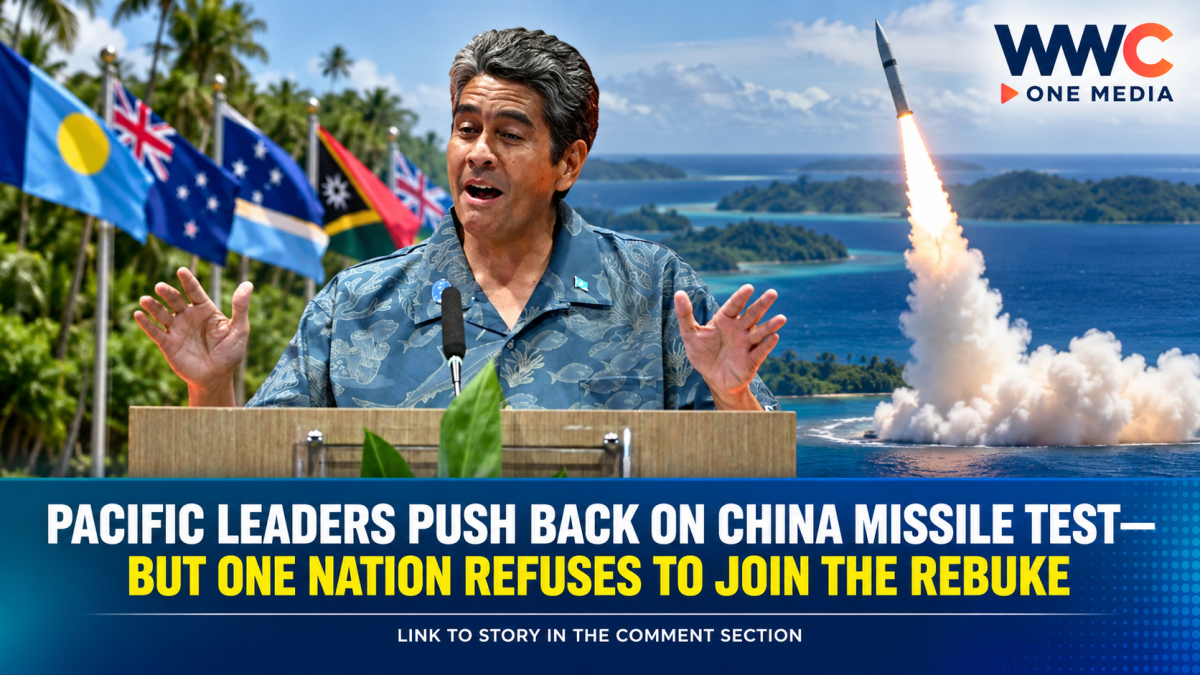
KOROR, Palau — Pacific leaders have expressed collective concern over China’s July ballistic missile test, demanding greater transparency and advance notification for future launches, but an unexpected split inside the regional bloc exposed just how difficult it is for Pacific nations to maintain a united position amid growing competition between China and Western powers.
The issue dominated the closing stages of the Pacific Islands Forum (PIF) Leaders’ Meeting in Palau, where members agreed to include language expressing concern over the Chinese test.
However, the statement fell short of an outright condemnation of Beijing.
More significantly, Nauru dissented from the missile-test provision, highlighting divisions within the 18-member regional organization over how Pacific countries should respond to China’s expanding strategic presence.
The development came after weeks of diplomatic pressure and disagreement over the appropriate regional response to the launch.
China missile test sparks Pacific alarm
China conducted the ballistic missile test in July, sending a long-range missile toward the South Pacific. The launch was only the second publicly known Chinese ballistic-missile test into international waters since 1980, according to CNA.
CNA reported that the missile traveled roughly 7,300 kilometers before landing in international waters. The missile carried a simulated warhead, and analysts said the weapon was likely a submarine-launched ballistic missile.
The test immediately raised concerns among Pacific governments because the missile’s trajectory passed over or near the airspace of several Pacific states.
SBS News reported that intelligence assessments indicated the missile flew over the airspace of the Philippines, Palau and Micronesia before reaching the Pacific Ocean.
For Pacific leaders, the issue was not simply the military capability demonstrated by the launch. It was also the lack of timely notification to countries whose airspace or surrounding region could be affected.
Palau President Surangel Whipps Jr., who chaired this year’s forum, repeatedly called for Beijing to respect Pacific sovereignty and transparency.
“We don’t want our backyard, our homes, to be threatened,” Whipps said during the summit, according to Reuters.
Pacific bloc demands advance warning
The final communiqué stopped short of directly naming China.
Instead, Pacific leaders agreed to “register concern” over the recent intercontinental ballistic missile test, saying it had overflown members without adequate notice.
The leaders also called on all states conducting ICBM tests to provide greater transparency and reassurance, including at least 24 hours’ advance notification, in line with international practice.
The wording was significant because the Pacific Islands Forum traditionally operates through consensus.
Yet Nauru declined to associate itself with the missile-test provision.
The disagreement follows an earlier failure by Pacific foreign ministers to reach agreement on a statement regarding China’s missile launch. Reuters reported that the foreign ministers’ meeting in August failed to produce a condemnation despite concern among several Pacific governments.
Nauru’s dissent exposes a deeper Pacific divide
Nauru’s position is particularly significant because the island nation has strengthened its relationship with Beijing.
In 2024, Nauru switched diplomatic recognition from Taiwan to China, aligning itself with Beijing’s position on Taiwan.
Palau, meanwhile, remains one of the Pacific countries that maintains official diplomatic relations with Taiwan.
That diplomatic divide has increasingly complicated regional meetings.
The Pacific Islands Forum summit itself was overshadowed by tensions between Beijing and Taipei, with China objecting to Taiwan’s participation in events surrounding the gathering. Reuters reported that several Pacific leaders also did not attend personally, sending ministers or other representatives instead.
The resulting divisions have fueled questions about whether major-power competition is beginning to affect the Pacific’s ability to speak with one voice.
Beijing rejects criticism
China has defended the missile launch as a routine military exercise and rejected accusations that the test threatened the Pacific.
Reuters reported that Chinese Foreign Ministry spokesman Guo Jiakun accused Palau of creating “hype” around the launch and attempting to influence other Pacific Forum members.
Beijing said the test was conducted safely and maintained that China was willing to cooperate with South Pacific nations on regional peace and stability.
The dispute therefore reflects a wider clash between China’s view of the test as a legitimate military activity and Pacific governments’ concerns over sovereignty, transparency and the militarization of their region.
Australia and New Zealand watch closely
The missile controversy also carries broader strategic implications for Australia and New Zealand, two major members of the Pacific Islands Forum.
Australia has been increasingly active in strengthening security relationships with Pacific island nations as China expands its diplomatic, economic and security engagement across the region.
The Australian Broadcasting Corporation reported that the missile issue had become a major test of the forum’s ability to respond collectively to China’s growing military power.
New Zealand Prime Minister Christopher Luxon, meanwhile, argued that Nauru’s dissent should not prevent the forum from expressing a broader Pacific position.
The outcome ultimately demonstrated both sides of the regional equation: Pacific countries were willing to raise concerns about China’s military activities, but they were not prepared to adopt a unanimous and direct condemnation of Beijing.
Why the missile test matters beyond the Pacific
The controversy is about more than one missile launch.
China’s test comes as the Pacific becomes an increasingly important arena for competition among China, the United States, Australia, New Zealand and Taiwan.
The region’s strategic importance has grown because of its location, vast maritime areas and increasingly contested diplomatic relationships.
CNA noted that China’s latest test raised questions about the country’s expanding nuclear capabilities and its ability to project strategic power farther into the Indo-Pacific.
At the same time, Pacific governments are trying to prevent the region from becoming simply another battleground for major-power rivalry.
That tension was reflected in the language adopted by the forum: rather than directly confronting China, leaders emphasized transparency, advance notification and the principle that Pacific nations should have a say in activities taking place around their own region.
A warning wrapped in diplomatic language
The final outcome may therefore be best understood as a diplomatic warning rather than a formal condemnation of China.
The Pacific Islands Forum made clear that missile testing without adequate notification is unacceptable to many members.
But Nauru’s dissent demonstrated that the bloc remains divided over how far it should go in confronting Beijing.
For Palau and other governments concerned about China’s military activities, the debate is unlikely to end with the summit.
The bigger question now is whether the Pacific can maintain a common position as competition between China and the West intensifies—and whether future military activity in the region will push more Pacific nations toward confrontation, neutrality or closer alignment with one side.
For now, the message from Palau is cautious but unmistakable: Pacific nations want greater transparency over military activity in their own backyard. What remains uncertain is whether the region can agree on how strongly to say it.
WWC ONE MEDIA J.M.S

Leave a Reply