
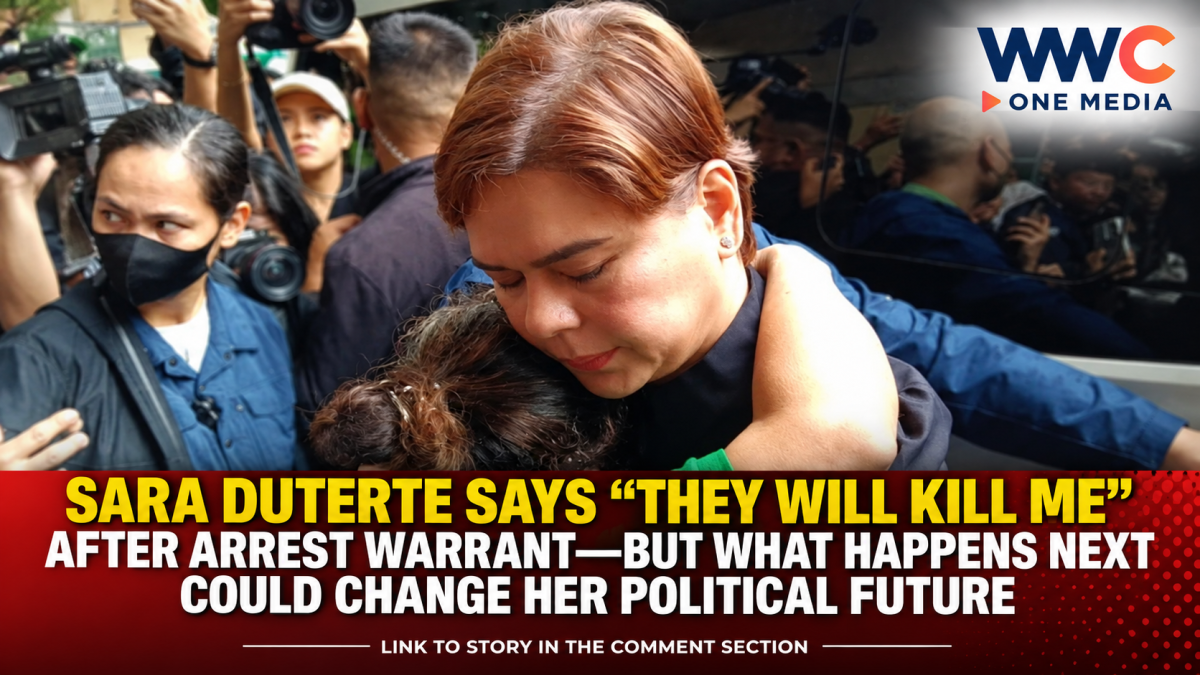
MANILA, Philippines — Vice President Sara Duterte said she fears for her life after a Quezon City court issued an arrest warrant against her over a grave threats case, accusing authorities of placing her in a situation where she does not feel safe.
“I feel they will kill me,” Duterte told reporters on Saturday as she arrived at the Quezon City Hall of Justice to face the legal proceedings.
The statement came a day after Quezon City Regional Trial Court Branch 98 issued a warrant of arrest after finding probable cause to put Duterte on trial on three counts of grave threats.
The case stems from Duterte’s controversial online press conference on Nov. 23, 2024, when she said she had arranged for a person to kill President Ferdinand Marcos Jr., First Lady Liza Araneta Marcos and then-House Speaker Martin Romualdez if she herself were killed.
Duterte has denied that her remarks constituted an actual threat and has accused the administration of pursuing legal and political cases against her.
Duterte posts bail after arrest warrant
Despite her concerns about her safety, Duterte appeared before the Quezon City court and posted bail on Saturday.
The court set bail at P120,000 for each of the three counts, bringing the total to P360,000.
The development means Duterte will remain free while the criminal case proceeds, although the warrant represents a significant escalation in the legal challenges facing the Vice President.
Reuters reported that Duterte was considered to have surrendered to authorities after appearing before the court and completing the necessary proceedings. Her legal team is expected to continue pursuing available remedies in the case.
Court finds probable cause
According to the Philippine News Agency, Quezon City RTC Branch 98 found probable cause to hold Duterte for trial on all three counts.
The Department of Justice said the court also rejected Duterte’s motion seeking to defer or recall the arrest warrant and her request to quash the criminal information.
DOJ spokesperson Polo Martinez said the department respects the court’s ruling and that the case will now proceed to trial.
The charges involve Article 282 of the Revised Penal Code on grave threats, in relation to the Cybercrime Prevention Act.
The Philippine Star likewise reported that Duterte’s lawyers had been notified of the Sept. 4 warrant and said they would attend to the matter. The report noted that the defense has challenged the government’s authority to pursue the criminal case while Duterte remains subject to an impeachment proceeding.
The controversial 2024 statement at the center of the case
The criminal case traces back nearly two years to Duterte’s November 2024 online press conference.
At the time, Duterte was involved in a bitter confrontation with the Marcos administration, while her chief of staff, Zuleika Lopez, was being detained by the House of Representatives during an investigation involving the Vice President’s office.
During the press conference, Duterte said she had spoken to an individual and instructed that person to kill Marcos, Liza Marcos and Romualdez if she were assassinated.
The remarks later became the subject of an investigation and criminal complaint.
Inquirer.net reported that the National Bureau of Investigation had characterized the statements as serious, real and actual threats during testimony before the Senate impeachment court.
Duterte, however, has maintained her own interpretation of the statements and has continued to challenge the government’s handling of the case.
Arrest warrant arrives amid impeachment trial
The timing of the arrest warrant has also triggered a political controversy because Duterte is simultaneously facing an impeachment trial before the Senate.
Sen. Christopher “Bong” Go questioned why the warrant was issued at this particular point, noting that the alleged statements were made in November 2024 and that the Senate impeachment proceedings are already underway.
Go stopped short of declaring the arrest politically motivated, saying the criminal case and impeachment process are separate proceedings.
The arrest warrant is particularly consequential because the alleged threats are also part of the accusations being examined in Duterte’s impeachment proceedings.
CNA reported that a conviction in the criminal case could carry a jail sentence of up to six months, while an impeachment conviction could remove Duterte from office and prevent her from pursuing a political career in the future.
Government rejects immunity argument
Another major legal question is whether Duterte, as Vice President, can face criminal prosecution while an impeachment case is pending.
The Department of Justice has maintained that presidential immunity from suit does not extend to the Vice President.
DOJ officials have argued that criminal proceedings can continue separately from impeachment because the two processes serve different purposes.
Duterte’s legal camp has challenged that position, arguing that the criminal case should not proceed against an impeachable official while the impeachment process remains unresolved.
Malacañang, meanwhile, said it respects the court’s decision.
Political stakes continue to rise
The case adds another layer to the increasingly bitter political rupture between the Marcos and Duterte camps.
Marcos and Duterte joined forces in the 2022 elections and won the presidency and vice presidency by a wide margin. Their alliance later collapsed, producing a series of increasingly public disputes involving the administration, Congress and the Duterte family.
Duterte was impeached by the House of Representatives and is now facing a Senate trial. At the same time, her legal battles have intensified, while the possibility of a Duterte presidential campaign in 2028 remains a major factor in Philippine politics.
For now, Duterte remains out on bail as the grave threats case moves toward trial.
But her statement that she fears she could be killed has added a dramatic new dimension to an already explosive confrontation.
The central question now is whether the criminal case will remain a courtroom battle—or become another defining chapter in the widening political war between the Marcos and Duterte camps.
WWC ONE MEDIA J.M.S




Leave a Reply