
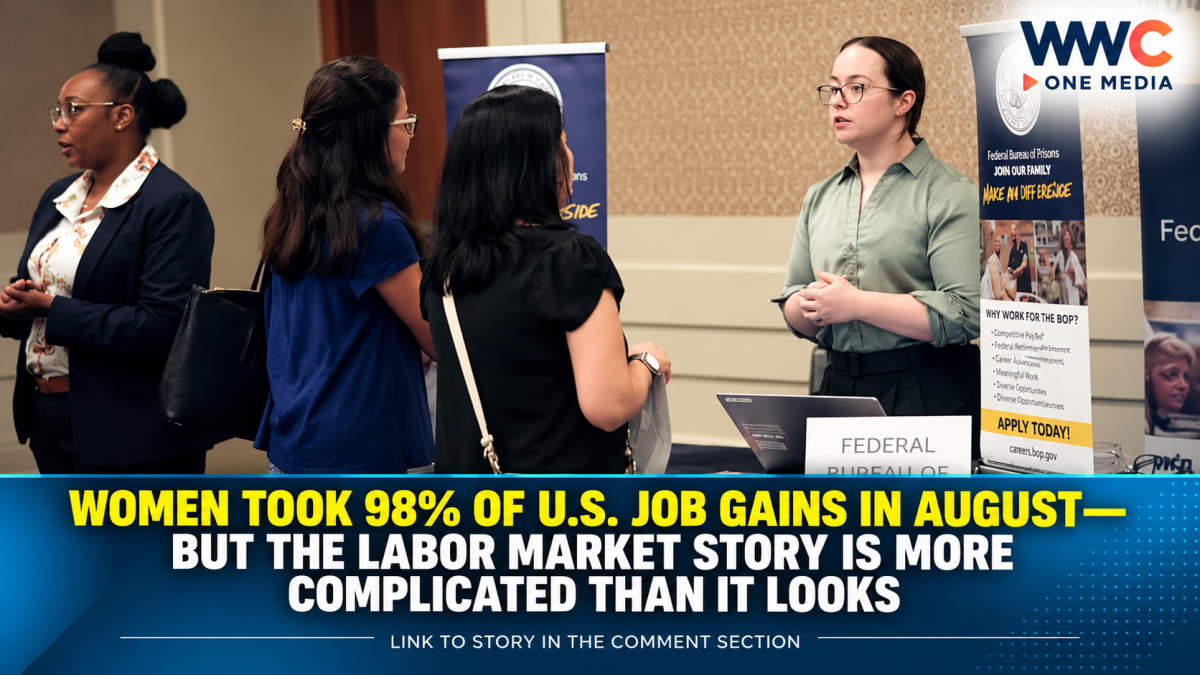
WASHINGTON — The U.S. labor market delivered a striking surprise in August: women accounted for about 158,000 of the 162,000 nonfarm payroll jobs added during the month, or roughly 98% of the net gain, according to an analysis of newly released Bureau of Labor Statistics data.
Men accounted for roughly 4,000 of the net payroll increase.
The unusually lopsided result comes as the broader U.S. labor market rebounds from a weak summer and as women have continued to gain ground in industries such as health care, education and hospitality.
But economists caution against interpreting one month’s gender split as evidence of a permanent transformation.
The more important story may be which industries are hiring—and which are not.
August delivered a major jobs surprise
The U.S. economy added 162,000 nonfarm payroll jobs in August, according to the BLS, far exceeding the roughly 55,000 jobs many economists had expected.
The unemployment rate remained at 4.1%, while the labor-force participation rate edged up to 61.6%.
The August increase was also significantly stronger than the average monthly payroll gain of just 31,000 over the previous 12 months.
The revisions to previous months were also favorable.
June’s job gain was revised from 20,000 to 31,000, while July was revised from an initially reported 23,000-job decline to a 21,000-job increase.
Together, those revisions added 55,000 jobs to the combined June-July total.
That means the latest report does more than simply show a strong August—it also makes the preceding two months look less weak than initially reported.
Why women dominated the August payroll increase
BLS payroll data show that women held approximately 79.75 million nonfarm payroll jobs in August, up about 158,000 from July.
Men held roughly 79.33 million, an increase of about 4,000.
Women therefore represented approximately 98% of the month’s net payroll increase.
However, this does not mean that 98% of every person hired in America during August was a woman.
That distinction is important.
The BLS establishment survey measures payroll employment, meaning jobs reported by employers. A person can hold more than one job, so payroll employment should not automatically be interpreted as the number of unique workers.
The gender breakdown also reflects changes in existing employment, not simply newly created positions.
The biggest clue: teachers and restaurant workers
The extraordinary August gender split appears to have been heavily influenced by the types of industries that added jobs.
Food services and drinking places added 59,000 jobs in August, substantially above their average monthly increase of 12,000 over the previous year.
Local government education added another 42,000 jobs, largely reversing a seasonal decline in the previous month.
Those two sectors alone represented about 101,000 of the 162,000 net jobs added, or roughly 62% of the month’s total.
And both industries employ large numbers of women.
Fortune’s analysis of the BLS figures found women gained roughly 68,000 jobs in leisure and hospitality, even though the sector’s overall employment increased by about 62,000. That implies a decline in male employment within the sector during the month.
Economists therefore warn against viewing the August numbers as evidence that American employers suddenly changed their hiring preferences.
Seasonal hiring patterns matter.
The return of teachers to classrooms and the rebound in restaurant employment had an outsized impact on the monthly figures.
Women have already reached a historic payroll milestone
The August numbers come after another significant development.
Earlier this year, women moved ahead of men in the number of nonfarm payroll jobs for the third time in U.S. history, according to analysis cited by Fortune.
In August, women represented 50.1% of all nonfarm payroll employment, according to the BLS.
That is a remarkable change in the composition of the American workforce.
But the current milestone is different from previous episodes when women temporarily overtook men.
Fortune notes that the earlier instances occurred around major economic disruptions, including the Great Recession and the period surrounding the COVID-19 pandemic.
The latest shift appears more closely connected to longer-running changes in the structure of the economy, particularly the expansion of female-heavy sectors such as health care and services.
Health care remains one of the strongest engines
Health care has remained an important source of employment growth and is heavily represented by women.
The BLS reported that health care employment continued to rise in August, although the increase was smaller than the sector’s average monthly gain over the previous year.
That matters because health care has been one of the most consistent employment engines in the post-pandemic U.S. economy.
Women also make up a large share of the sector’s workforce, meaning continued health-care hiring can disproportionately support female employment.
Education has a similar demographic effect.
Women hold a particularly large share of jobs in education, training and library-related occupations, according to labor-market analysis cited by Fortune.
But this isn’t necessarily a victory lap for women
The headline “women got 98% of the jobs” is attention-grabbing—but economists say the underlying picture requires more caution.
Heather Long, chief economist at Navy Federal Credit Union, warned that month-to-month gender employment figures can be highly volatile.
The August surge was heavily influenced by seasonal education hiring and the restaurant sector, meaning the gender gap could narrow again in subsequent reports.
There is also a question of job quality and pay.
Average hourly earnings for private-sector workers increased by 0.3% in August, reaching $37.75, while wages were up 3.1% from a year earlier.
So the economy is creating jobs, but wage growth remains an important part of the story.
The August report therefore does not establish that women are suddenly outperforming men across every measure of economic well-being.
The male-female employment gap is moving in different directions
The latest figures show a widening divergence in some measures.
Fortune reported that over the year, the number of employed women increased by more than 870,000, while the number of employed men declined by nearly 1.5 million in the household-survey data.
In August, the unemployment rate for women was 3.9%, compared with 4.4% for men, according to the analysis.
The BLS establishment data also show that women represented 50.1% of total nonfarm payroll employment in August.
But again, these are different surveys measuring different concepts.
The household survey measures people and their labor-force status.
The establishment survey measures payroll jobs.
Mixing the two can create misleading conclusions, particularly when discussing the number of men and women working.
Some traditionally male-heavy sectors remain under pressure
The labor-market recovery is also uneven by industry.
The BLS reported that the information industry lost jobs in August.
Manufacturing and several other sectors showed little overall change, while professional and business services, retail, transportation and warehousing also registered little change during the month.
That helps explain why the gender divide looked so dramatic.
If industries with large female workforces are expanding while male-dominated industries are stagnant, women can capture a disproportionately large share of net employment growth even without an economy-wide hiring shift based on gender.
The jobs report may complicate the Federal Reserve’s next move
The strong August employment number also has consequences far beyond the gender statistics.
Markets immediately began reassessing the outlook for Federal Reserve interest rates after the report.
A stronger labor market can give policymakers more room to keep monetary policy restrictive—or even raise rates—if inflation remains too high.
Reuters reported that the jobs report increased expectations for a possible Fed rate hike at the Sept. 15–16 meeting, although the decision will also depend heavily on incoming inflation data.
That creates an unusual economic situation:
Good news for workers can become bad news for borrowers.
A stronger labor market reduces fears of recession, but if policymakers believe the economy remains too strong to bring inflation back to the Fed’s 2% target, interest rates could remain higher for longer.
The bigger picture: America’s workforce is changing
The August numbers highlight a broader transformation in the U.S. economy.
Employment growth is increasingly concentrated in sectors such as:
- Health care
- Education
- Hospitality
- Social services
- Other service industries
Many of these industries have historically employed more women than men.
At the same time, sectors traditionally associated with male employment—including manufacturing and some information-related industries—have struggled to generate comparable employment growth.
That does not mean men are disappearing from the workforce.
It means the structure of job creation is changing, and the August report provides an unusually dramatic snapshot of that transition.
What the August report really tells us
The most viral statistic is undoubtedly 98%.
But the deeper story is more nuanced:
Women accounted for about 158,000 of the 162,000 net payroll jobs added in August.
The unemployment rate remained at 4.1%.
Food services added 59,000 jobs.
Local government education added 42,000.
June and July payrolls were revised upward by a combined 55,000.
Women represented 50.1% of all nonfarm payroll employment.
And perhaps most importantly, economists are warning that one month should not be mistaken for a permanent structural break.
August may have produced an extraordinary gender split—but the forces behind it are largely visible in the industries doing the hiring.
The next few jobs reports will reveal whether August was simply a seasonal statistical shock—or another step toward a fundamentally different U.S. labor market.
WWC ONE MEDIA M.J.E




Leave a Reply