
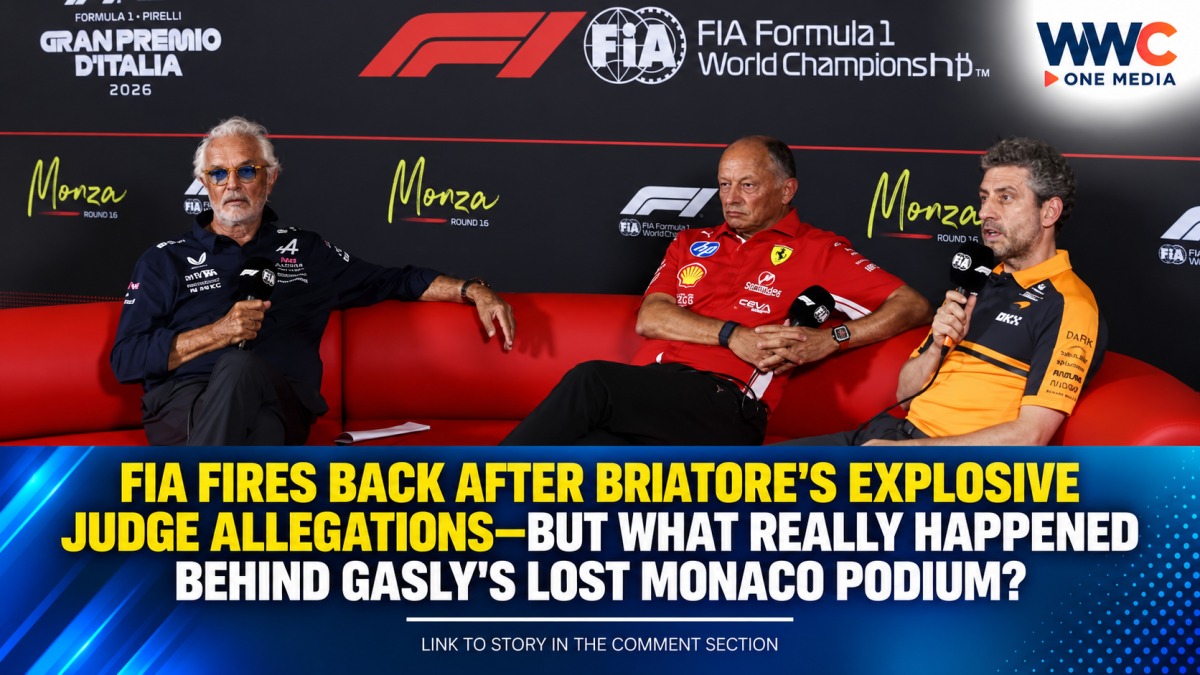
MONZA, Italy — The controversy surrounding Pierre Gasly’s lost Monaco Grand Prix podium has escalated after Alpine executive advisor Flavio Briatore publicly questioned the independence of an FIA International Court of Appeal judge—prompting the court to issue a strong defense of its impartiality and judicial process.
The dispute erupted after the FIA’s International Court of Appeal reinstated two five-second penalties against Gasly, overturning an earlier decision that had restored his third-place finish at the 2026 Monaco Grand Prix.
The latest ruling means Gasly is officially classified seventh, while Red Bull’s Isack Hadjar moves back into third and McLaren’s Oscar Piastri rises to fourth.
The ruling followed appeals from McLaren Racing and Red Bull Racing against the Monaco stewards’ June 12 decision to remove Gasly’s penalties.
How the Monaco controversy began
Gasly was initially handed two five-second penalties during the Monaco race for pit-lane speeding.
Alpine subsequently requested a review, arguing that new information concerning the timing system constituted a significant and relevant element that had not been available to the stewards when the original penalties were imposed.
On June 12, the stewards accepted Alpine’s argument, rescinded both penalties and revised the race classification—effectively restoring Gasly to third place.
McLaren and Red Bull then appealed that decision to the FIA International Court of Appeal.
Following a hearing in Paris on August 25, the court ruled that the original penalties should stand and ordered the relevant championship classifications to be amended accordingly.
Briatore takes aim at the appeal process
While Alpine acknowledged the ruling, Briatore took a much more confrontational stance during Friday’s Italian Grand Prix press conference at Monza.
He accepted that the decision would stand but questioned the participation of one of the four judges, Filippo Marchino, alleging that the judge had previous connections with McLaren.
Briatore referred to Marchino’s appearance at a McLaren-related event in 2018 and alleged that McLaren had supported a charity associated with the judge.
He also accused the judge of behaving more like a prosecutor than an impartial member of the panel during the hearing.
Those claims, however, remain Briatore’s allegations. There has been no finding by the FIA court that Marchino acted improperly or that the ruling was influenced by McLaren.
McLaren pushes back
McLaren team principal Andrea Stella strongly rejected the suggestion that the appeal process had been compromised.
Stella said McLaren’s concern was not simply about recovering championship points. According to the McLaren boss, the appeal was about obtaining clarity and consistency in how FIA regulations are applied across Formula 1.
He also described the allegations concerning the court process as inappropriate and defended the importance of maintaining confidence in the FIA’s judicial system.
The dispute has therefore moved beyond Gasly’s two penalties and into a broader argument about judicial independence, conflicts of interest and transparency in Formula 1’s disciplinary system.
FIA International Court of Appeal responds
The FIA’s International Court of Appeal has now directly addressed the controversy.
In a statement, the FIA Courts said the appointment and participation of the judges in the case were conducted under the applicable FIA judicial procedures and practices, which are informed by international conflict-of-interest standards.
The court also said its judges are elected through the FIA General Assembly process and are subject to independence and confidentiality requirements. Judges must disclose interests to the FIA Compliance Officer and sign a declaration of independence for each individual case.
Perhaps most significantly, the court said the parties involved were given opportunities both at the beginning and conclusion of the hearing to raise concerns about the proceedings or the composition of the panel.
According to the FIA, no objection was raised during the hearing regarding the court’s composition or the way the proceedings were conducted.
The FIA therefore rejected the suggestion that the judicial process had been compromised, expressing confidence in the proceedings and the integrity of its judges.
Why the controversy matters
The FIA International Court of Appeal is the final appeal tribunal for international motor sport and operates as an independent body with its own administration. The FIA says its court system was established to provide an independent judicial mechanism for resolving disputes within international motorsport.
The latest clash highlights a difficult issue for Formula 1: even when a ruling is legally valid, questions about perceived conflicts of interest can undermine confidence in the process if teams or fans believe the decision-makers may have connections to competitors.
At the same time, allegations of bias cannot by themselves establish that a judge acted improperly.
In this case, the FIA has publicly stood behind its judicial procedures, while Briatore has continued to question whether the panel was sufficiently independent.
Gasly’s podium is gone—but the controversy is far from over
For Alpine, the immediate sporting consequence is clear: Gasly loses the Monaco podium he briefly regained after the team’s successful review.
Hadjar is restored to third, while Piastri moves into fourth.
But the larger fallout could prove more significant.
The argument now centers on whether Formula 1’s judicial system has provided enough transparency around potential conflicts of interest—and whether teams should be expected to raise such concerns during hearings rather than after an unfavorable verdict.
For now, the FIA says its process was conducted according to its rules and that the integrity of the judges remains intact.
Briatore, meanwhile, has made it clear that he is not satisfied with the explanation.
And with the Formula 1 paddock now gathered at Monza, the question hanging over the controversy is no longer simply who finished third in Monaco.
It is whether this dispute will end with the FIA’s statement—or become the beginning of a much bigger battle over how Formula 1’s judicial system operates.
WWC ONE MEDIA M.J.E



Leave a Reply