
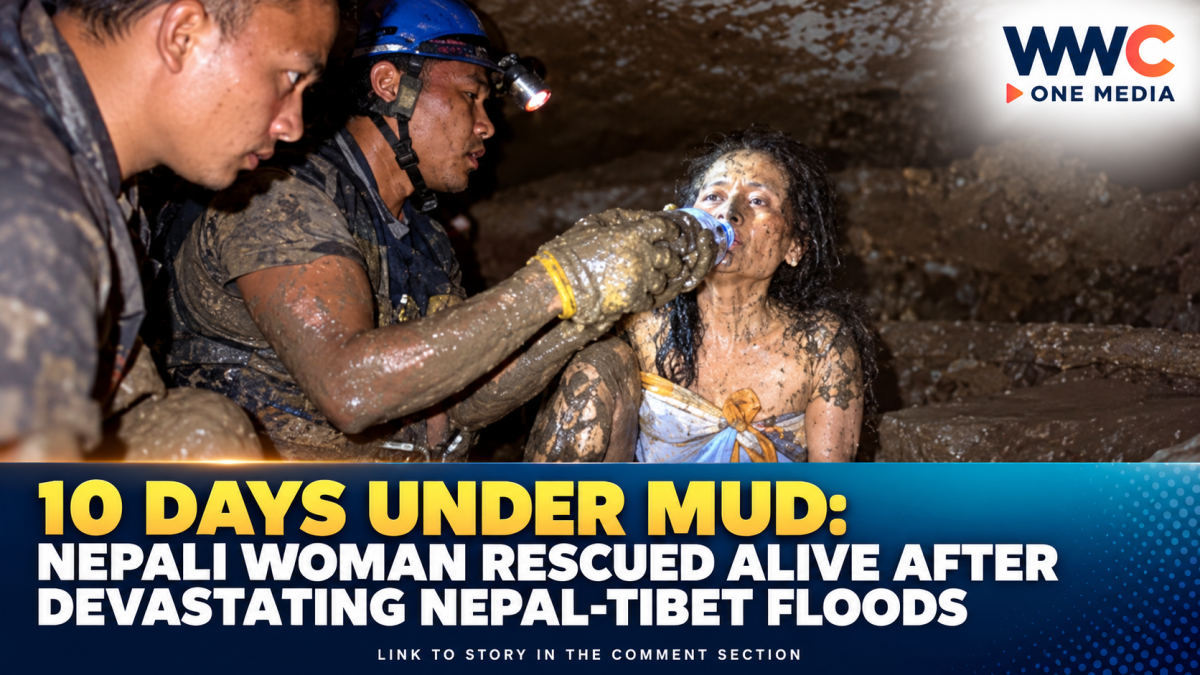
NUWAKOT, Nepal — A rescue operation that had appeared to be a race against time delivered an extraordinary breakthrough Saturday when rescuers pulled a Nepali woman alive from a home buried beneath mud and debris 10 days after catastrophic flooding struck the Nepal-Tibet border region.
The woman was rescued in Nepal’s Nuwakot district, according to officials cited by Channel NewsAsia and other international media. She was taken to Kathmandu for medical treatment after being recovered from the wreckage.
Her survival comes as rescue teams continue searching devastated communities and hydropower facilities for people still missing after the August 26 disaster.
The latest rescue has renewed hopes that other people could still be alive beneath collapsed structures and inside tunnels across the disaster zone.
Another survivor found after days underground
The woman’s rescue was not the only remarkable development Saturday.
Nepalese authorities also reported the rescue of Chinese national Lu Haitao, who was found alive inside a roughly 225-meter tunnel at the Upper Trishuli-1 Hydropower Project in Rasuwa district.
Lu had reportedly been trapped for about 10 days. He was rescued with stable vital signs but showed signs of mild hypothermia before being airlifted to an army hospital.
His rescue followed the recovery of two workers from another hydropower tunnel at the Trishuli-3A project on Friday.
The sequence of rescues has dramatically changed the outlook for search teams, which had been confronting increasingly difficult conditions as the disaster entered its second week.
More than 1,300 people reported dead
The scale of the disaster remains enormous.
According to the latest Reuters reporting, the August 26 flash floods and landslides have killed more than 1,300 people, while thousands remain unaccounted for. Reuters reported that Nepalese authorities had listed about 4,887 people as missing, while dozens more deaths and hundreds of missing people were reported in Tibet.
Earlier official figures had placed Nepal’s death toll and missing-person count lower, illustrating how rapidly authorities have been updating casualty figures as previously inaccessible areas are reached.
The disaster was triggered by a massive collapse of ice, rock and debris in the Himalayan region, sending destructive floodwaters through valleys and settlements near the Nepal-China border.
Rescue teams are now racing against time
The biggest challenge for rescuers is no longer simply reaching destroyed communities.
Authorities believe hundreds of workers could have been trapped inside tunnels connected to hydropower projects damaged by the floods.
Reuters reported that approximately 900 workers may have been caught up in the disaster at various hydropower sites, with some believed to have taken shelter in tunnel sections that may still contain survivable spaces.
That possibility has prompted intensified operations involving Nepalese personnel and international rescue teams.
Nepal’s Ministry of Foreign Affairs said rescue teams from India, China and South Korea were working alongside the Nepali Army, using specialized equipment, drones and other resources to search affected areas.
The tunnel rescues have provided rescuers with an important reason not to give up.
Voices from inside tunnels raised hopes
The rescue effort at Trishuli-3A received a major boost after rescuers reported hearing voices from inside a tunnel.
Two workers, identified in reports as Sanjay Sah and Kabir Maharjan, were subsequently rescued. ABC News reported that rescuers had received a response from people inside after calling out to them.
The discovery demonstrated that survival was possible even after many days underground.
But rescuers face formidable obstacles: tunnels have been filled with mud and debris, access routes have been destroyed, and unstable terrain and weather continue to complicate operations.
Drones become a crucial part of the search
With roads and bridges washed away across large parts of the affected region, helicopters and drones have become increasingly important to rescue operations.
The Associated Press reported that drone operators have been using thermal imaging and other technology to search difficult terrain and help locate possible survivors. But searching inside narrow, debris-filled hydropower tunnels remains particularly challenging.
The destruction has also left some communities effectively isolated, making conventional ground searches extremely difficult.
Australia has also deployed disaster specialists and drones to help map difficult-to-access areas and support search-and-rescue operations.
Thousands of families are still waiting
Behind the casualty figures are thousands of families still searching for answers.
The disaster has affected both Nepali communities and foreign nationals who were traveling through the region, including people on pilgrimage and tourism trips near the Nepal-Tibet border.
ABC News reported that families of missing Australians have traveled to Nepal and, in some cases, attempted to organize their own searches using helicopters and location data.
For those families, the discovery of survivors after 10 days offers a small but powerful source of hope.
The search is far from over
The rescue of the woman from the buried home and the survival of workers trapped inside hydropower tunnels have demonstrated one crucial fact: the window for finding survivors may not yet be completely closed.
Rescue teams are continuing to search collapsed buildings, flooded settlements and underground facilities while authorities work to identify victims and reunite survivors with their families.
The disaster, however, has already become one of the deadliest natural catastrophes to hit the Himalayan region in recent years.
And as rescuers dig through the remaining debris, families are still waiting for the answer to one haunting question:
How many more people could still be alive beneath the wreckage?
WWC ONE MEDIA M.J.E




Leave a Reply