
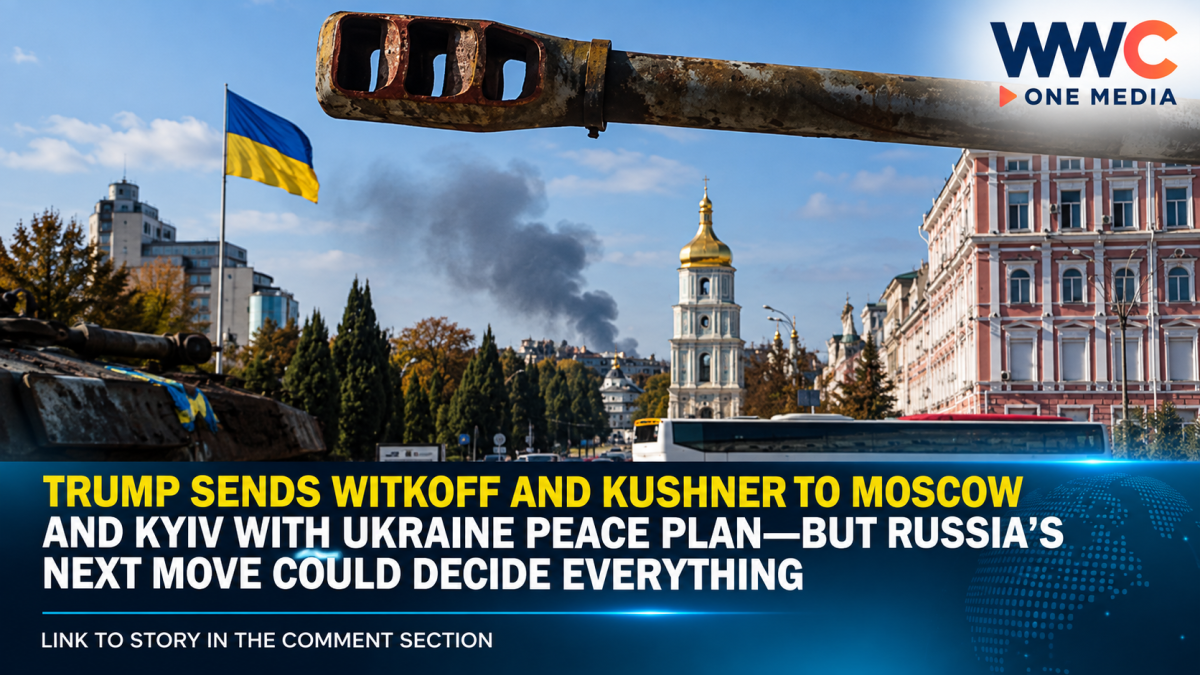
MOSCOW/KYIV — September 5, 2026 — A new U.S. diplomatic push to end Russia’s war in Ukraine is underway, but hopes for a breakthrough remain uncertain as American envoys Steve Witkoff and Jared Kushner arrived in Moscow with a proposal from President Donald Trump aimed at ending the conflict.
The visit comes at a particularly tense moment. Russian and Ukrainian forces continue exchanging drone and missile attacks even as Washington attempts to restart negotiations that have stalled in recent months.
Trump has described the proposal as a plan to “end the war,” but the administration has not publicly released its detailed terms.
The biggest questions—including how the proposal addresses territory, security guarantees and the future of Ukraine—remain unanswered.
And that uncertainty could make the meetings in Moscow and Kyiv among the most consequential diplomatic encounters of the latest phase of the war.
Witkoff and Kushner land in Moscow
Witkoff and Kushner arrived in Moscow on Saturday, where they were met by Russian presidential envoy Kirill Dmitriev, according to people familiar with the visit cited by Reuters.
The two American representatives are expected to hold discussions with Russian officials before traveling to Kyiv on Sunday, according to Ukrainian President Volodymyr Zelenskyy and reporting from multiple outlets.
The Moscow stop is significant because Witkoff has previously held discussions with Russian officials, but this latest mission is part of a broader effort by Washington to revive a peace process that has struggled to gain traction.
Kushner, meanwhile, is Trump’s son-in-law and has been involved in the administration’s diplomatic efforts.
Trump said Friday that the pair were carrying a concrete proposal, although he declined to disclose whether the plan would require Ukraine to give up territory.
“We have an idea for peace.”
Trump also expressed optimism that the effort could produce progress.
Russia remains deeply skeptical
The diplomatic mission is taking place against a backdrop of considerable pessimism in Moscow.
People familiar with Kremlin thinking told Bloomberg that expectations for a breakthrough were extremely low, with Russian officials reportedly seeing little reason to believe the latest American initiative would produce an agreement acceptable to Moscow.
The fundamental disagreements are enormous.
Russia has continued to press territorial demands involving Ukrainian regions it claims, while Ukraine has rejected surrendering territory and continues to seek security guarantees.
Those unresolved issues have repeatedly complicated previous attempts to reach a settlement.
Russian President Vladimir Putin, however, recently suggested that a peace agreement remains possible.
At an economic forum in Russia’s Far East on Thursday, Putin said there was a chance for a settlement and expressed appreciation for countries—including the United States and China—that were attempting to contribute to the process.
That creates a potentially important opening for the American delegation—but it does not guarantee an agreement.
Zelenskyy offers a temporary air-truce
Ukraine has also made a significant gesture ahead of the American delegation’s arrival.
Zelenskyy said Ukraine would refrain from launching airstrikes during the envoys’ diplomatic mission and called on Russia to reciprocate.
The goal is to create enough calm for the negotiations to take place without the immediate threat of long-range attacks undermining the mission.
Reports from Ukrainian media also said Ukrainian military units were ordered to observe a temporary halt in fighting from September 5 through September 8.
But there is a major complication:
Russia has not clearly committed to matching the pause.
That leaves the diplomatic mission unfolding while the battlefield remains active.
Russian strike hits Ukraine’s intelligence headquarters
Just before the American envoys’ arrival, a Russian drone struck the headquarters of Ukraine’s Security Service, or SBU, in central Kyiv.
Ukrainian officials said the attack injured people and damaged the building. AP reported that 12 people were injured, while Reuters described the strike as a significant escalation because of the importance and location of the target.
The timing immediately raised questions in Kyiv.
The attack occurred only days before the planned visit by Witkoff and Kushner, prompting Ukrainian officials to accuse Moscow of undermining diplomatic efforts.
Russia, meanwhile, has continued carrying out long-range attacks across Ukraine, while Ukraine has increased its own strikes against targets inside Russia, including energy infrastructure and fuel facilities.
Ukraine is also under pressure to pause its attacks
The temporary air pause is not simply a Ukrainian gesture.
The United States wants to create a safer environment for its diplomats as they move between Moscow and Kyiv.
Reports indicate Washington has sought reciprocal restraint from both sides during the envoys’ mission, including a reduction in strikes that could threaten the diplomatic process.
That makes the next several days especially sensitive.
Any major Russian or Ukrainian attack could undermine the atmosphere Washington is trying to create.
Why this diplomatic mission matters
The United States has attempted several times to move Russia and Ukraine toward negotiations.
Previous efforts have produced discussions but failed to resolve the core disputes.
The latest initiative comes after months of continued fighting and stalled diplomacy.
The front lines have remained relatively resistant to major changes, while both countries have increasingly relied on long-range missiles and drones to strike targets far behind the battlefield.
The diplomatic challenge is therefore not simply convincing Russia and Ukraine to sit down.
It is finding terms that both sides can accept without believing they are surrendering their fundamental interests.
The territorial question remains the biggest obstacle
One of the most difficult issues will be territory.
Trump has previously floated proposals involving territorial concessions, but he has not publicly confirmed whether the current proposal requires Ukraine to surrender land.
When asked Friday whether the plan involved territorial concessions, Trump declined to provide details.
For Kyiv, that is a critical issue.
Ukraine has consistently opposed recognizing Russian sovereignty over territories seized during the war.
For Moscow, territorial control remains central to its negotiating position.
That leaves the American envoys facing one of the hardest questions in the entire peace process:
What would Russia accept—and what would Ukraine actually be willing to sign?
The next stop is Kyiv
After their Moscow meetings, Witkoff and Kushner are expected to travel to Kyiv on Sunday.
It will be their first visit to Ukraine during this latest diplomatic effort, according to Ukrainian officials and international reporting.
That makes the sequence of the trip particularly important.
The envoys will hear Russia’s position first before taking the diplomatic effort directly to Ukraine.
What they learn in Moscow could shape the discussions in Kyiv.
And what they hear from Zelenskyy could determine whether Trump’s proposal has any realistic path forward.
A breakthrough—or another diplomatic dead end?
For now, there is reason for both cautious optimism and skepticism.
Putin has acknowledged that a settlement is possible.
Trump believes his representatives have a proposal worth taking directly to both capitals.
Zelenskyy has offered a temporary pause in air operations to facilitate the talks.
But the underlying disputes remain unresolved, while attacks continue.
That means the arrival of the U.S. envoys in Moscow is not evidence that a peace agreement is imminent.
It is evidence that Washington is making another serious attempt to reopen a diplomatic channel.
The real test comes next.
If Moscow rejects Trump’s proposal, the peace effort could quickly stall again. If Russia and Ukraine find enough common ground to continue negotiations, however, this weekend could mark the beginning of a very different chapter in the war.
And that is why all eyes are now turning from Moscow to Kyiv—and to what Putin and Zelenskyy say next.
WWC ONE MEDIA M.J.E
Leave a Reply