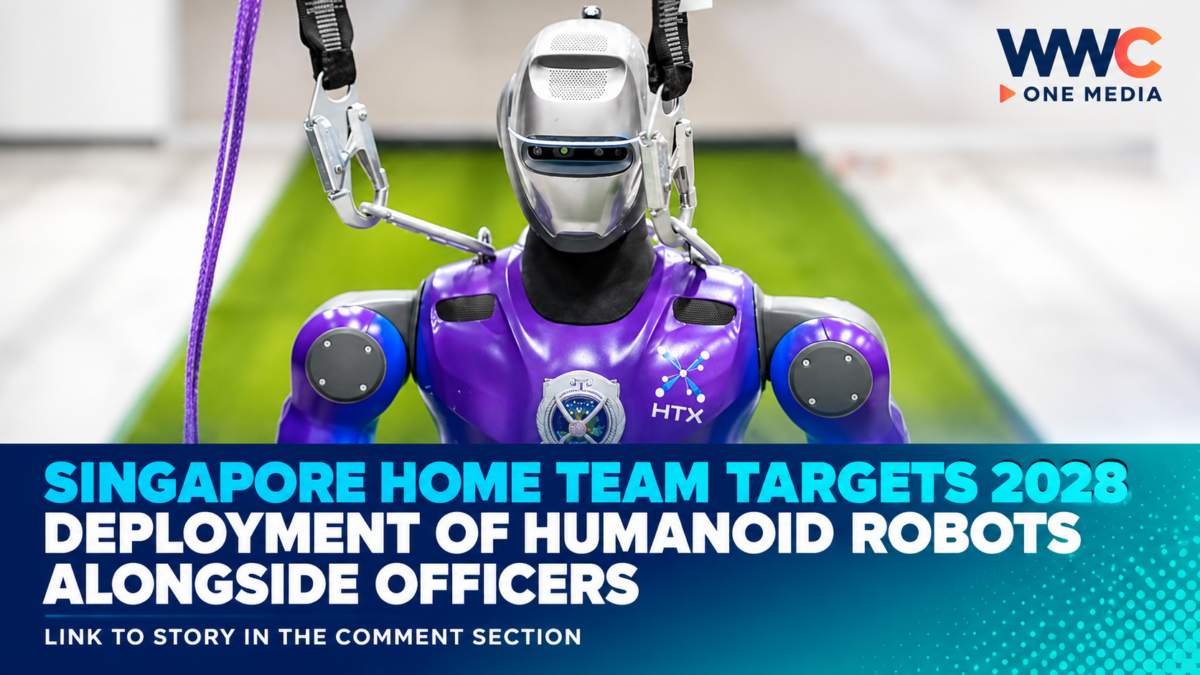
Singapore’s Home Team is targeting 2028 for the deployment of its first humanoid robot alongside officers in real-world operations, as the government expands the use of artificial intelligence and robotics for public safety.
The Home Team Science and Technology Agency officially opened the Home Team Humanoid Robotics Centre, or H2RC, on September 30. The 29,000-square-foot facility in One-North is designed to develop and train humanoid robots for routine, physically demanding and dangerous tasks.
Second Minister for Home Affairs and Minister for Law Edwin Tong said the goal is to have the first humanoid robot working with Home Team officers in an operational setting by 2028, performing defined tasks safely and reliably. The initiative is intended to support officers rather than replace them.
Potential applications include hazardous-material operations by the Singapore Civil Defence Force, where robots could enter contaminated areas, identify hazards and collect samples while reducing officers’ exposure to dangerous substances.
The Singapore Police Force could also use humanoid robots in post-blast investigations. The machines are being trained to move through unstable debris and recover evidence after explosions, including tasks that could expose human officers to secondary hazards.
Another potential application is prison operations. Robots could assist the Singapore Prison Service with routine cell searches and contraband detection, allowing prison officers to spend more time on duties requiring human interaction, judgment and rehabilitation work.
The centre will also explore less hazardous but repetitive tasks, including restocking emergency medical supplies in ambulances. HTX said the humanoid form was selected because robots can operate in environments designed for people and use equipment already intended for human workers.
H2RC will serve as a testing and collaboration platform for government agencies, companies, universities and research institutions. Its facilities include motion-capture systems, teleoperation equipment, human demonstration tools and simulated environments that allow engineers to collect data and train embodied AI systems.
The project is part of Singapore’s broader effort to use technology to address manpower constraints while improving operational safety. Officials said the country’s ageing workforce and increasingly complex operating environment make technology an important part of future public safety operations.
HTX is also working with ST Engineering under a new memorandum of understanding covering robotics research and development, technology and platform integration, industry and academic partnerships, and cybersecurity. The centre is designed to remain open to multiple technology platforms as the robotics industry develops.
Before any operational deployment, the robots will undergo trials and validation focused on reliability and cybersecurity. HTX said the development process will begin with individual capabilities before moving toward more complex missions involving embodied AI that can perceive, reason and act in changing environments.
The planned 2028 deployment would mark a significant step in Singapore’s use of humanoid robotics, moving the technology from controlled demonstrations toward defined public safety tasks alongside human officers.