
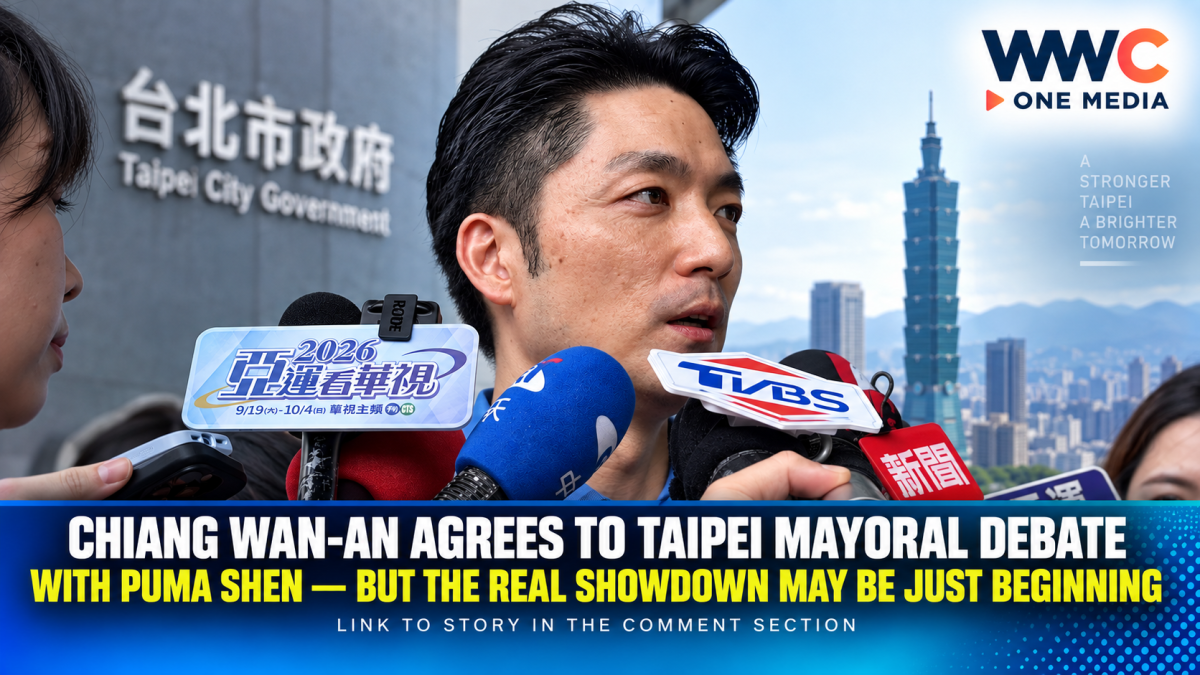
Taipei’s mayoral race is entering a more confrontational phase.
Incumbent Taipei Mayor Chiang Wan-an of the Kuomintang (KMT) and Democratic Progressive Party (DPP) candidate Puma Shen have both expressed willingness to participate in a televised debate as the November 28 local elections draw closer.
But while Chiang has indicated that he will take part in the officially organized debate, Shen is demanding something more than the traditional candidate-by-candidate format.
The DPP challenger wants the candidates to directly question each other, follow up on their opponents’ answers and allow Taipei residents to ask questions — setting the stage for a potentially much sharper confrontation over the city’s future.
Chiang says he will participate
Chiang confirmed during the final stage of candidate registration that he had selected the option to participate in a debate.
His decision opens the possibility of a direct public confrontation with Shen, who has repeatedly challenged the incumbent to debate his record and policies.
TVBS reported that Chiang said he would have someone complete his registration on his behalf and that he would select the debate option. He also pointed to the 2022 Taipei mayoral election, when Taipei was the only one of Taiwan’s six special municipalities to hold a debate among the main candidates.
Candidate registration for Taiwan’s November 28 local elections closed Friday, September 4.
According to Taiwan News, Chiang and Shen are the two major contenders in the Taipei mayoral race, alongside four other candidates.
Puma Shen wants more than prepared statements
For Shen, simply appearing on the same stage is not enough.
During a visit to Taipei’s Nanmen Market on Saturday, he argued that a conventional format in which candidates deliver separate statements would represent only the minimum level of public accountability.
Shen said voters should be able to see the candidates directly challenge one another.
His preferred format would begin with each candidate delivering a three-to-five-minute opening statement, followed by questions and answers for the remainder of the debate.
He also wants candidates to be able to ask each other questions and pursue follow-up questions, while giving citizens an opportunity to question the candidates directly.
That demand could become one of the first major tests of how aggressively the two campaigns are prepared to confront each other.
The debate issue has been building for weeks
The debate dispute is not entirely new.
Shen previously called for regular policy debates with Chiang while criticizing the incumbent’s response to questions over Taipei’s controversial Xinyi District pedestrian-shade project.
In August, Shen argued that Chiang should hold regular debates on city governance and said residents deserved direct answers about major municipal projects.
At the time, Chiang argued that he was already addressing residents’ concerns through his daily activities.
The latest developments, however, mean that Chiang has now indicated his willingness to participate in the officially organized debate.
Why this matchup matters
The Chiang-Shen contest is shaping up as one of the most closely watched races in Taiwan’s 2026 local elections.
Chiang, a KMT incumbent, is seeking another term after becoming Taipei mayor in 2022.
Shen, a DPP legislator and prominent figure in Taiwan’s civil-defense movement, was formally selected by the DPP in May to challenge Chiang.
Their political approaches also differ sharply.
Shen has presented a policy platform centered on areas including housing, transportation, childcare, long-term care, youth development and urban governance.
His campaign has branded the framework “HEART,” standing for Habitat, Empower, Accompany, Resilience and Time.
He has also proposed measures specifically targeting younger Taipei residents, including an urban youth fund that would provide monthly contributions to eligible young people aged 18 to 22.
From city policy to cross-strait relations
The Taipei race is also likely to touch on issues extending beyond municipal services.
Shen has taken a tougher position on Taipei’s relationship with Chinese cities, including proposing that the city end the Taipei-Shanghai Twin City Forum if he becomes mayor.
He has argued that the forum provides limited practical benefits and could create channels for Chinese influence operations.
Chiang, meanwhile, has defended continued exchanges, citing the importance of maintaining communication across the Taiwan Strait.
That means a future debate could extend well beyond roads, housing and public services.
Voters may also hear sharply different visions for Taipei’s relationship with China, international cities and Taiwan’s broader security environment.
The format could become the first battle
The most immediate question is not whether Chiang and Shen will debate.
It is how they will debate.
Chiang has signaled participation in the election commission’s official debate, while Shen wants a format that allows sustained back-and-forth questioning.
Mirror Media reported that Shen described an official debate as the minimum expected from candidates but emphasized that genuine debate requires direct questioning, follow-ups and opportunities for citizens to participate.
That difference could become politically significant.
A traditional debate gives candidates greater control over their prepared messages.
A question-and-follow-up format creates more opportunities for candidates to challenge claims, expose inconsistencies and force opponents to respond in real time.
Taipei voters will be watching
With candidate registration now closed and election day set for November 28, the Taipei mayoral contest is moving into a more intense campaign phase.
The debate could become one of the campaign’s biggest moments.
For Chiang, it will be an opportunity to defend his record as incumbent mayor.
For Shen, it will be a chance to demonstrate that his challenge is about more than criticizing the current administration and that he has a detailed alternative vision for Taipei.
And if Shen gets the direct, question-heavy format he is demanding, the candidates may have far less room to rely on prepared talking points.
Chiang has said yes to the debate. Shen wants the real confrontation.
Now Taipei is waiting to see whether the two candidates will simply share a stage — or finally go head-to-head.


Leave a Reply