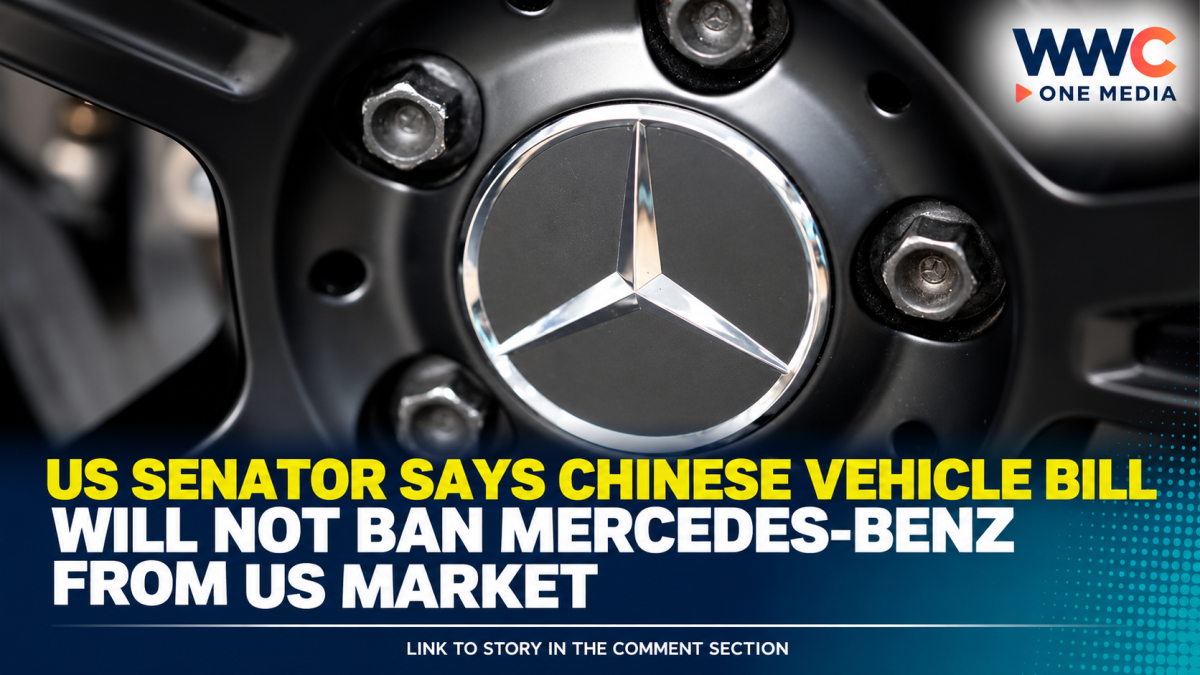
A Republican US senator sponsoring legislation aimed at restricting Chinese-owned vehicle companies said discussions are continuing to ensure Mercedes-Benz will not be barred from selling vehicles in the United States.
Senator Bernie Moreno said the intention of the bill is not to prevent Mercedes-Benz from operating in the US, despite the German automaker having nearly 20% passive ownership from Chinese entities. The proposed legislation would generally prohibit companies with more than 15% Chinese ownership from selling vehicles in the US.
The Senate Commerce Committee approved the measure in July. Moreno said lawmakers are examining possible changes that would allow affected companies to comply with the ownership threshold without causing major disruptions to their businesses. He said he hopes to secure fast-track Senate approval while discussions with Republican Senator Rand Paul continue.
Paul has criticized the provision, arguing that it unfairly targets Mercedes-Benz. He has indicated that he could support moving the legislation forward if the company-specific issue is addressed.
The legislation could also affect other automakers with significant Chinese ownership. Moreno said lawmakers are discussing how Volvo Cars, which is majority-owned by China’s Geely Holding, could continue selling vehicles in the US. Aston Martin, which has a 17% stake held by Geely, and Britain’s Lotus, which is majority-owned by Geely, could also face restrictions under the proposed ownership threshold.
The bill is part of broader US efforts to restrict Chinese influence in the American automotive and connected-vehicle market. Existing rules introduced under the Biden administration effectively prevent Chinese automakers from selling or producing passenger vehicles in the US because of concerns about sensitive vehicle and driver data. The US also maintains tariffs of more than 100% on Chinese electric vehicles.
The proposed legislation has gained substantial congressional support. A House version has more than 100 co-sponsors, while lawmakers supporting the Senate measure have been seeking to move it through Congress before the end of the year.
The debate comes as the US considers how to balance national-security concerns surrounding connected vehicles with the operations of international automakers that have Chinese investors. China has criticized US restrictions on its automotive industry, arguing that such measures undermine fair competition.
For now, the legislation remains under discussion, with lawmakers working on provisions that could determine how companies such as Mercedes-Benz and other automakers with Chinese ownership would be treated if the measure becomes law.