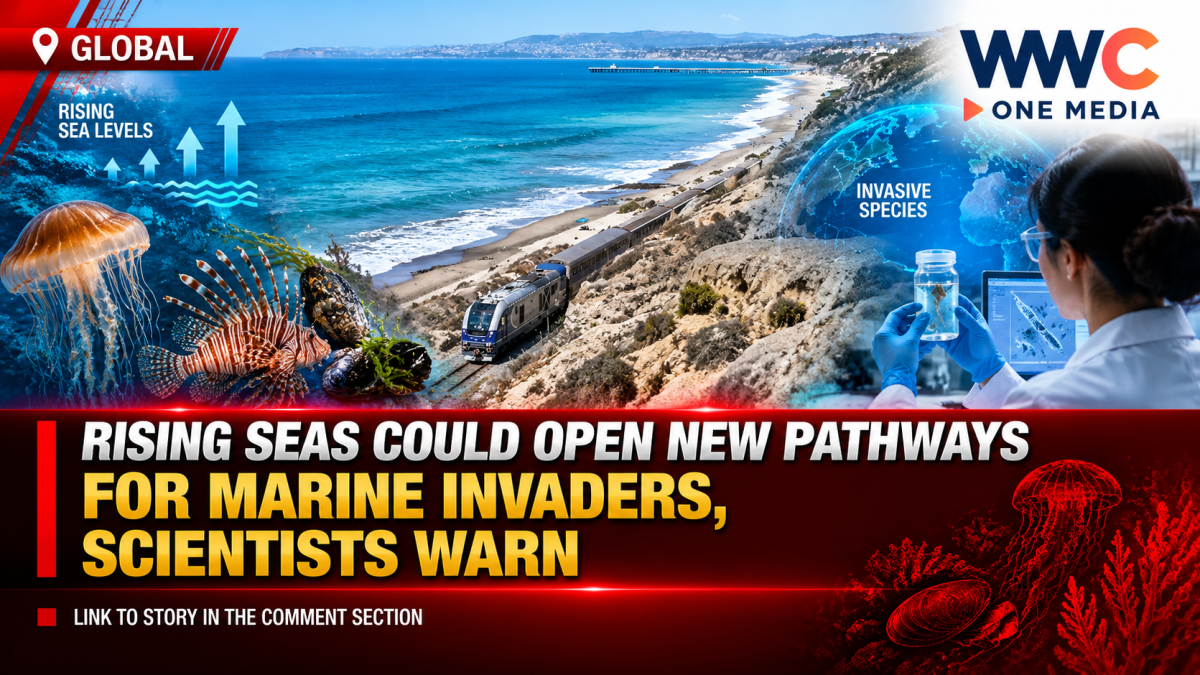
Climate-driven sea-level rise could do more than flood coastlines—it may also create new routes for invasive marine species to spread into areas that have never faced them before, researchers warn.
A new study published in Nature Ecology & Evolution has highlighted a potentially overlooked consequence of rising seas: newly flooded coastal areas could become suitable habitats for established non-native marine animals, increasing risks to biodiversity and some economic activities.
Researchers modelled the potential future distribution of 122 established non-native marine species, including fish, crustaceans, molluscs and sea stars, under different climate and sea-level scenarios.
Under a scenario involving moderate greenhouse-gas emissions, global sea levels are projected to rise by about 20 centimetres by 2050 and 56 centimetres by 2100.
That could result in roughly 360,000 square kilometres of coastal land being flooded by 2050, increasing to around 550,000 square kilometres by the end of the century, according to the study’s projections.
More than two-thirds of those newly flooded areas—estimated at approximately 290,000 to 470,000 square kilometres—could potentially become suitable for the marine species examined.
Estuaries Could Become Critical Front Lines
Researchers identified estuaries as particularly vulnerable because they connect directly to the ocean while also serving as major centres of human activity.
As sea levels advance, these environments could provide what researchers describe as stepping stones for invasive species to move farther inland.
Study co-author Xuan Liu of Beijing Normal University said the changes could potentially expose ecosystems and human activities that have not previously been affected by these species.
The projected risk is concentrated in several regions, including the eastern United States, Gulf of Mexico, North Sea, Gulf of Guinea, Arabian Gulf, northern Bay of Bengal, southeastern China and northern Australia.
Some of the species examined are already established in Europe, including the Pacific oyster, Atlantic blue crab and veined rapa whelk, a predatory marine snail.
A Growing Climate and Biodiversity Challenge
The findings underline how climate change and biodiversity loss can interact rather than unfold as separate environmental problems.
Rising temperatures and changing coastlines can alter habitats, potentially giving non-native species opportunities to establish themselves in places where they previously could not survive.
The researchers’ projections come as governments prepare for major international discussions on climate change and biodiversity, including COP17 in October and COP31 in November.
The economic stakes are already substantial. A global assessment by the UN-backed IPBES estimated that the economic costs associated with biological invasions exceeded US$423 billion in 2019.
With coastlines changing and sea levels continuing to rise, scientists say the challenge may no longer be simply keeping invasive species out—but understanding where the next invasion fronts could emerge.
WWC ONE MEDIA G,A