
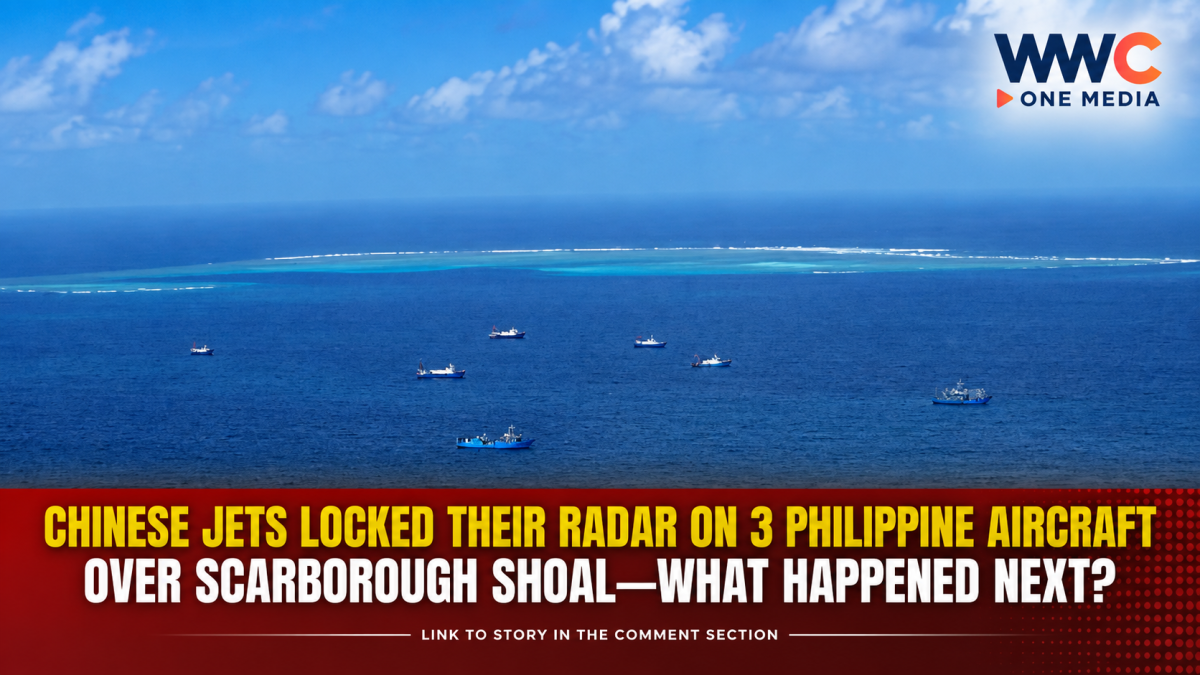
MANILA, Philippines — Tensions in the West Philippine Sea have taken a more dangerous turn after armed Chinese military aircraft reportedly locked their radar systems onto three Philippine aircraft during an encounter over the disputed Bajo de Masinloc, also known as Scarborough Shoal, on September 2.
The incident involved at least three Chinese JL-10 advanced trainer aircraft carrying live PL-5 short-range air-to-air missiles, according to footage released by the People’s Liberation Army (PLA) Southern Theater Command. The video showed the Chinese aircraft identifying and tracking three Philippine planes: a BN-2A Islander, a C-208 single-engine turboprop and a PA-31T twin-engine turboprop.
One of the most striking portions of the footage showed an electronic targeting display with a green crosshair tracking a Philippine aircraft.
The Chinese military also broadcast a warning telling the Philippine aircraft that they had allegedly entered what Beijing calls the territorial airspace of Huangyan Dao, China’s name for Scarborough Shoal, and ordered them to leave.
The Philippines, however, does not recognize China’s sovereignty claim over the shoal.
A sharper military signal
What makes the latest encounter particularly significant is that the Chinese aircraft were not merely conducting a routine surveillance mission.
The JL-10s shown in the footage were armed with live air-to-air missiles. The PLA described the operation as a combat-readiness patrol around Scarborough Shoal, while Chinese military messaging said the patrols were intended to strengthen control of the surrounding sea areas and airspace.
The South China Morning Post reported that the use of armed trainer aircraft could represent a more cost-effective method for China to confront the Philippines’ slower-moving turboprop aircraft, rather than repeatedly deploying more expensive frontline fighter jets.
That distinction matters.
The aircraft involved on the Philippine side are relatively light utility or surveillance platforms. The Chinese JL-10, meanwhile, is a military trainer capable of carrying air-to-air weapons.
The encounter therefore places two very different classes of aircraft in the same increasingly tense operating environment.
China expands its military presence around the shoal
The PLA footage did not show only JL-10 aircraft.
USNI News reported that the Chinese patrol also involved a broader mix of military assets, including a Type 052C destroyer, other naval vessels, J-16 fighter aircraft and an H-6 bomber.
That broader deployment gives the September 2 encounter greater significance than an isolated aircraft interception.
It demonstrates that China’s military presence around Scarborough Shoal increasingly involves coordinated air and naval operations.
The PLA Southern Theater Command has described these patrols as measures to protect what China considers its territorial sovereignty and to counter what it calls provocative or rights-violating activities.
For Manila, however, the situation is part of a much larger dispute over China’s increasingly assertive activities in the West Philippine Sea.
Scarborough Shoal remains a major flashpoint
Scarborough Shoal has been under effective Chinese control since 2012 and remains one of the most sensitive flashpoints between Beijing and Manila.
The Philippines continues to reject China’s sweeping claims in the South China Sea and maintains that its maritime rights must be determined under international law.
The 2016 arbitral ruling in the Philippines’ favor rejected the legal basis of China’s expansive historic-rights claim within the so-called nine-dash line. Beijing has repeatedly rejected the ruling.
The dispute has nevertheless continued on the water—and increasingly in the air.
In July, the Philippines also filed its territorial sea baselines for the relevant areas with the United Nations, adding another layer to the ongoing legal and diplomatic contest.
This is not China’s first dangerous encounter with Philippine aircraft
The latest radar-lock incident also comes against the backdrop of previous confrontations involving Chinese military aircraft and Philippine patrol planes.
In August 2024, the Philippines accused Chinese military aircraft of flying dangerously close to a Philippine Air Force NC-212i aircraft and releasing flares in its path over Scarborough Shoal.
Philippine officials condemned the maneuver as dangerous, while China said the Philippine aircraft had entered airspace that Beijing claimed around the shoal.
The pattern shows how the South China Sea confrontation is no longer limited to coast guard ships and maritime patrols.
Aircraft are increasingly becoming part of the pressure campaign.
More Chinese vessels were already operating in the West Philippine Sea
The latest air confrontation also comes as the Philippines monitors a significant Chinese maritime presence in the region.
The Philippine News Agency reported that the Armed Forces of the Philippines detected 56 Chinese warships and coast guard vessels across four key areas of the West Philippine Sea during August.
That figure provides important context for the aircraft encounter.
The September 2 radar-lock incident did not occur in isolation. It happened amid a broader increase in Chinese military and maritime activity around contested Philippine waters.
Why the radar lock matters
A radar lock is more serious than simply detecting another aircraft.
In military aviation, an aircraft can use radar to search for and track another aircraft. A fire-control or targeting function can represent a much more direct indication that the tracked aircraft is being treated as a potential target.
That does not automatically mean an attack was imminent.
There is no indication from the reports that weapons were fired during the September 2 encounter, and no casualties or damage were reported.
But the combination of armed aircraft, radar tracking and direct radio warnings raises the risk of an accident or miscalculation.
That is precisely what makes encounters like this dangerous.
The bigger question now
The immediate incident may be over, but the strategic implications are harder to dismiss.
An analysis published by the East Asia Institute described the deployment of armed JL-10 aircraft around Scarborough Shoal as evidence that competition in the South China Sea is increasingly moving into the air domain, not just the maritime space.
For the Philippines, the challenge is becoming increasingly complex: Philippine aircraft continue operating in areas Manila considers within its lawful maritime rights, while China is simultaneously attempting to reinforce its physical control and its own claims over the surrounding waters and airspace.
That creates a dangerous operating environment in which a close encounter, radar lock, warning maneuver or miscommunication could escalate far faster than either side intends.
For now, the September 2 incident ended without shots being fired.
But the message from the skies over Scarborough Shoal is unmistakable: the contest between Manila and Beijing is becoming more militarized—and increasingly, the next confrontation may happen above the sea rather than on it.
WWC ONE MEDIA J.M.S




Leave a Reply