
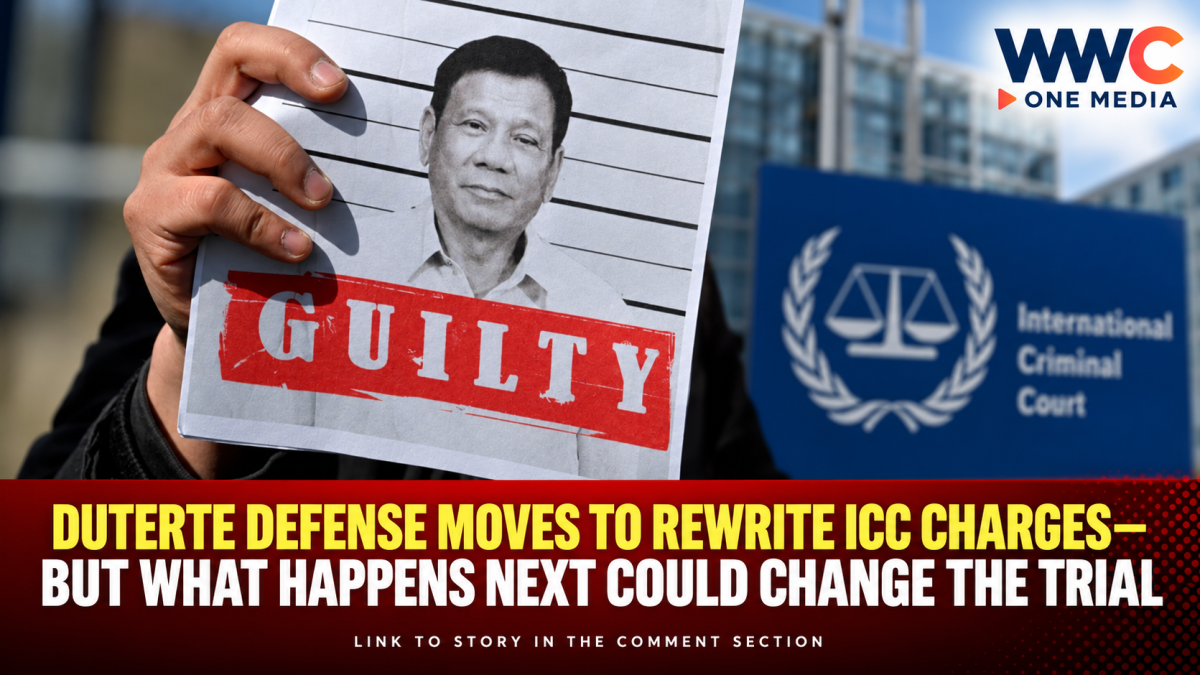
THE HAGUE — Former Philippine President Rodrigo Duterte’s legal team has asked the International Criminal Court (ICC) to order prosecutors to refile the charges against him, arguing that the current charging document does not clearly define the specific acts he must defend against.
The defense motion, dated August 31 and led by British lawyer Peter Haynes, argues that the prosecution’s description of the alleged crimes remains too broad because it identifies incidents as “illustrative” and “non-exhaustive.”
The lawyers contend that this creates what they describe as a “moving target” for the defense and could undermine Duterte’s right to be informed in detail of the nature, cause and content of the charges.
The request does not mean the ICC has dismissed the case or agreed to alter the charges. It is a defense motion asking Trial Chamber III to require the prosecution to submit a new charging document with clearly defined counts and an exhaustive list of the acts underpinning those counts.
Defense questions scope of ICC charges
The dispute centers on how the prosecution has structured its case.
The ICC previously confirmed three counts of crimes against humanity against Duterte. According to the defense and reports on the filing, the charges initially identified 49 incidents, grouped under three broad categories involving alleged killings during Duterte’s time as Davao City mayor and later as Philippine president.
The first count concerns alleged murder as a crime against humanity in Davao City during Duterte’s mayoral period.
The second involves alleged killings of so-called “high-value targets” in various parts of the Philippines during his presidency.
The third covers alleged murder and attempted murder during so-called barangay clearance operations across the country.
The defense says prosecutors subsequently notified them of eight additional incidents, bringing the number of identified incidents to 57.
For Duterte’s lawyers, the central problem is whether those incidents constitute the complete factual basis of the charges or merely examples of a much broader alleged pattern of criminal conduct.
The defense argues that if the incidents are merely examples, it could leave Duterte preparing for allegations involving other killings that are not specifically identified in the charging document.
Evidence volume becomes another major issue
Duterte’s lawyers have also raised concerns over the amount of evidence disclosed by prosecutors.
According to the defense filing reported by GMA News and Daily Tribune, the prosecution had disclosed roughly 5,000 items of evidence when the charges were confirmed, but that figure had risen to more than 25,000 items by the end of August — an increase of more than 400 percent.
The defense argues that the sheer volume of material could make it extremely difficult to review everything before the scheduled opening of trial.
The lawyers have separately challenged the ICC’s electronic evidence procedures, raising concerns about the authentication and reliability of materials submitted through the prosecution’s digital evidence system. Daily Tribune reported that the defense also questioned the possibility of manipulated, forged or otherwise unreliable material entering the evidentiary record.
The defense has therefore asked the court to ensure that the prosecution identifies precisely which acts form the basis of each charge.
ICC has already confirmed the case will proceed to trial
The defense challenge comes after a major ruling earlier this year.
On April 23, 2026, ICC Pre-Trial Chamber I unanimously confirmed all three crimes-against-humanity charges against Duterte and committed him to trial.
The ICC said the judges found substantial grounds to believe that Duterte was responsible for alleged crimes against humanity involving murder and attempted murder in the Philippines in the context of the so-called “war on drugs.”
The ICC’s official case information says the alleged crimes fall within the period from November 1, 2011, to March 16, 2019.
Duterte has denied wrongdoing and has maintained that his campaign against illegal drugs was aimed at fighting criminality. His defense has challenged several aspects of the ICC proceedings.
The ICC, meanwhile, emphasizes that Duterte is presumed innocent unless proven guilty beyond reasonable doubt.
November 30 trial remains the key date
Despite the latest defense motion, the ICC’s current schedule places the opening of Duterte’s trial on November 30, 2026.
The court has already constituted Trial Chamber III, composed of Presiding Judge Joanna Korner, Judge Keebong Paek and Judge Nicolas Guillou. Peter Haynes KC is listed as Duterte’s lead defense counsel, while Mame Mandiaye Niang is the ICC deputy prosecutor assigned to the case.
The chamber must now deal with pending procedural matters, including the defense’s challenge to the formulation of the charges and issues surrounding evidence disclosure.
That means the latest motion could become an important procedural battle before the trial itself begins.
What happens next?
The immediate question is whether ICC Trial Chamber III will grant Duterte’s request and require prosecutors to submit a substantially revised charging document — or reject the defense’s argument and allow the case to proceed under its existing framework.
Either way, the dispute goes to the heart of Duterte’s upcoming trial: exactly which alleged acts must prosecutors prove, and how specifically must those acts be identified before an accused can be required to defend himself?
For now, there has been no ICC ruling granting Duterte’s request to strike out or refile the charges.
The case remains active, Duterte remains in ICC custody in The Hague, and the scheduled November 30 trial remains the next major milestone.
WWC ONE MEDIA J.M.S



Leave a Reply