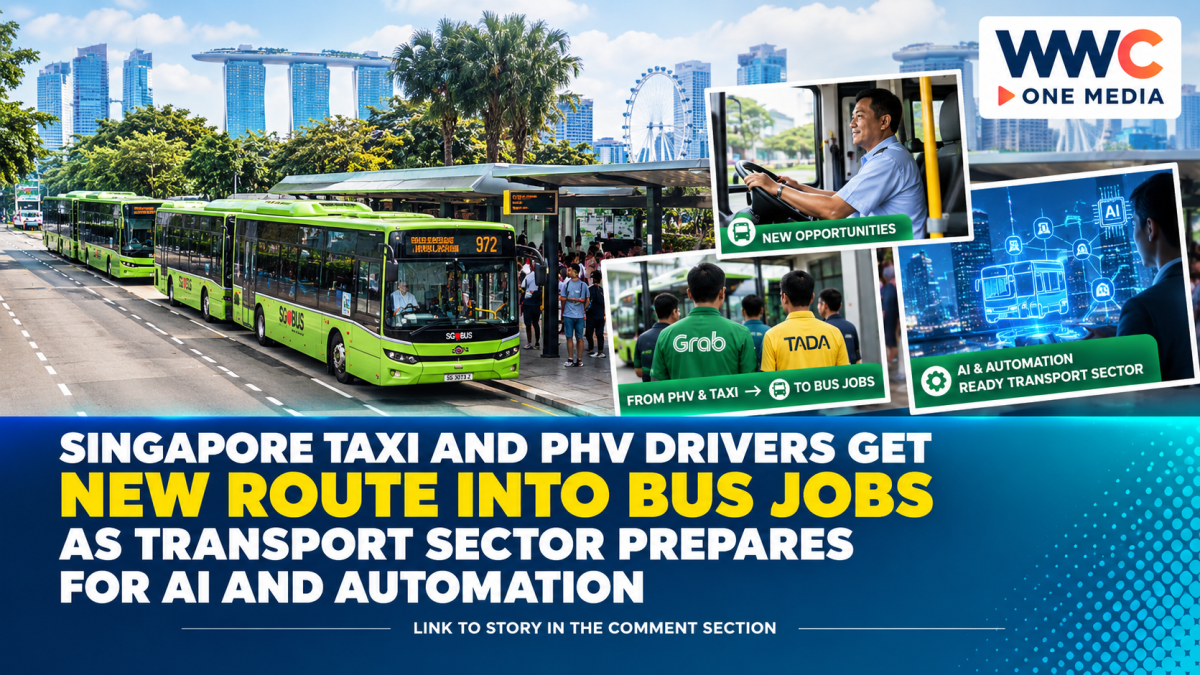
Singapore taxi and private-hire vehicle (PHV) drivers are being offered a new pathway into public bus driving, giving experienced drivers another career option as the country’s transport sector prepares for wider adoption of autonomous vehicles.
The initiative forms part of a manpower transition package announced by Singapore’s Ministry of Transport (MOT) in partnership with the Ministry of Manpower, NTUC, Grab Singapore and ComfortDelGro. The package is designed to help taxi and PHV drivers build new skills and move into other transport-sector roles.
From Taxi and PHV Driving to Bus Captain
Under the new pathway, drivers interested in moving into public transport can pursue training to become bus captains.
The initiative is being introduced as Singapore faces changing manpower needs across the transport sector. At the same time, the Government is progressively testing and adopting autonomous-vehicle technology.
The Ministry of Transport said the new pathway under the Career Conversion Programme (CCP) for Public Transport Professionals provides a customised route for drivers interested in becoming bus captains.
For drivers who already have substantial experience on Singapore’s roads, the pathway creates an opportunity to transfer existing driving experience into another part of the public-transport system.
Why the Government Is Creating New Driver Pathways
Singapore’s transport industry is undergoing a significant transition.
Autonomous vehicles are being introduced progressively, including trials involving driverless shuttle services. The Government has said the technology will eventually be scaled up to help meet Singapore’s growing transportation needs.
At the same time, Singapore faces manpower challenges in the public-transport sector.
Prime Minister Lawrence Wong said in his 2026 National Day Rally speech that the Government would not allow autonomous-vehicle adoption to move faster than its ability to retrain and support affected drivers.
That approach means the transition is not simply about introducing new technology. It also involves creating alternative employment opportunities for people whose livelihoods are connected to driving.
A New Career Option as Singapore’s Transport Landscape Changes
The new bus-driver pathway is part of a wider manpower package announced in July.
The package also includes training opportunities for drivers interested in moving into autonomous-vehicle-related roles. GrabAcademy, Grab’s training arm, has been onboarded as a registered training provider to deliver relevant training.
Drivers who want to move outside the transport sector can also tap other career-conversion programmes, the Mid-Career Pathways Programme and the SkillsFuture Career Transition Programme.
MOT and LTA are additionally planning a new training-incentive scheme focused on shorter courses, scheduled to begin in January 2027 and run for three years.
Bus Driver Demand Remains Part of the Picture
The push toward retraining comes as Singapore continues expanding its bus network.
The Government has been investing in additional bus services and improvements under the Bus Connectivity Enhancement Programme. Transport Minister Jeffrey Siow said in September that nearly S$1 billion is being invested to enhance bus services across Singapore.
So far, 37 new or extended bus services have been introduced under the programme, while 76 existing services have been strengthened. These improvements are benefiting more than 300,000 commuters daily, according to the minister.
The Government is also providing higher starting salaries and sign-on bonuses as part of efforts to attract more bus drivers.
What This Means for Singapore’s Drivers
For taxi and PHV drivers, the new pathway represents a shift from viewing driving jobs as a single career track to treating road experience as a skill that can transfer across different transport roles.
That is becoming increasingly relevant as Singapore balances three developments at once: growing transport demand, shortages of drivers and the gradual arrival of autonomous technology.
The strategy is designed to keep experienced workers connected to the transport sector while giving them opportunities to adapt as the industry changes.
Singapore’s taxi and PHV drivers have long been an important part of the country’s point-to-point transport network. Now, some of them could be behind the wheel of public buses instead.
And as autonomous vehicles move from trials toward wider deployment, the bigger question is how many traditional driving careers could be transformed by Singapore’s next phase of transport innovation.
WWC ONE MEDIA G,A