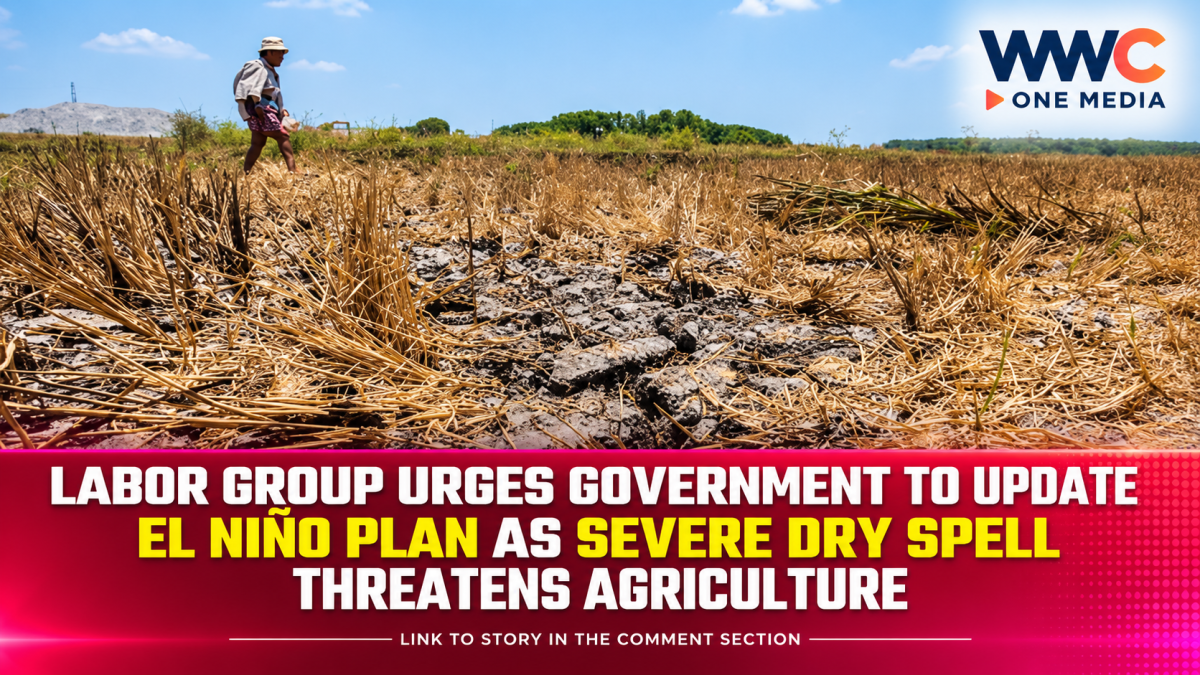
The Philippine government is being urged to update its national El Niño response plan as forecasts point to a potentially severe and prolonged dry spell that could threaten agriculture, food security, water supplies and household livelihoods.
A labor group called for the government to review and strengthen its existing preparations, arguing that the expected effects of the climate phenomenon could require measures beyond those included in previous contingency plans.
The call comes as authorities intensify preparations for El Niño. President Ferdinand Marcos Jr. has directed officials to ready the El Niño task force, with particular attention to protecting farmers and agricultural production. The Palace said the government is already coordinating with the National Irrigation Administration and encouraging farmers to consider drought-resistant crops and appropriate planting schedules.
The Philippine Atmospheric, Geophysical and Astronomical Services Administration has previously warned that the developing El Niño could bring drier-than-normal conditions and affect critical sectors including agriculture, water resources and energy. Earlier forecasts indicated that the phenomenon could persist into 2027.
The threat is significant because agriculture remains particularly vulnerable to prolonged heat and water shortages. During the previous El Niño episode, which lasted from July 2023 to June 2024, the Department of Agriculture estimated agricultural damage at about ₱15.3 billion, with crop losses reaching 784,344 metric tons.
Government agencies have already begun putting measures in place. The Department of Agriculture has said it is assessing irrigation systems, reviewing regional vulnerabilities and pre-positioning drought-tolerant seeds, fertilizer and irrigation assistance.
The agency is also encouraging farmers to adjust planting schedules and consider less water-intensive crops. Other preparations include climate-risk mapping, localized planning, crop insurance, credit access and market assistance.
The Department of Budget and Management has likewise said the government is not waiting until 2027 to respond. It said agricultural interventions have already been front-loaded under the Unified Package for Livelihoods, Industry, Food and Transport framework, including additional support for farm inputs and efforts to help farmers adjust their planting calendars.
Food security is another major concern.
Earlier projections from the Agriculture Department indicated that Philippine rice imports could reach 4.8 million metric tons this year as rising fuel and fertilizer costs combine with the threat of weaker domestic production. The department had also warned that second-season rice output could suffer substantial losses under a severe El Niño scenario.
The potential impact extends beyond farms. Lower water levels could affect irrigation, drinking-water supplies and electricity generation, while higher temperatures could increase electricity demand as households and businesses use more cooling equipment.
The Energy Department previously projected that the El Niño dry spell could contribute to additional grid alerts, particularly in the Visayas and Mindanao, where tighter power reserves could increase the risk of supply disruptions.
Water security is therefore emerging as another key component of the country’s preparations. Earlier in the year, the Climate Change Commission urged local governments to incorporate drought, El Niño and water scarcity into their local climate and development plans. It also recommended measures such as rainwater harvesting, watershed protection, improved early-warning systems and stronger community preparedness.
The renewed call for an updated national plan comes as government preparations are taking place across several agencies. Agriculture officials are working on farm interventions, irrigation agencies are assessing water availability, energy authorities are examining power-system risks and disaster-management agencies are preparing broader response measures.
The challenge is coordinating those efforts before the most severe effects are felt.
An updated El Niño strategy could also have implications for workers and low-income households if drought pushes up food prices, reduces agricultural employment or increases household expenses for water and electricity. These effects could extend well beyond rural communities if lower farm output contributes to tighter food supplies.
The government has already established that the coming dry spell requires early action. The latest push to update the national plan reflects growing concern that preparations must keep pace with the changing forecasts and the potential scale of the phenomenon.
With authorities now preparing for an El Niño that could intensify toward the end of 2026 and persist into the first half of 2027, the focus is shifting from monitoring the weather to ensuring that irrigation, food supply, power, water management and social protection measures are ready before conditions deteriorate further.