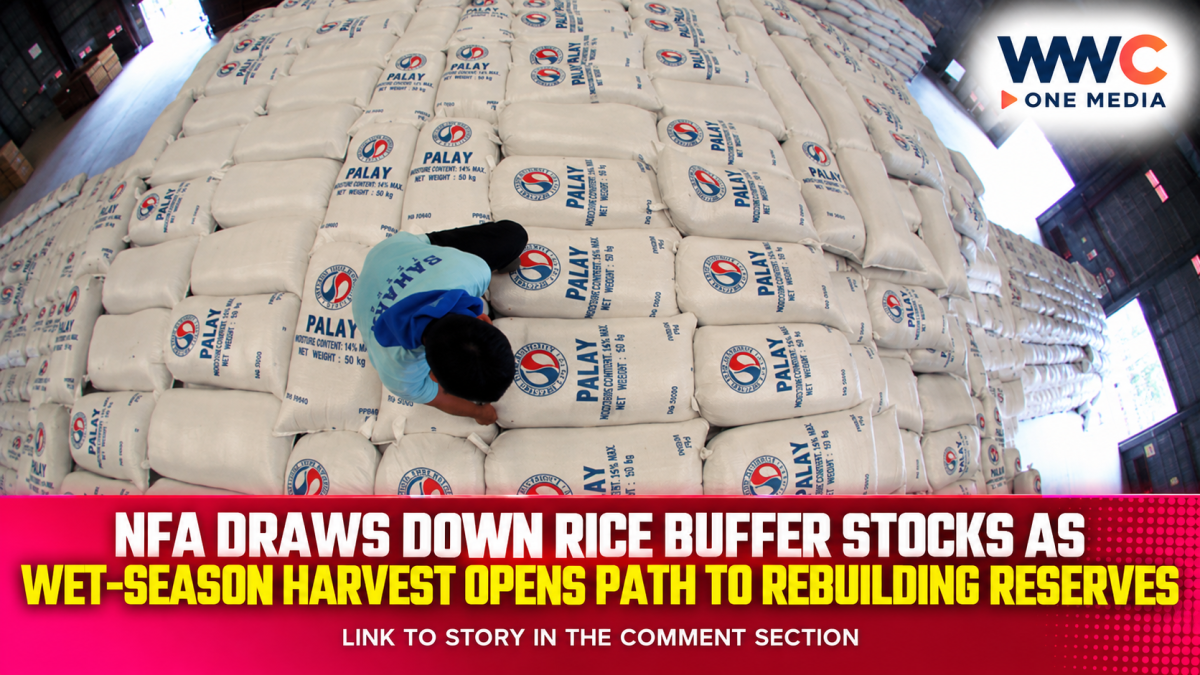
MANILA — The National Food Authority is drawing down its rice buffer stocks to make room for the incoming wet-season harvest, with the government preparing to replenish its reserves as more locally produced palay becomes available.
The move comes as the NFA balances two competing needs: releasing rice stocks for government programs while ensuring its warehouses have enough capacity to absorb the next major harvest.
As of Sept. 18, the NFA had an expected milled-rice inventory of 278,444 metric tons, equivalent to about seven days of its daily consumption requirement. From January through September, the agency had procured 92,032 metric tons of palay while distributing 207,648 metric tons of rice.
The agency has been clearing older inventory ahead of the main wet-season harvest. It recently auctioned nearly 39,600 metric tons of aging rice stocks, generating an estimated ₱1.1 billion while freeing warehouse space for newly harvested palay.
The timing is significant because the NFA is expected to substantially increase procurement during the September-to-November harvest period. The agency is targeting around 592,000 metric tons of palay purchases for the full year, although that would remain below its original 790,000-metric-ton target for 2026.
To encourage farmers to sell to government warehouses, the NFA has set a buying price of ₱22 per kilogram for wet palay and ₱27 per kilogram for dry palay during the wet-season harvest. The agency expects the current harvest to provide much of the additional volume needed to rebuild its buffer stocks.
The NFA is also introducing a purchase-order system for locally produced palay. Under the new arrangement, farmers and eligible farmers’ organizations can formalize procurement commitments before bringing their harvest to NFA facilities, allowing the agency to better plan storage, drying operations and funding requirements.
The new system is also intended to improve traceability and ensure that procured palay meets required quality and documentation standards. Individual farmers can currently deliver up to about 200 bags, or 10,000 kilograms, although the ceiling could be adjusted later.
The rebuilding of government rice reserves comes as national rice inventories have also declined. The Philippine Statistics Authority estimated total rice stocks at 2.18 million metric tons as of Aug. 1, down 6.3% from a year earlier and 13.3% from the previous month. Stocks held in NFA depositories were down 32.2% year on year.
The NFA’s buffer stocks are particularly important during emergencies, disasters and periods when market supplies become disrupted. The government has also been using its rice inventory to support subsidized rice initiatives, including the Benteng Bigas, Meron Na! program.
Storage capacity is therefore becoming just as important as procurement. The NFA said it has committed ₱10.363 billion for 36 modern facilities and the rehabilitation of 128 warehouses, with 100 of those facilities already repaired or rehabilitated. It has also inaugurated a modern grain facility in Iloilo and secured a Japanese grant for a rice-processing project in Cauayan.
The agency’s strategy reflects a shift toward replenishing government reserves during the harvest season while moving older stocks into distribution or disposal channels before new palay arrives.
For farmers, the government’s procurement prices and expanded purchasing activity could provide another outlet during the harvest period. For consumers, rebuilding the NFA’s reserves could strengthen the government’s ability to respond when supply disruptions, disasters or sudden market pressures affect rice availability.
But the scale of the rebuilding effort will depend on how much palay the NFA can actually procure during the remaining months of the year, how quickly newly purchased stocks can be processed and stored, and how much rice continues to be released through government programs.
The bigger issue now is whether the incoming harvest will allow the NFA to rebuild a stronger rice buffer while continuing to support consumers and farmers at the same time.