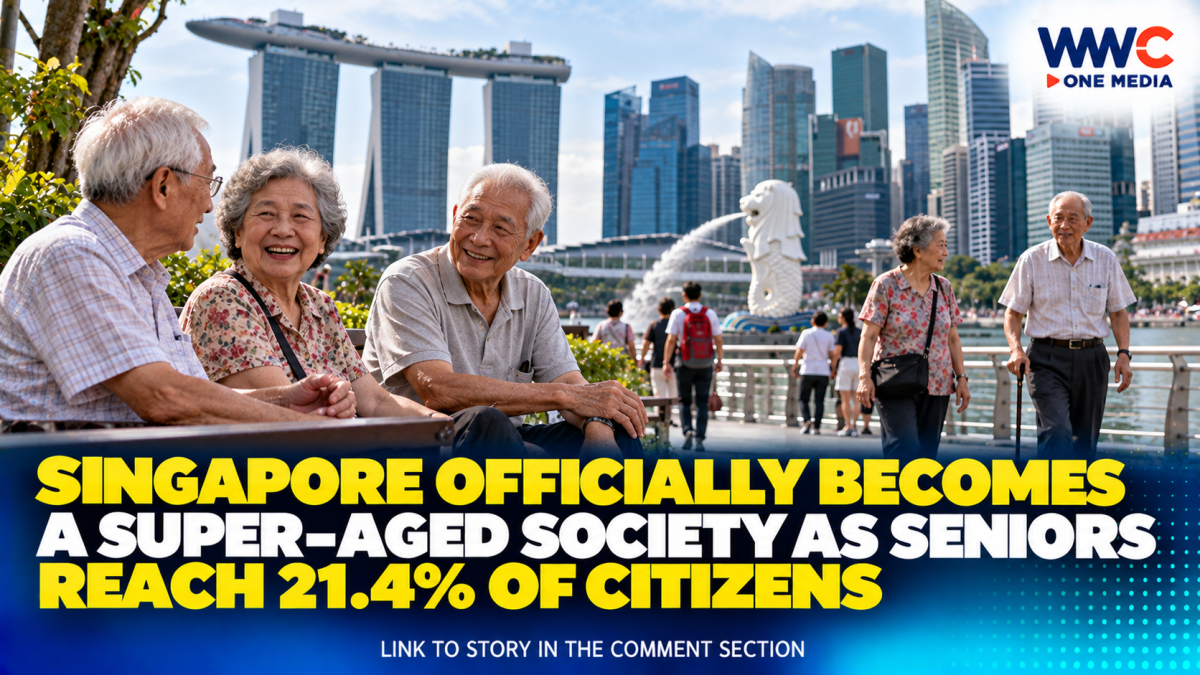
Singapore has officially crossed a major demographic milestone, with 21.4% of its citizen population now aged 65 and above, placing the city-state in the United Nations’ “super-aged” category.
The figure, released in the National Population and Talent Division’s Population in Brief 2026 report on September 25, represents a significant increase from 20.7% in 2025 and 13.7% a decade earlier.
The UN threshold for a super-aged society is reached when at least 21% of the population is 65 or older. Singapore has now moved beyond that benchmark.
Singapore’s Population Is Getting Older
The shift is particularly visible among the oldest age groups.
The number of Singapore citizens aged 80 and above reached 152,000 in 2026, compared with 145,000 in 2025 and 95,000 a decade ago—an increase of about 60% over that period.
Singapore’s broader population data also show the continuing rise in old-age dependency. In 2025, there were about 3.3 people aged 20 to 64 for every person aged 65 and above, compared with 4.3 in 2020.
That demographic change has implications for healthcare, housing, employment, transport and long-term care.
More Than One in Four Citizens Could Be 65+ by 2035
The demographic shift is expected to continue.
According to the 2026 population report, more than one in four Singapore citizens could be aged 65 and above by 2035.
At the same time, the number and proportion of working-age people are projected to remain broadly stable between 2030 and 2035. The report attributes this partly to smaller cohorts entering the 65-and-over group and an inflow of younger people into the working-age population, including through immigration.
This means Singapore’s demographic challenge is not simply about having more older people—it is also about how the country maintains enough working-age residents to support an ageing population.
Government Expands Ageing Support
Singapore has been preparing for the demographic shift for several years.
The Ministry of Health’s Age Well SG programme focuses on helping seniors remain active, socially connected and supported within their communities. The programme covers areas including housing, transport, active ageing and care services.
The government has committed at least S$3.5 billion from FY2024 to FY2035 for Age Well SG.
The programme reflects a broader shift toward adapting communities and public services to a population in which older residents make up an increasingly large share.
A Demographic Turning Point
Singapore’s move into the super-aged category did not happen overnight.
The proportion of citizens aged 65 and above has risen steadily over the past decade, while the number of people in the oldest age groups has also increased.
Now that more than one in five citizens are 65 or older, the country’s next challenge is managing the longer-term consequences of that transition—from healthcare and caregiving to housing, work and community design.
Singapore has crossed the super-aged threshold. The bigger demographic transformation, however, is still unfolding.
WWC ONE MEDIA G,A