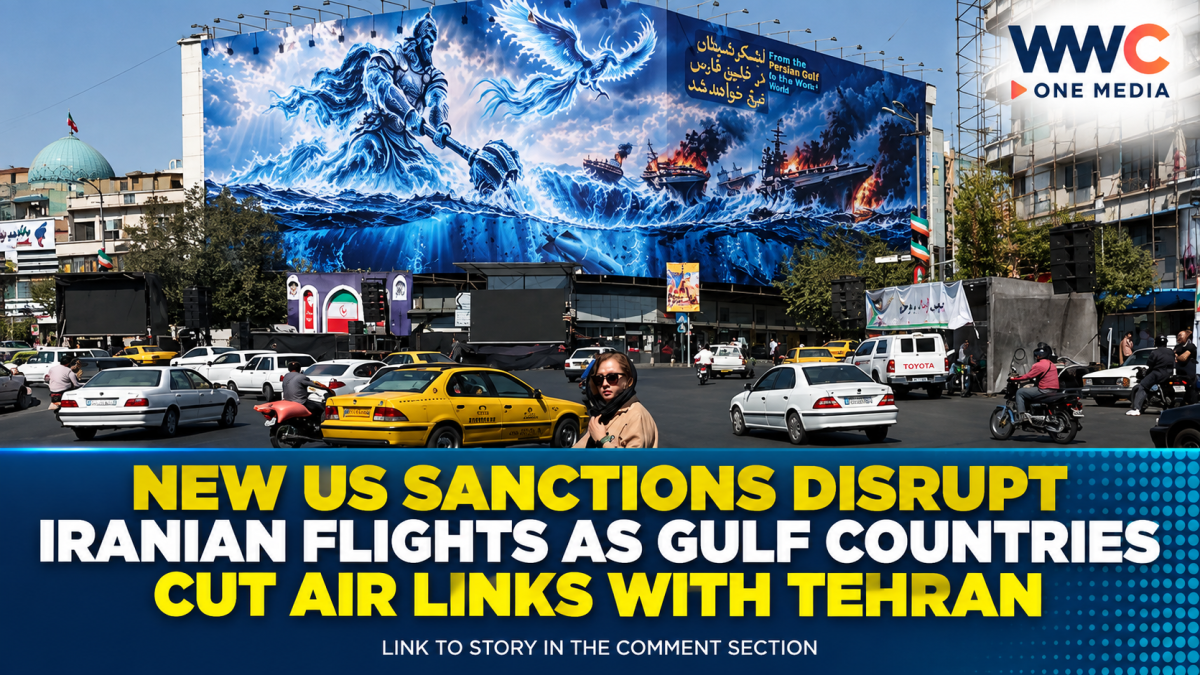
Iranian airlines are facing a major disruption to international operations after new US sanctions pushed several countries to restrict or suspend flights operated by Iranian carriers.
The United States set Sept. 23 as a deadline for companies worldwide to stop providing services to Iranian airlines. Washington’s strategy extends sanctions to companies in third countries that continue doing business with Iran’s aviation sector, increasing the pressure on airports, fuel suppliers and other aviation service providers.
The impact quickly became visible across the region.
The United Arab Emirates suspended all flights operated by Iranian airlines to and from the country until further notice. The UAE’s aviation authority said the decision was made in response to the US sanctions, effectively cutting Iranian carriers off from one of the region’s most important aviation hubs.
Oman, Georgia and Azerbaijan have also restricted Iranian airline operations, while flights involving Baghdad have been affected. Iran had already cancelled services to Baghdad and Muscat after authorities were informed that those airports would no longer accept Iranian flights.
The measures represent a significant escalation because the US is not only targeting Iranian airlines themselves. The new approach also puts pressure on foreign companies that provide services needed to keep those airlines operating internationally.
US Treasury Secretary Scott Bessent has warned that companies providing fuel, landing services or ticket sales to Iranian carriers could face consequences under the sanctions regime, including exclusion from the US dollar financial system.
The US Treasury announced on Sept. 8 that it had sanctioned 36 targets connected to Iran’s aviation sector, including 27 Iranian airlines and companies involved in aircraft procurement and support networks. The department said the measures were designed to restrict Iran’s ability to obtain aircraft, aviation technology and other resources.
For Iranian passengers, the consequences are already being felt. Some international routes have been cancelled, while others remain operational. Flights involving countries such as China and Turkey have continued in some cases, demonstrating that the impact is not yet uniform across Iran’s international network.
The situation has also raised concerns for Iranians travelling abroad, including members of Iran’s delegation attending the United Nations General Assembly in New York. With international connections shrinking, returning to Iran could become more complicated if additional countries enforce the restrictions.
Iran has warned that neighbouring countries cooperating with the US measures could face retaliation. Tehran has also threatened that airports complying with the restrictions could become targets of countermeasures, adding another layer of risk to an already unstable regional aviation environment.
The immediate question for Iran’s aviation sector is how many international routes can remain viable if airports, fuel providers and ground-service companies decide that continuing to serve Iranian airlines is too risky.
If the restrictions continue spreading, Iran could become increasingly dependent on a smaller number of countries willing to maintain air links — potentially making international travel more expensive, complicated and limited for millions of passengers.
The latest sanctions therefore mark more than another round of economic pressure. They are testing how effectively Washington can use the global aviation and financial systems to isolate Iran — and how Tehran and its remaining international partners respond next.