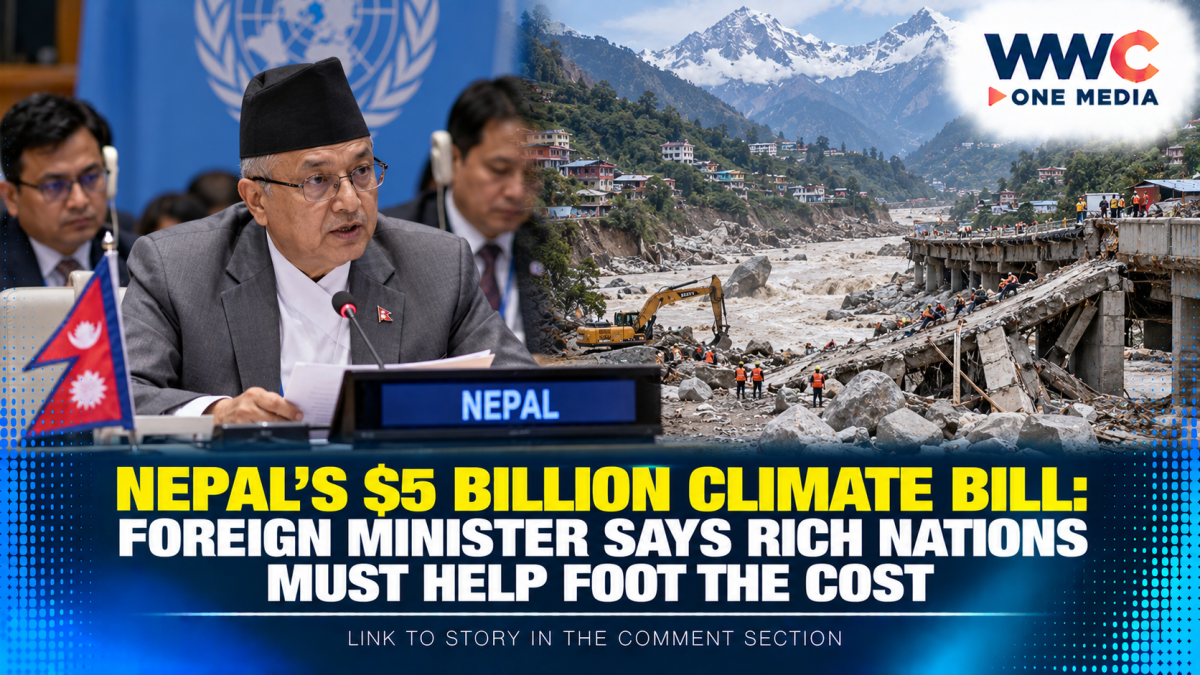
Nepal Says the Climate Crisis Is No Longer Theoretical
NEW YORK — Nepal is pressing wealthy nations to provide greater financial and technical assistance after a catastrophic Himalayan disaster exposed the enormous gap between the countries contributing least to global emissions and those bearing some of the most severe climate-related risks.
Foreign Minister Shisir Khanal told AFP that wealthy nations should do their fair share to help countries such as Nepal recover from climate-related disasters.
His comments came during the United Nations General Assembly’s high-level week in New York, weeks after a devastating flood triggered by a high-altitude glacial collapse struck communities along the Nepal-China border.
More than 1,400 people were reported dead and about 6,000 remained missing, while Nepal’s preliminary estimate puts the economic damage at roughly $5 billion.
For Kathmandu, the disaster has transformed climate finance from an international negotiating issue into an immediate recovery challenge.
Nepal Points to Its Tiny Share of Global Emissions
Khanal emphasized that Nepal contributes only about 0.1% of global greenhouse-gas emissions, arguing that the country should not be left carrying the financial consequences of a crisis to which it has contributed relatively little.
Nepal also points to its energy profile: more than 90% of its electricity comes from hydropower, while electric vehicles account for more than 70% of new car sales, according to figures cited by AFP.
Khanal’s argument reflects a broader debate at international climate negotiations over loss and damage — financial assistance intended to help vulnerable developing countries deal with climate-related destruction.
The $5 Billion Problem
The scale of Nepal’s recovery needs dwarfs the resources currently available through the international climate-finance system.
Nepal has asked the UN’s Fund for Responding to Loss and Damage for $20 million, the maximum amount available under the relevant allocation, according to AFP.
But that amount would cover only a small fraction of the government’s preliminary $5 billion estimate for the disaster.
The fund itself remains under-resourced. Earlier reporting found that more than $822 million had been pledged by 27 countries and other partners, while about $485 million had actually been paid in. No money had yet been allocated from the fund’s earlier applications when the Straits Times reported on the issue in September.
Nepal Wants Grants — Not More Debt
The funding debate has another complication: how developing countries should pay for reconstruction.
Nepal’s Prime Minister Balendra Shah separately called at the UN for grant-based international assistance, arguing that countries devastated by climate disasters should not be pushed deeper into debt to rebuild.
Reuters reported that Shah estimated Nepal’s recovery and reconstruction needs at around 10% of the country’s GDP following the glacier-related flood.
That places climate finance at the center of a wider question facing vulnerable countries: should disaster recovery rely primarily on loans, grants, compensation mechanisms or a combination of different forms of international assistance?
Scientists Are Examining the Climate Connection
The disaster has also intensified scientific discussion about the role of climate change in Himalayan hazards.
A rapid scientific review cited by Nature concluded that unusually high temperatures during July and August contributed to destabilizing an already vulnerable region. Scientists have also described the disaster as a compound crisis, involving geological instability alongside long-term warming, glacier retreat and permafrost thaw.
At the same time, the precise contribution of climate change to the individual disaster remains an area of scientific assessment rather than a simple one-cause explanation.
That distinction matters as Nepal seeks international financing tied specifically to climate-related loss and damage.
Nepal Says It Needs Better Warning Systems
Khanal said Nepal also needs international technical assistance to strengthen its ability to monitor glaciers and anticipate dangerous changes.
That could include more sophisticated satellite monitoring and early-warning systems capable of detecting changes in the Himalayan environment before they become catastrophic.
The need is particularly urgent because the country’s existing systems were not designed to anticipate every possible combination of geological and climate-related hazards, according to Khanal’s comments reported by AFP.
A Test for the World’s Climate-Finance System
Nepal’s request is becoming a major test of whether the international loss-and-damage system can deliver assistance quickly enough when a disaster strikes.
The UN fund was created specifically to help vulnerable developing countries deal with climate-related losses. But reporting from The Straits Times, Nature and other outlets has highlighted concerns over its limited resources and slow decision-making process.
Nepal’s crisis therefore raises a question that extends far beyond the Himalayas:
When climate-related disasters become more destructive and expensive, who pays for rebuilding — and can the world’s climate-finance system deliver the money before vulnerable countries are forced to shoulder the bill themselves?
That debate is now moving from climate conference rooms into Nepal’s devastated communities — where the cost of waiting is already being measured in lives, infrastructure and billions of dollars.
WWC ONE MEDIA G,A