
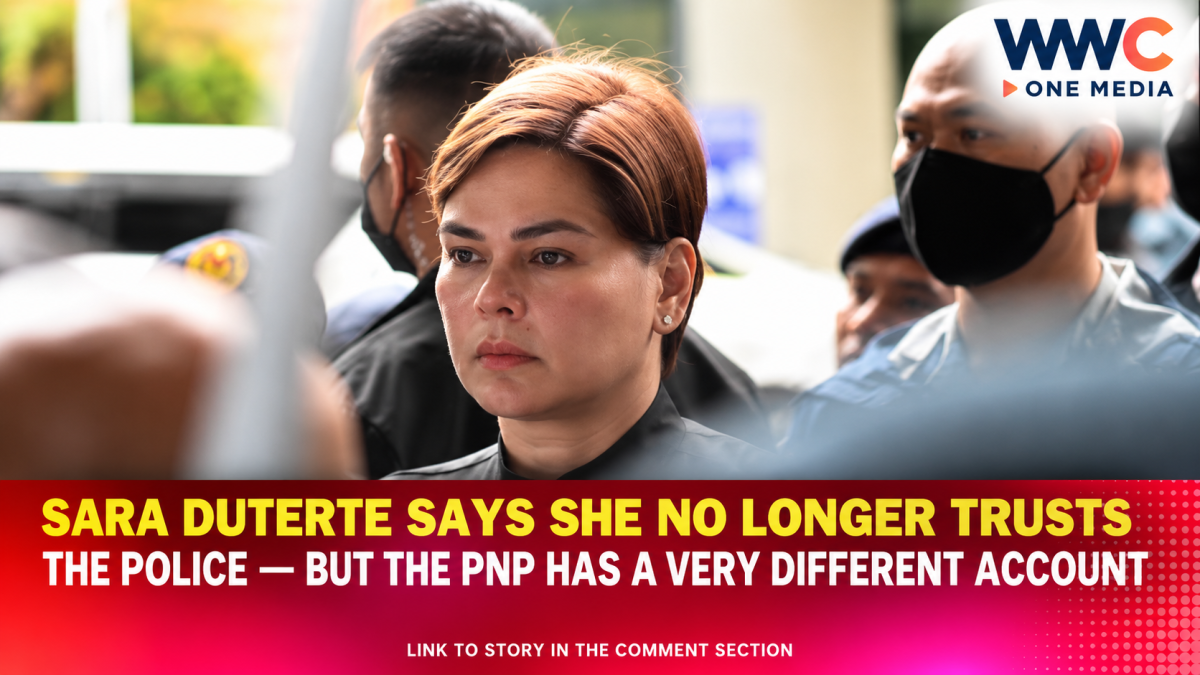
Vice President Sara Duterte has openly questioned whether she can trust the Philippine police to protect her, saying she fears for her life and the safety of her children as she faces a criminal case and a newly issued arrest warrant.
Duterte made the remarks after a Quezon City court issued a warrant for her arrest over three counts of grave threats. She later posted ₱360,000 bail, or ₱120,000 for each count, allowing her to remain free while the case proceeds.
But her claims have triggered a direct response from the Philippine National Police, which says it has not received a formal report or verified any legitimate threat against Duterte or her family.
That clash — between Duterte’s allegations of harassment and surveillance and the PNP’s denial that it has verified such threats — is now adding another explosive layer to an already intense political and legal confrontation.
Duterte: “I Do Not Feel Safe”
In a statement released before she posted bail, Duterte said she had documented threats and harassment dating back to 2023.
She also said she was worried about her children and questioned whether she would be safe if she were taken into police custody.
Bombo Radyo reported that Duterte said she did not trust the police and expressed concern that there was no guarantee she would remain safe inside detention.
Philstar and GMA News separately reported that Duterte said she feared for her life and claimed police had gone to the location where her children were staying even after she had left to attend court.
The Vice President did not publicly identify the police officers she was referring to or provide details of the alleged threats in those statements.
PNP: No Verified Threat Has Been Reported
The police response was immediate.
PNP chief Gen. Jose Melencio Nartatez Jr. said Duterte had not reported any threat against herself or her family to the police, including the threats she said had existed since 2023.
He also said the PNP had not monitored any legitimate threat that would endanger the Vice President or her family.
However, Nartatez said police remain prepared to investigate any threat if Duterte submits a document, report or statement that can be verified.
This distinction is crucial.
Duterte’s allegations are claims that have not been independently established, while the PNP’s position is that it has not verified a credible threat against her.
Why Duterte Chose to Post Bail
Duterte’s concerns about police custody were also tied directly to her decision to go to court and post bail rather than remain subject to possible arrest.
According to Philstar, Duterte said her lawyers advised her to post bail because she believed being publicly visible would provide greater protection than being taken into police custody where, in her words, the public would not know what might happen to her.
She arrived at the Quezon City Hall of Justice accompanied by lawyers and supporters and asked that members of the media accompany her.
Her lawyers subsequently said the court lifted the arrest warrant after the bail requirements were completed.
The Quezon City Police District said Duterte voluntarily went directly to court, meaning she was not arrested by police before posting bail.
The Case Behind the Arrest Warrant
The criminal case stems from Duterte’s November 2024 online press conference, during which she said she had arranged for someone to kill President Ferdinand Marcos Jr., First Lady Liza Araneta Marcos and then-House Speaker Martin Romualdez if she herself were killed.
Duterte has denied that her remarks constituted a criminal threat.
The Department of Justice subsequently pursued three grave-threat charges against her.
On September 4, Quezon City Regional Trial Court Branch 98 found probable cause and ordered the arrest warrant issued. The court set bail at ₱120,000 for each count.
Duterte posted the combined ₱360,000 bail the following day. Reuters and the Associated Press confirmed the development.
Malacañang Defends the Police
The Palace has rejected Duterte’s characterization of the police response.
Presidential Palace officials said the PNP had acted professionally and in accordance with the law.
Interior Secretary Jonvic Remulla also defended the police, saying the PNP had accorded Duterte the respect appropriate to her position.
Remulla said authorities knew where Duterte was after the warrant was issued but did not forcibly implement the warrant at that time. He also said police officers serving arrest warrants use body cameras as a safeguard against potential human-rights violations.
The Palace further said concerns or complaints about police conduct should be pursued through appropriate legal channels.
A Political Crisis Is Now Colliding With a Criminal Case
The controversy comes at an exceptionally sensitive moment for Duterte.
She is already facing an impeachment trial in the Senate, while her political relationship with President Marcos has deteriorated dramatically since the two camps joined forces during the 2022 elections.
Reuters described the arrest-warrant episode as another escalation in the political conflict between the former allies.
The legal case could also have significant political consequences.
Duterte has been widely discussed as a potential contender in the 2028 presidential election, but her growing legal problems and impeachment proceedings could affect her political future.
At the same time, her camp has questioned whether criminal proceedings against an impeachable official can proceed while she remains Vice President. Her lawyers have raised jurisdictional and constitutional arguments that are expected to be addressed through the legal process.
The Most Important Issue Now: Evidence
The confrontation over Duterte’s safety should not obscure the underlying legal question.
The court has found probable cause, which is the legal threshold used to allow the criminal case to proceed. It is not a finding of guilt.
Duterte remains entitled to defend herself against the charges, and the prosecution must still establish the allegations in court.
Likewise, her claims that she has been subjected to threats, harassment or surveillance should be treated as allegations unless independently substantiated.
The PNP’s denial is also specific: it says it has not received a formal report from Duterte and has not verified a legitimate threat.
Those are two separate issues that should not be conflated.
What Happens Next?
For Duterte, posting bail means she avoids detention while the criminal proceedings continue.
For the PNP, the challenge is now to address Duterte’s security concerns without compromising the implementation of the court case.
And for the administration, the controversy threatens to deepen an already bitter political divide.
The situation is particularly sensitive because the Vice President is simultaneously fighting a criminal case, an impeachment proceeding and an increasingly public dispute with institutions controlled by the government.
The bigger picture
This is no longer simply a story about an arrest warrant.
It is becoming a test of trust in law enforcement, due process and the ability of Philippine institutions to handle an extraordinarily politically charged case without either side claiming that the system is being weaponized.
Duterte says she fears for her life.
The police say they have not verified a credible threat.
The courts have ordered the criminal case to proceed.
And now, all three claims will face scrutiny as the legal battle moves forward.
The next question is whether Duterte can substantiate the security concerns she has raised — and whether the criminal case will become an even bigger political flashpoint before the 2028 elections.
WWC ONE MEDIA M.J.E



Leave a Reply