
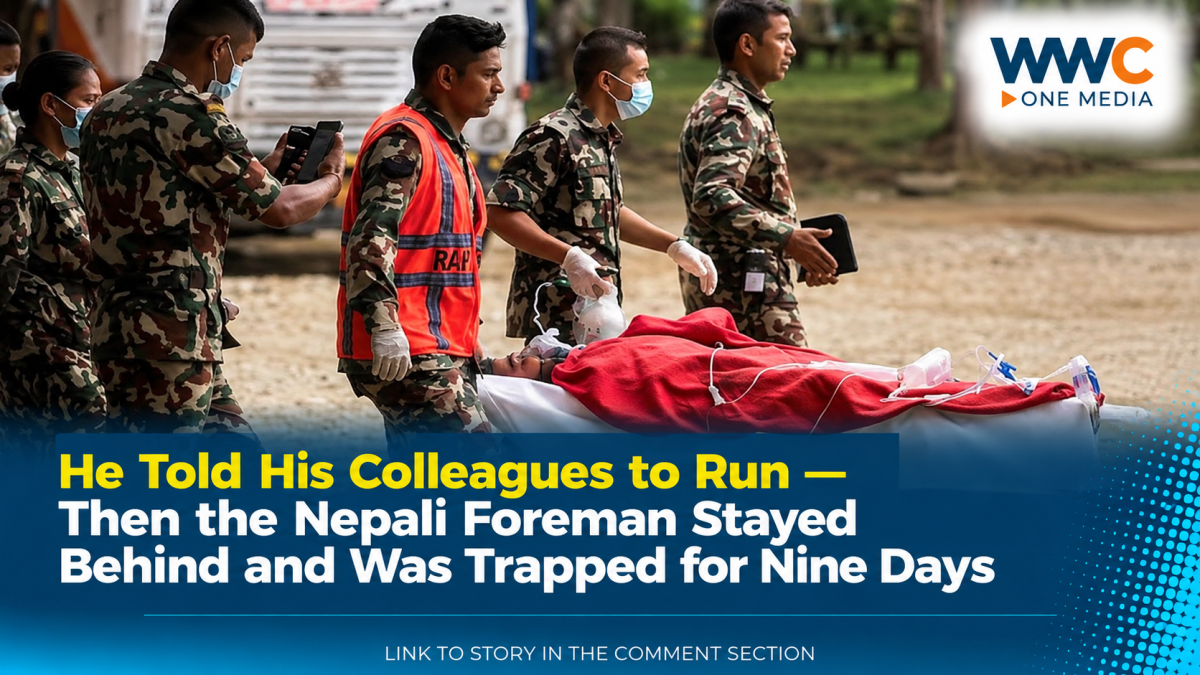
KATHMANDU — When disaster struck the hydropower project where he worked, Nepali mechanical foreman Sanjay Sah says he faced a decision that would change the next nine days of his life.
Run for safety — or stay behind and help his colleagues.
Sah chose to stay.
Moments later, the tunnel system at the Upper Trishuli 3A Hydropower Station was cut off by catastrophic flooding and debris. Sah became trapped underground in darkness, where he would remain for nine days before rescuers finally pulled him out alive.
His explanation for why he did not immediately flee was simple.
“I had to save everyone.”
He told his colleagues to escape
Sah was working as a mechanical foreman when news arrived that a devastating disaster was unfolding outside.
A massive flow of ice, rock, mud and debris had swept through the area after catastrophic flooding struck Nepal’s Himalayan region.
Sah said he urged his colleagues to get out.
But because he was responsible for operations in the control room, he believed his duty was to help ensure others could escape before thinking about himself.
By the time he could make his own attempt to leave, it was too late.
The mountain and flood debris had sealed off access points.
Sah was trapped underground.
Nine days in darkness
For more than a week, Sah remained inside the tunnel.
He was not alone at all times.
According to his account, he was able to maintain some contact with several other people believed to be elsewhere in the tunnel system.
But conditions were terrifying.
The tunnels were dark, blocked in places by debris and surrounded by the aftermath of one of Nepal’s worst recent disasters.
Sah said he recited mantras and prayers to remain calm and maintain hope while waiting for rescuers.
His story has since become one of the most remarkable survival accounts to emerge from the disaster.
Then rescuers found a way in
After days of searching, clearing mud and debris and attempting to locate survivors inside the hydropower tunnels, rescuers finally reached Sah and another worker, Kabir Maharjan.
The two men were pulled alive from the Upper Trishuli 3A tunnel nine days after the disaster struck.
Their rescue immediately raised hopes that others could still be alive inside Nepal’s damaged network of hydropower tunnels.
Sah and Maharjan were flown to Kathmandu for medical treatment following their ordeal.
Sah was reported to be in relatively stable condition, while Maharjan required more serious medical care.
A third worker was rescued alive
The survival story did not end with Sah and Maharjan.
The following day, rescuers pulled a third worker alive from another tunnel.
Chinese national Lu Haitao was rescued from a 225-metre tunnel at the Upper Trishuli-1 Hydropower Project after spending about 10 days trapped following the disaster.
His rescue strengthened hopes that survivors could still be found even after prolonged periods underground.
Rescue teams have been working under extremely difficult conditions, with tunnels filled or blocked by mud, debris and massive rocks.
But the scale of the disaster remains enormous
Sah’s survival is extraordinary because it came amid a disaster of staggering scale.
The catastrophic flooding and landslides that struck Nepal on Aug. 26 caused widespread destruction, killing more than 1,200 people in Nepal and leaving thousands more missing, according to recent reporting.
Hydropower projects along the affected river systems were particularly hard hit.
Authorities have focused major rescue operations on damaged tunnels where large numbers of workers were believed to have been on duty when the disaster struck.
Reports have indicated that around 900 workers were unaccounted for at hydropower projects, with hundreds feared trapped inside tunnels.
Those figures remain fluid as rescue operations continue and authorities work to account for workers and recover victims.
Why the tunnel rescue is so difficult
Finding survivors underground is dramatically harder than searching open terrain.
Rescuers must first determine whether a tunnel entrance still exists beneath the debris.
They then face:
- Massive mud and rock blockages
- Flooded sections
- Collapsed tunnel structures
- Unstable mountainsides
- Limited visibility
- Difficulty establishing communication with survivors
Drones and other technology have been deployed, but narrow and debris-filled tunnels limit their effectiveness.
Rescuers have also relied on engineering records, maps and information about the hydropower facilities to determine where trapped workers may be located.
His decision to stay behind is now being remembered
For Sah, the rescue ended a nine-day nightmare.
But his first explanation of what happened focused less on his own survival than on why he stayed.
He was the foreman.
He was in the control room.
And when disaster struck, he believed his responsibility was to get others out.
Reuters reported that Sah said he urged his colleagues to flee but remained behind because he felt responsible for saving lives.
That decision ultimately left him trapped.
But it also produced one of the most powerful stories to emerge from Nepal’s unfolding tragedy.
Hope for families still waiting
The successful rescue of Sah, Maharjan and later Lu has given families of missing workers something they desperately needed: hope.
But the rescue operation is far from over.
Authorities continue searching damaged hydropower tunnels while families wait for news of relatives who disappeared when the floods and debris swept through the region.
Some survivors and rescuers have reported possible signs that additional people could still be alive underground.
Each successful rescue has therefore added urgency to the search.
‘I had to save everyone’
Sanjay Sah entered the disaster zone as a foreman responsible for machinery and operations.
Nine days later, he emerged as one of the first major symbols of survival.
His story is not simply about enduring darkness, isolation and uncertainty.
It is also about the moment before the tunnel became a trap.
Sah says he had a chance to run.
Instead, he told others to escape — and stayed behind to help.
Nine days later, rescuers finally found him alive.
But as hundreds of workers remain unaccounted for, Sah’s extraordinary survival has become something more than a personal miracle.
It has become proof that even after days of darkness underground, rescuers may still find someone waiting to be brought home.
Editorial accuracy note
Sanjay Sah should be described as saying he stayed behind to help his colleagues and fulfill his responsibility as a foreman. This is based on Sah’s own account reported by Reuters, rather than an independently established determination of exactly how many people his actions saved.
The disaster’s death and missing-person figures are changing as authorities continue rescue and recovery operations. For publication, it is safer to attribute casualty figures to the latest official or major-news-agency reporting and avoid presenting the number of workers still trapped as a fixed final total.
WWC ONE MEDIA J.M.D

Leave a Reply