
SINGAPORE — An 85-year-old retiree thought he was helping the police catch a criminal.
Instead, he was just one bank transfer away from losing almost S$110,000 — a large portion of his life savings.
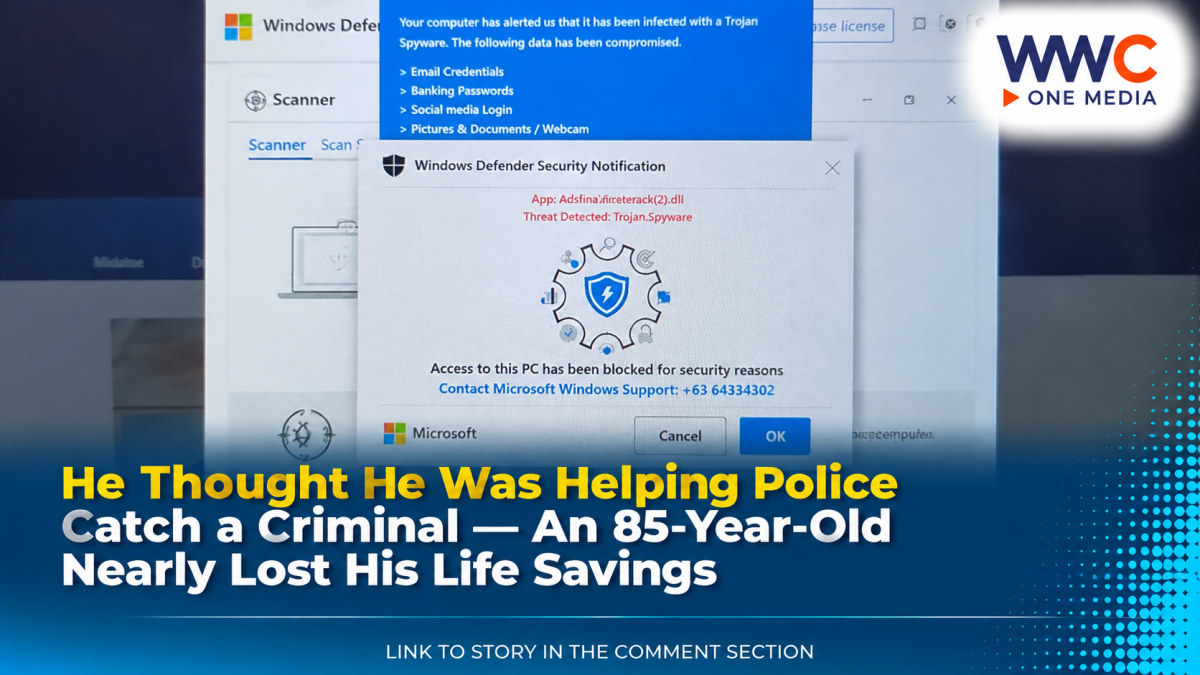
What started with a frightening pop-up on his computer quickly escalated into an elaborate tech support scam involving a fake technical support officer, a bogus police officer and instructions to move his money into another bank account.
The scam was only stopped after alert bank employees at an OCBC branch spotted warning signs and intervened before the transfer could be completed.
It began with a terrifying computer pop-up
The retiree, identified only as Jim, was checking his emails when a pop-up suddenly appeared on his computer screen.
The message claimed his device had been blocked for security reasons.
It also displayed a telephone number.
Jim called.
On the other end was someone claiming to be a technical support officer.
The supposed technician then told him that the matter was serious enough for the police to become involved.
That was when the scam entered its next phase.
A second scammer, posing as a police officer, allegedly told Jim that his bank account had been used to transfer illicit funds.
The fake officer even made Jim believe he could help authorities catch the supposed criminal.
“He even said to me: ‘I’m glad you’re on the line with me, because you can help me catch this culprit,’” Jim told reporters.
He believed he was helping the police
The story sounded convincing.
Jim was told that money from the joint OCBC account he shared with his wife needed to be transferred elsewhere as part of a supposed operation to trap the criminal.
Believing he was cooperating with the authorities, the 85-year-old prepared to move nearly S$110,000.
The amount represented a substantial portion of his life savings.
Because Jim is wheelchair-bound, he asked his helper to accompany him to an OCBC branch in Marine Parade.
He then handed a bank employee a piece of paper containing a name and account number for the proposed transfer.
That was when the scam began to unravel.
The bank teller noticed something was wrong
OCBC teller Robert Tan immediately noticed a possible red flag.
Jim had described the recipient as his cousin.
But according to the report, the name of the supposed cousin suggested the person was of a different race.
When Tan asked Jim why he was making such a large transfer, Jim reportedly insisted that the money be sent without further questions.
That raised even more concerns.
Tan alerted customer service officer Chai Mei Li, who brought Jim to a private room so bank staff could better understand what was happening.
The intervention would prove critical.
The truth slowly came out
As bank employees spoke with Jim, they learned more about the unusual circumstances surrounding the transfer.
The story involved a sudden computer warning.
A call to an unknown technical support number.
And someone claiming to be a police officer who wanted him to move his savings to another account.
Those are now well-established warning signs of a technical support scam.
Singapore authorities have warned that scammers often use alarming pop-ups to convince victims that their computers have been hacked or compromised.
Victims are then instructed to call a number displayed on the screen.
Once they do, they may be connected to a scammer posing as technical support staff before being transferred to another fraudster impersonating a government official or police officer.
His S$110,000 was saved
Bank staff eventually stopped the transaction and the account was frozen to prevent the money from being transferred.
Jim avoided losing almost S$110,000.
Looking back, however, the retiree said he felt embarrassed by what had happened.
“Only later did I realise how stupid I was,” he said.
But Singapore authorities repeatedly warn that scam victims should not be blamed for falling for increasingly sophisticated fraud.
Scammers deliberately exploit fear, urgency and trust in authority.
In this case, the fraudsters did not simply ask Jim for money.
They built a story around his computer, alleged criminal activity and a supposed police investigation.
They made him believe he was not the victim.
They made him believe he was helping to catch a criminal.
Tech support scam losses are rising sharply
Jim’s case comes as technical support scams are becoming increasingly costly in Singapore.
According to figures cited in the latest report, losses from technical support scams jumped from about S$769,000 in the first half of 2025 to S$4.9 million in the first half of 2026.
The number of reported cases also increased from 33 to 49 over the same period.
That means the financial damage caused by these scams grew dramatically even though technical support scams were not among Singapore’s top 10 scam types by case numbers.
The Singapore Police Force and Cyber Security Agency have separately warned about scam variants involving criminals impersonating major technology companies, including Microsoft.
Since February 2026, authorities have received reports of victims encountering fraudulent pop-ups claiming that their computers had been hacked or compromised.
Victims were instructed to call supposed technical support personnel and were subsequently transferred to scammers impersonating police officers.
The victims were then told that their devices had been connected to illegal activities such as money laundering.
The scam follows a dangerous pattern
The latest case shows how quickly a seemingly simple computer pop-up can become a major financial emergency.
The pattern typically works like this:
- A victim sees a frightening pop-up on a computer.
- The screen may appear frozen or display warnings about viruses, hackers or compromised accounts.
- The victim is instructed to call a telephone number.
- A scammer pretends to be technical support staff.
- The victim is told the problem is linked to criminal activity.
- Another scammer may impersonate a police officer or government official.
- The victim is pressured to move money, reveal banking information or grant access to a device.
Singapore’s ScamShield warns the public never to grant remote access to a device or approve bank transactions for unsolicited callers claiming to provide technical support.
A real police officer will not tell you to move your money
One of the most important warnings from Singapore authorities is simple:
Government officials will not ask members of the public to transfer money over the phone.
ScamShield also advises the public to independently verify suspicious claims rather than relying on telephone numbers provided in pop-ups or unsolicited messages.
If a computer suddenly displays an alarming security warning, users should avoid calling the number on the screen.
They should close the suspicious browser or seek help through official channels instead.
Members of the public who are unsure whether they are dealing with a scam can contact the 24-hour ScamShield Helpline at 1799.
Why elderly victims are often targeted
Older people are frequently targeted by scammers, but authorities stress that scams can affect people of all ages.
What makes technical support scams particularly dangerous is the combination of technology and authority.
The initial computer warning creates panic.
The supposed technical expert creates confidence.
Then the fake police officer adds pressure and fear.
By the time victims are instructed to move money, they may already believe they are cooperating with an official investigation.
Singapore Police have also warned of other recent scam variants targeting seniors and exploiting technology, social media and fake official identities.
The bank employees became the final line of defence
Jim’s case also highlights the increasingly important role banks and frontline staff play in stopping scams.
The S$110,000 transfer was not stopped because Jim initially recognized the fraud.
It was stopped because bank employees noticed inconsistencies, asked questions and refused to ignore the warning signs.
One suspicious detail led to another.
The unusual recipient.
The insistence that no questions be asked.
The confusing explanation for the transfer.
And eventually, the story about the computer pop-up and fake police officer.
By the time the full picture emerged, Jim’s savings had been protected.
‘Only later did I realise’
Jim’s words after the ordeal may sound harsh on himself.
But scam experts and authorities consistently warn against assuming that only careless or uninformed people become victims.
Modern scams are designed to manipulate human emotions.
Fear.
Trust.
Urgency.
And the belief that an authority figure is giving legitimate instructions.
That is precisely why the safest response to an unexpected security warning is not to panic.
Stop.
Verify.
And never call a number provided by an alarming pop-up.
For Jim, one conversation with alert bank employees was enough to prevent what could have been a devastating loss.
He thought he was helping police catch a criminal. In reality, he was being led step by step toward losing S$110,000.
The money was saved.
But his story is a warning to everyone who has ever seen a frightening message suddenly take over their computer screen.
The person on the other end of the phone may sound like an expert. They may sound like the police. But before you move your money, ask yourself one question: Why would a real investigation require you to transfer your life savings?
What to do if you see a suspicious pop-up
Singapore’s official ScamShield guidance advises members of the public to:
- Do not call telephone numbers displayed in suspicious pop-ups.
- Do not grant strangers remote access to your computer or device.
- Do not disclose banking or login credentials.
- Do not approve transactions requested by unsolicited callers.
- Verify claims through official channels.
- Call the ScamShield Helpline at 1799 if you are unsure whether something is a scam.
- Contact your bank immediately if you believe you have been targeted or have already transferred money.
Editorial accuracy note
The S$110,000 in this case was nearly transferred but was ultimately protected after OCBC staff intervened. It should therefore not be reported as money that the retiree actually lost.
The increase in technical support scam losses — from S$769,000 in the first half of 2025 to S$4.9 million in the first half of 2026 — should be attributed to the reported Singapore scam statistics cited by The Straits Times.
Official Singapore advisories confirm that fake technical support pop-ups followed by impersonation of police officers are an active scam pattern.
WWC ONE MEDIA J.M.D




Leave a Reply