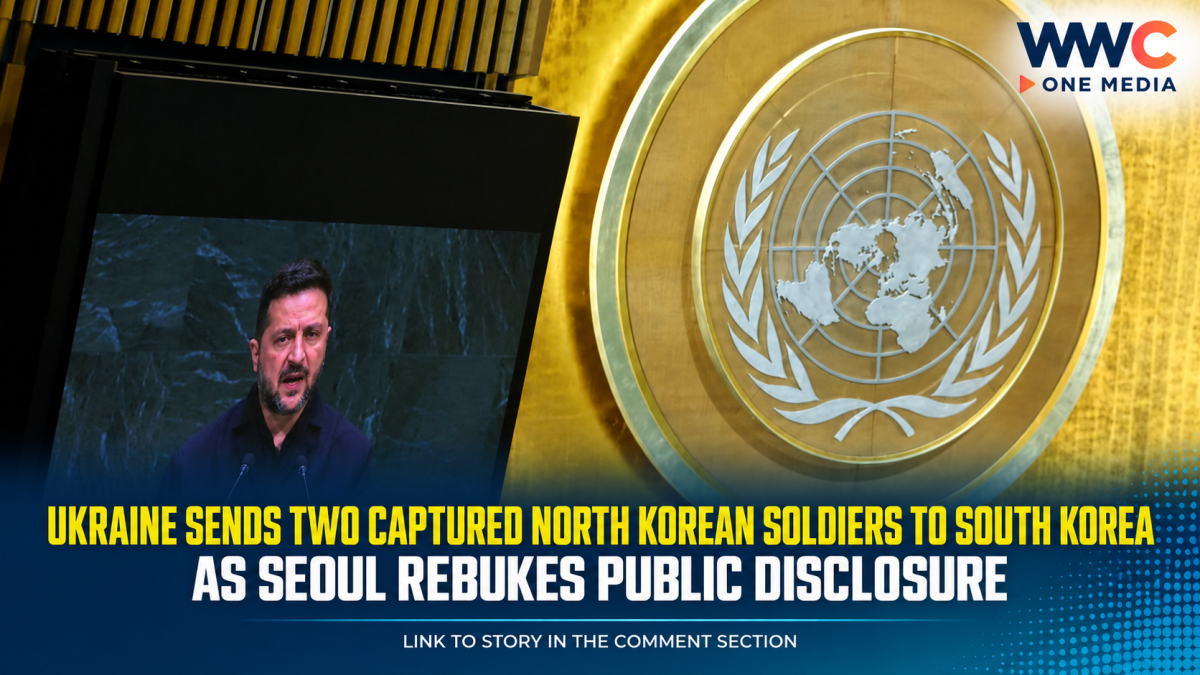
Ukraine has transferred two North Korean soldiers captured while fighting alongside Russian forces to South Korea, Ukrainian President Volodymyr Zelenskyy said, revealing a sensitive operation that Seoul says had been agreed to remain confidential.
Zelenskyy announced the transfer during his address to the United Nations General Assembly on Sept. 23, saying the two North Korean prisoners of war had recently been sent to the Republic of Korea. South Korean authorities did not deny that the transfer occurred, but initially declined to confirm details because of security and privacy concerns involving the soldiers and their families.
The two men were captured by Ukrainian forces in Russia’s Kursk region in January 2025 after North Korean troops were deployed there to support Moscow’s war effort against Ukraine. They were the first North Korean soldiers known to have been captured alive after Pyongyang became directly involved in the conflict.
Their future had been a sensitive issue since their capture. Zelenskyy previously said Ukraine could potentially return the soldiers to North Korean leader Kim Jong Un as part of a prisoner exchange involving Ukrainians held by Russia. However, the soldiers later expressed a desire to go to South Korea, according to South Korean media and a North Korean defector group.
South Korea had maintained that the wishes of the two men should be respected and that the issue should be handled according to international law and humanitarian principles. Seoul and Kyiv had also discussed the matter before the transfer.
The situation took a diplomatic turn after Zelenskyy’s public announcement.
South Korean President Lee Jae Myung said Ukraine had breached an agreement to keep the transfer confidential. Lee said disclosure was regrettable because the case could have implications for diplomacy, national security and the security environment on the Korean Peninsula.
The Ukrainian presidential office said the transfer had been carried out through direct discussions with South Korea and described it as a highly sensitive matter. Seoul’s Foreign Ministry has continued to avoid confirming the soldiers’ exact location, timing or route, citing their safety and the protection of their families.
A South Korean opposition lawmaker, Yu Yong-weon, said the two soldiers had arrived in South Korea several days earlier after traveling through a third country. That account has not been fully confirmed by South Korean authorities, who have kept operational details confidential.
The soldiers’ arrival also carries significance beyond their individual cases.
North Korea has deployed thousands of troops to support Russia since 2024. Ukrainian and South Korean estimates put the number at roughly 14,000 to 15,000 personnel. Their involvement has strengthened military cooperation between Pyongyang and Moscow while raising concerns in Seoul and other countries about North Korea gaining battlefield experience and potentially receiving military or technological assistance from Russia.
Zelenskyy used the UN speech to criticize North Korea’s participation in the war, arguing that Pyongyang was sending its citizens to fight for Russia while receiving benefits in return. Those comments were part of Ukraine’s broader diplomatic effort to highlight North Korea’s military support for Moscow.
For South Korea, however, the immediate priority is the safety and status of the two former prisoners. Under South Korean law and policy, North Koreans who enter the South are generally subject to government protection and screening procedures, although authorities have not publicly detailed what arrangements have been made for these two men.
The case could also become relevant to future North Korean deployments. If more North Korean troops are captured while fighting for Russia, Seoul may face additional decisions over whether and how to receive soldiers who refuse to return to the North.
For now, the two soldiers have moved from a battlefield in Russia’s Kursk region to South Korean custody, but the circumstances surrounding their transfer have already created friction between Kyiv and Seoul.
The bigger question is what happens next if more North Korean soldiers are captured — and whether this unprecedented case will shape how South Korea, Ukraine and Russia handle future North Korean prisoners of war.