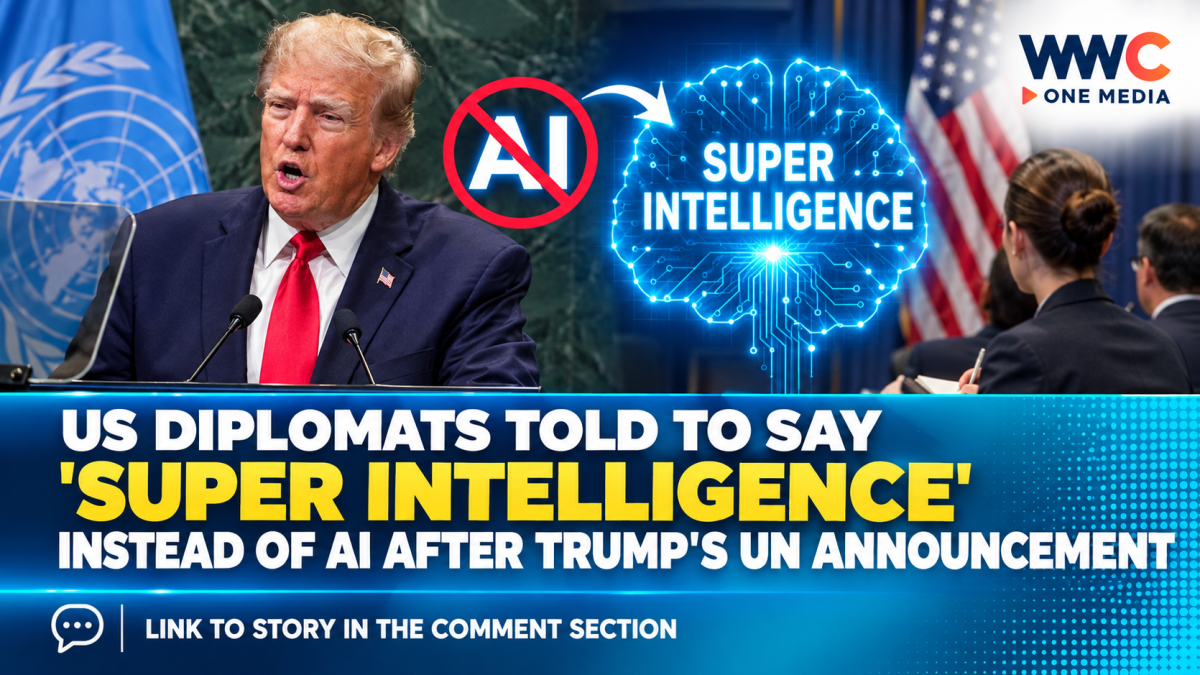
US diplomats working on international organisations have been instructed to replace the term “artificial intelligence” with “super intelligence” in official communications, following President Donald Trump’s announcement at the United Nations that the US government would adopt the new terminology.
The directive came from the State Department’s Bureau of International Organization Affairs, which oversees US diplomatic missions to the United Nations and other multilateral organisations worldwide. An email sent to staff on September 22 instructed them to change references to “Artificial Intelligence” to “Super Intelligence,” using “SI” in official remarks, positions and press materials. The Associated Press obtained the email the following day.
The change followed Trump’s September 22 address to the UN General Assembly, where he said the word “artificial” makes intelligence sound “fake.” He said US government documents would instead use what he described as the more accurate term “super intelligence.”
The directive currently appears limited to the State Department bureau responsible for international organisations. It was not immediately clear whether other State Department divisions or federal agencies had received similar instructions.
The terminology change has already reached the international diplomatic stage. US representatives used “SI” at a UN Security Council meeting on September 23 focused on the risks and governance of AI, where technology executives called for stronger international safeguards.
The timing is notable because artificial intelligence has become an increasingly important issue in US foreign policy and competition with China. Trump has repeatedly argued that the United States should maintain its technological lead and has opposed policies that he believes could slow the development of AI.
In a social media post before his UN address, Trump claimed that the US was ahead of China in AI and said he would not “stifle” the growth of a technology he believes could have an impact greater than the Industrial Revolution or the internet.
The terminology shift also comes as Washington is confronting broader debates over the risks of increasingly capable AI systems. Technology executives, lawmakers and researchers have raised concerns that AI development could move faster than governments’ ability to establish effective safeguards. Trump has taken a different approach, emphasizing continued development while saying the Justice Department would monitor the industry and intervene if necessary.
The distinction between the terms is also worth noting. “Artificial intelligence” remains the established technical and policy term used internationally, while “super intelligence” generally refers to a much more specific concept involving AI systems that would surpass human intellectual capabilities across a broad range of tasks. Trump’s announcement therefore represents a change in US government terminology rather than an established scientific redefinition of AI.
The change could also affect terminology surrounding Trump’s recently announced “AI Force.” If the administration applies the new naming convention more broadly, that initiative could eventually be referred to using the “SI” terminology as well.
For now, however, there is no indication that the new wording has replaced “artificial intelligence” across the entire US government. The available directive specifically concerns the State Department’s international organisations bureau.
The development illustrates how presidential language can quickly influence official diplomatic communications, even while the technology itself continues to be discussed under the established global term.
The bigger question now is whether “super intelligence” will remain a terminology used by a limited part of the US government or expand into a broader official language shift as Washington competes over the future of advanced AI.