
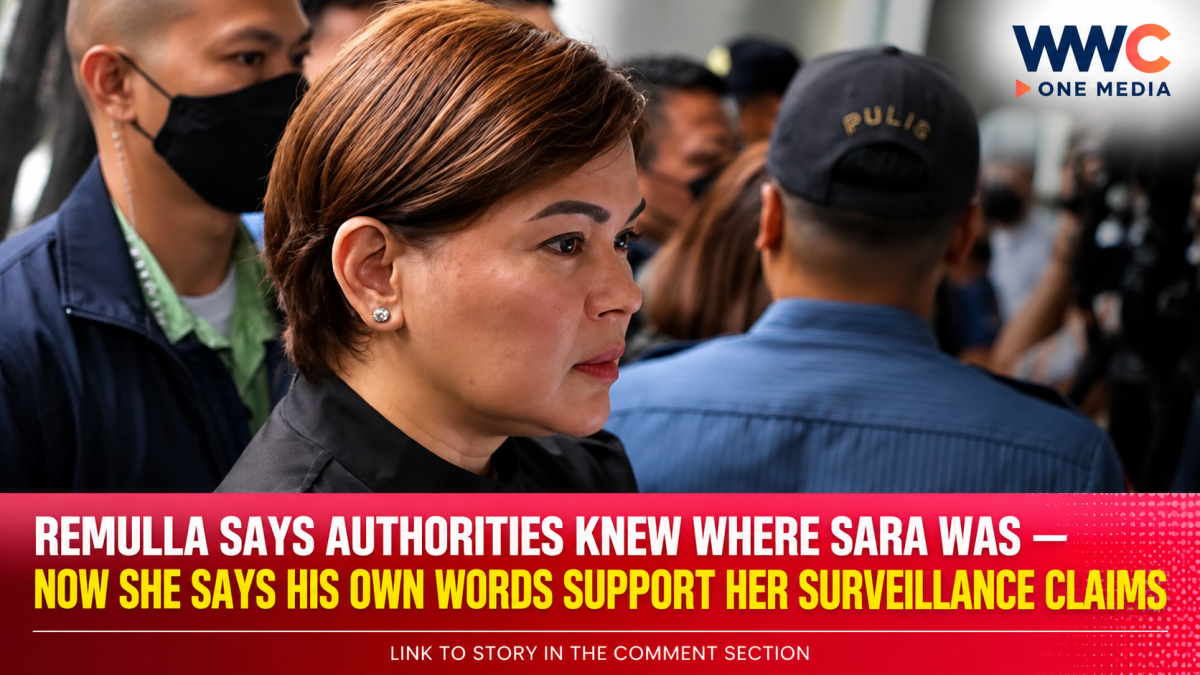
MANILA — A statement from Interior Secretary Jonvic Remulla has become a new flashpoint in Vice President Sara Duterte’s escalating legal and political battle after he confirmed that authorities already knew her whereabouts before she appeared in court to post bail.
Duterte is now citing that admission as support for her long-standing claim that she has been subjected to surveillance and harassment by government authorities.
But there is an important distinction: Remulla’s statement confirms that authorities knew where Duterte was; it does not, by itself, establish that she was illegally surveilled or harassed. The Philippine National Police, meanwhile, says Duterte has not formally reported any threats against herself or her family to the police.
What Remulla actually said
On Saturday, Remulla said the Department of the Interior and Local Government and police authorities knew where Duterte was on Friday night, after a Quezon City court issued an arrest warrant against her over three counts of grave threats.
But authorities chose not to force the warrant’s implementation at that time.
Remulla said police respected Duterte’s position and that authorities had body-camera footage documenting the service of warrants and her subsequent appearance at court to post bail.
His comments were made after Duterte appeared at the Quezon City Hall of Justice and posted P360,000 bail, or P120,000 for each of the three grave-threat charges.
Duterte turns the statement into a new allegation
Duterte subsequently argued that Remulla’s admission strengthens her allegation that government agencies have been monitoring her.
In a statement, she questioned why authorities allegedly went to her mother and children if officials already knew where she was.
She also claimed that surveillance and harassment against her had been occurring for years and alleged that public resources were being used for monitoring activities.
Those are Duterte’s allegations and have not been independently established by Remulla’s statement.
That distinction is crucial as the political fight intensifies.
PNP pushes back on the surveillance claim
PNP chief Police General Jose Melencio Nartatez Jr. said the police have not received a report from Duterte concerning threats against her life or the safety of her family, including threats she says date back to 2023.
He added that the PNP remains open to receiving documents, reports or statements concerning those alleged threats so they can be verified and validated.
The PNP also said Duterte was provided security during her appearance at the Quezon City court and was able to arrive and leave safely.
So far, therefore, there are two competing narratives:
- Duterte says authorities’ knowledge of her location supports her allegation of surveillance and harassment.
- The PNP says it has not received a formal report of the alleged threats and remains willing to investigate information Duterte can provide.
Why Duterte was facing arrest in the first place
The controversy follows a major legal development on Friday, when Quezon City Regional Trial Court Branch 98 issued a warrant for Duterte’s arrest over three counts of grave threats.
The charges stem from her November 2024 online press conference in which she spoke about having someone allegedly prepared to kill President Ferdinand Marcos Jr., First Lady Liza Araneta-Marcos and then-House Speaker Martin Romualdez if she herself were killed.
Duterte has denied wrongdoing and is pursuing legal remedies against the charges.
The court set bail at P120,000 for each count, bringing the total to P360,000. Duterte subsequently appeared before the court and posted bail.
The timing is politically explosive
The criminal case is unfolding while Duterte is simultaneously facing an impeachment trial before the Senate.
The grave-threat allegations also overlap with Article IV of the impeachment case, which involves alleged threats against Marcos, his wife and Romualdez.
That overlap has made the latest legal development politically significant, although the criminal proceedings and impeachment proceedings remain separate legal processes. Reuters noted that the criminal case adds to Duterte’s growing legal and political challenges while her impeachment trial continues.
Duterte’s potential political future is also at stake. A conviction in the impeachment case could remove her from office and affect her plans for the 2028 presidential election.
The impeachment case is moving on a separate track
While the arrest-warrant controversy dominates headlines, prosecutors are also preparing to present evidence on the unexplained-wealth allegations against Duterte.
The House prosecution panel recently received bank and tax records involving Duterte, her husband Manases Carpio and companies linked to the couple.
Bicol Saro Party-list Rep. Terry Ridon described those documents as the “last important pillar” of evidence the prosecution intends to examine for Article II of the impeachment case. The records came from six banks and the Bureau of Internal Revenue.
At the same time, the House prosecution panel has yet to make a final decision on whether to skip further presentation of evidence on the separate bribery article and focus instead on the unexplained-wealth allegations.
What happens next?
The immediate question is whether Duterte will provide documents or formal reports supporting her claims of surveillance and threats.
The PNP has publicly said it is willing to receive and verify such information.
That could turn the current political dispute into a more concrete evidentiary battle.
For now, Remulla’s statement establishes that authorities knew Duterte’s location before she went to court — but it does not independently prove the broader surveillance allegations she is making.
That distinction will matter as Duterte’s legal battles continue on two fronts: the criminal case involving the alleged threats and the Senate impeachment trial that could determine her political future.
And with both proceedings unfolding simultaneously, a single statement about where the Vice President was could become part of a much larger fight over surveillance, police power, due process and political persecution claims.
WWC ONE MEDIA M.J.E
Leave a Reply