
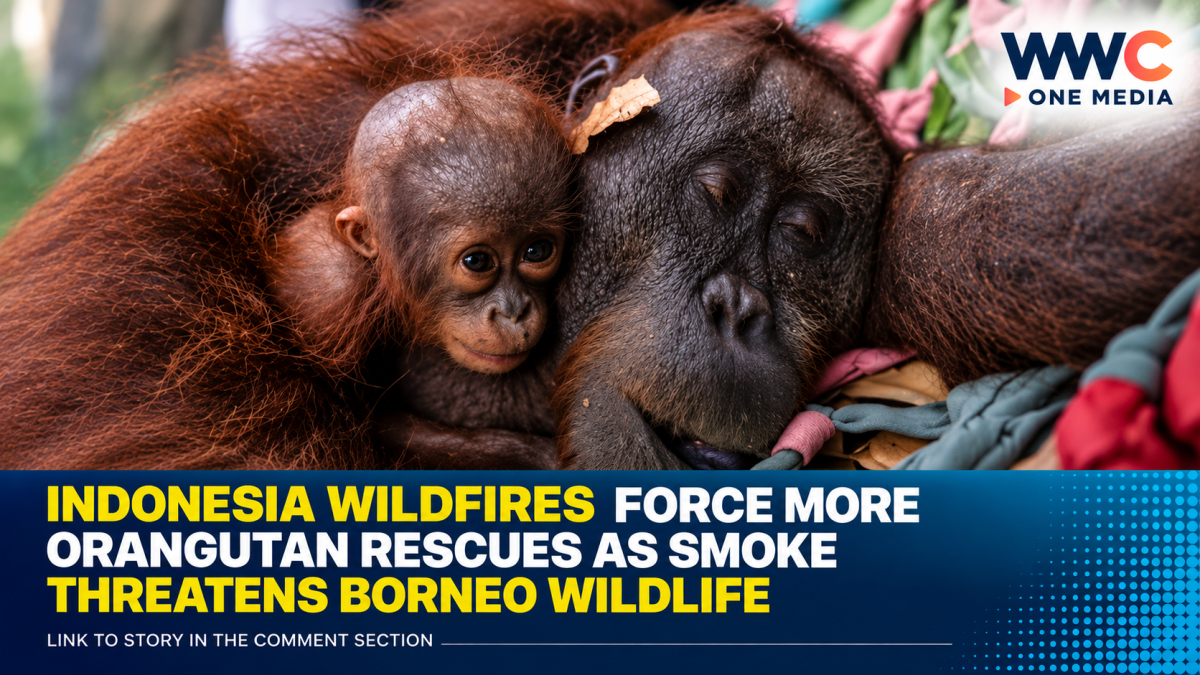
JAKARTA, Indonesia — Indonesia’s worsening forest and land fires are pushing endangered orangutans out of their shrinking habitats, prompting another wave of emergency wildlife rescues across Borneo.
The latest rescue involved a mother orangutan and her baby in West Kalimantan, where authorities evacuated the pair after fires began spreading toward their habitat. Their rescue brings the number of orangutans evacuated because of wildfire threats in Ketapang district to nine in less than a month, according to conservation officials cited by Agence France-Presse.
The development is part of a broader wildlife emergency unfolding as Indonesia battles extensive fires across parts of Borneo and Sumatra, sending thick smoke across populated areas and neighboring countries, including Malaysia, Singapore and the Philippines.
Mother and baby rescued as flames approach
The mother-and-baby pair in West Kalimantan had reportedly been monitored since July after being spotted in a plantation area near a forest.
As fire moved closer to their habitat, authorities decided to evacuate them to a rescue facility operated by Yayasan Inisiasi Alam Rehabilitasi Indonesia (YIARI).
Veterinarians found no obvious burn injuries during an initial examination. However, conservation specialists warned that prolonged exposure to dense wildfire smoke can damage an orangutan’s respiratory system, even when the animal has not been directly touched by flames.
The pair are being monitored while receiving care at the rescue and rehabilitation center.
The latest operation has also underscored how fires can leave wildlife with fewer options to escape.
YIARI operational director Argitoe Ranting said fires do more than destroy forests: they eliminate animals’ access to food, shelter and safe habitat, leaving many wildlife species with nowhere to go.
Another dramatic rescue unfolded days earlier
The latest incident follows another rescue in which a mother orangutan and her one-year-old daughter were found surrounded by heavy smoke in Central Kalimantan.
The pair, named Raya and Rayu, were discovered after officials received information about an orangutan clinging to a tree amid haze rising from recently burned peatland.
The mother, estimated to be about 20 years old, was found carrying her one-year-old daughter. Rescuers determined that remaining in the area posed a serious health risk and carried out an emergency evacuation.
Initial veterinary checks found no serious injuries from the fire or smoke, and officials said the animals would be released if they were deemed healthy enough to return to the wild.
The discovery of the baby made the rescue especially urgent — and highlighted the vulnerability of orangutan families when fire destroys the forest around them.
One rescued orangutan suffered severe smoke exposure
Another rescue in Ketapang, West Kalimantan, showed just how dangerous the smoke itself can be.
Reuters reported that a local farmer found an orangutan lying weak on a palm-oil plantation near an area affected by fires. The animal, later named Sampurna, was reportedly suffering from oxygen deprivation after inhaling thick smoke.
Veterinarians found no severe burns but suspected an acute respiratory infection. Sampurna, estimated to be around 20 years old, was given oxygen and intravenous fluids before being transferred for further rehabilitation.
At the time of the Reuters report, rescuers said seven orangutans had already been rescued because of fires.
That number has since increased, with the latest AFP reporting putting the number of wildfire-related evacuations in Ketapang at nine in less than a month.
Fires have already threatened an orangutan rehabilitation center
The danger is not limited to wild orangutans living in forests.
Earlier in August, fires came dangerously close to the Yiari orangutan rehabilitation center in West Kalimantan, which was caring for about 60 orangutans rescued from previous threats including wildlife trafficking.
The Guardian reported that flames moved from roughly one kilometer away to within about 100 meters of the center, forcing staff to move the animals into protected enclosures while firefighters and conservation workers battled the blaze.
Authorities also used water-bombing efforts as teams fought to prevent the fire from reaching the facility.
The episode demonstrated a grim irony: orangutans already rescued from human exploitation were once again being threatened by environmental destruction.
More than 200,000 hectares burned
The wildlife crisis comes amid a major Indonesian fire season.
Reuters reported that Indonesia’s Forestry Ministry recorded at least 202,010 hectares of land burned from January through July 2026, up sharply from the January-to-June figure of 107,465 hectares.
The fires have affected multiple provinces across Borneo and Sumatra, with smoke contributing to respiratory problems and disrupting education in affected areas.
The scale of the fires has also raised concerns about their wider environmental consequences, particularly in peatlands and forests that serve as critical habitat for endangered wildlife.
Why orangutans are especially vulnerable
Orangutans depend heavily on large, connected forest habitats.
Indonesia’s ANTARA news agency reported that West Kalimantan is an important stronghold for Bornean orangutans and that fires can restrict their movement and reduce access to natural food sources.
When habitat becomes fragmented, orangutans may be forced toward human settlements, potentially increasing encounters and conflict between wildlife and people.
Conservation officials say protecting the animals therefore requires more than rescuing individual orangutans after fires begin. Maintaining forest corridors, preventing habitat destruction and supporting local communities are also critical to long-term conservation.
A rescue story that points to a much larger problem
For the orangutans pulled from the smoke, the immediate goal is survival.
But conservationists warn that every emergency rescue is also evidence of a deeper problem: the forest they depend on is disappearing or becoming unsafe.
The latest rescues show that the fires are not simply an issue of burned vegetation. They are disrupting entire ecosystems, cutting animals off from food and shelter and forcing endangered wildlife into increasingly dangerous environments.
And with Indonesia continuing to battle fires and haze, conservation teams face a race against time — not only to save the orangutans already in danger, but to protect the forests that remain their last refuge.


Leave a Reply