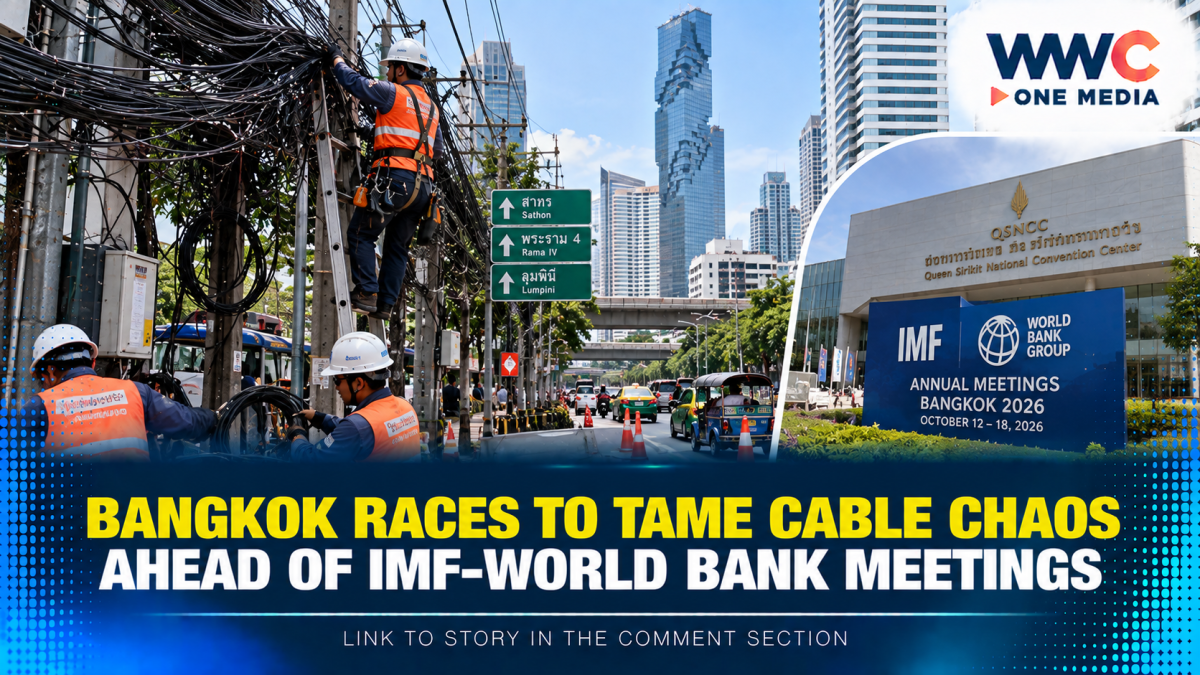
BANGKOK — Bangkok is accelerating efforts to clean up its notorious web of overhead power and telecommunications cables as the Thai capital prepares to welcome thousands of international officials for the 2026 IMF-World Bank Annual Meetings next month.
The Bangkok Metropolitan Administration (BMA), working with the Metropolitan Electricity Authority (MEA), telecommunications agencies and other partners, has launched a coordinated push to organise existing cables, remove unused lines and gradually move infrastructure underground in key parts of the capital.
The cleanup comes as Bangkok prepares to host the International Monetary Fund (IMF) and World Bank Group Annual Meetings from October 12 to 18, 2026, at the Queen Sirikit National Convention Center.
The IMF says the meetings are expected to put Bangkok at the center of global economic discussions, with Thailand hosting the event for the first time since 1991.
Bangkok’s Tangled-Cable Problem Gets Global Attention
Bangkok Governor Chadchart Sittipunt described the tangled overhead wiring as a problem that has persisted for decades.
Because the network involves electricity authorities, telecommunications providers and multiple government agencies, Chadchart said it cannot be solved by a single organisation. A coordinated approach is therefore being used to tackle the problem.
The immediate goal is not simply cosmetic.
City officials say organising the cables can improve public safety, infrastructure management and the appearance of major Bangkok roads, particularly as the city prepares to receive international delegates.
Three Ways Bangkok Is Tackling the Cable Mess
Authorities are using three main approaches.
First, where conditions and funding allow, power cables will be moved underground, electricity poles removed and telecommunications cables relocated underground as well.
Second, where underground power infrastructure is not yet available, communications cables can be placed inside existing underground conduits. This reduces the amount of wiring hanging from electricity poles.
Third, crews can take the faster route by identifying unused cables, removing them and reorganising the lines that are still active.
The methods will be applied differently depending on the infrastructure and conditions in each area.
Key Bangkok Areas Targeted Before Global Finance Summit
Several prominent areas have been prioritised ahead of the IMF-World Bank meetings, including:
- Wireless Road
- Rama IV Road
- Parts of Sathon Road
- The area around Lumpini Park
Work is already under way in sections of the capital, including efforts to relocate cables and remove infrastructure that is no longer needed.
However, Bangkok’s entire cable problem will not be solved before the international meetings.
Instead, the October summit is accelerating work that forms part of a much larger infrastructure modernisation effort.
Bangkok Wants to Stop the Cable Chaos From Returning
City Hall is also working on measures designed to prevent the problem from simply returning after the cleanup.
Under the proposed system, telecommunications companies seeking to install new cables on electricity poles would have to follow required procedures and obtain the appropriate permits. Companies that fail to comply could face legal action.
That means the challenge for Bangkok extends beyond removing today’s tangled wires: authorities are also trying to establish a system for managing new telecommunications infrastructure in the future.
Why the IMF-World Bank Meetings Matter
The cable cleanup comes as Thailand prepares for one of the country’s biggest international gatherings of the year.
The 2026 IMF-World Bank Annual Meetings will run from October 12–18 in Bangkok, bringing finance ministers, central bank officials, policymakers and other participants from around the world to the Thai capital.
Thailand’s Ministry of Finance, Bank of Thailand and IMF reported earlier this year that preparations were progressing across areas including construction, security and event logistics.
The meetings are expected to draw roughly 15,000 delegates and visitors, according to Thai government preparations reported earlier this year.
For Bangkok, the cable cleanup is therefore about more than making streets look better before international guests arrive. It also highlights a long-running infrastructure challenge that the city is attempting to address through a combination of underground construction, cable removal and tighter regulation.
And while the October deadline is putting the spotlight on Bangkok’s overhead wires, the city’s larger cable transformation is likely to continue long after the global financial gathering leaves town.
WWC ONE MEDIA G,A