
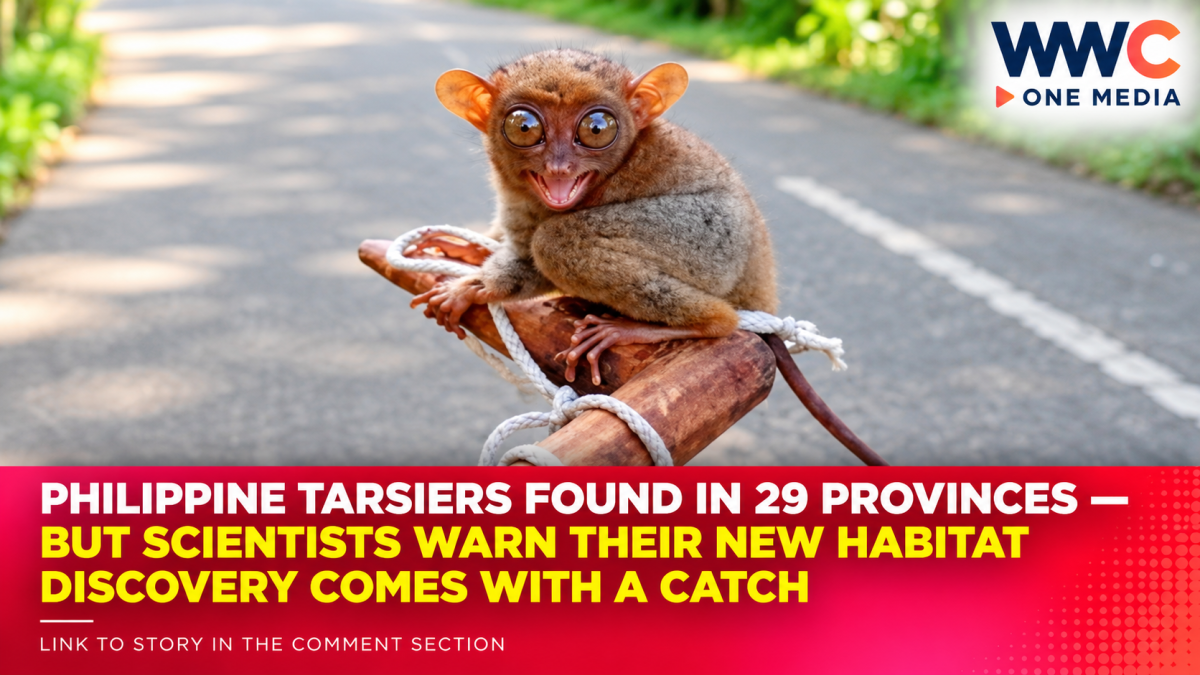
Researchers from the University of the Philippines Diliman Institute of Biology analyzed 1,125 Facebook posts published between 2006 and 2024 that contained information about Philippine tarsier encounters.
The posts documented encounters across 29 provinces in the Greater Mindanao Faunal Region — more than twice the number of provinces previously listed in the species’ IUCN range description.
The findings were published in the International Journal of Primatology in a study titled “Improving Our Understanding of a Cryptic Primate, the Philippine Tarsier (Carlito syrichta), Through Social Media.”
Researchers Maria Sabrina Tabeta and Simeon Gabriel Bejar found reports not only in the famous tarsier areas of Bohol but across Mindanao, Samar, Leyte, Camiguin and nearby islands.
The result suggests the Philippine tarsier may have a much broader distribution than conventional scientific records have captured.
Facebook became an unexpected wildlife-monitoring tool
The study highlights an unusual source of scientific information: social media.
Because Philippine tarsiers are nocturnal, small and difficult to study in the wild, researchers face major challenges documenting their populations and distribution.
By analyzing publicly available Facebook posts, however, scientists were able to identify locations that conventional field research had not adequately documented.
UP Diliman said the approach could help fill important gaps in biodiversity research and potentially be applied to other elusive wildlife species.
The researchers also launched the Philippine Tarsier Conservation and Research Initiative to encourage the public to contribute information and promote conservation awareness.
But there’s a major warning behind the discovery
Finding tarsiers in more places does not necessarily mean the species is doing better.
In fact, researchers found that only about 2.4% of the georeferenced encounters were inside designated protected areas, while approximately 3.68% were within Key Biodiversity Areas.
That means many reported encounters occurred outside the areas specifically designated for biodiversity protection.
Researchers say this could indicate that tarsiers are more capable of surviving in human-altered environments than previously believed.
But it also means humans and tarsiers are coming into closer contact.
And that can create serious risks.
Dogs, cats and development are emerging threats
The Facebook data revealed reports of tarsiers being kept in captivity, rescued, turned over to authorities, injured and even found dead.
Researchers identified several emerging threats, including attacks by domestic animals, forest fires and infrastructure development.
The study recorded 74 wild sightings, 50 turnovers to authorities, 19 cases involving confinement, 18 releases, 14 reported deaths and nine rescues, alongside hundreds of other posts and ecotourism-related encounters.
That paints a more complicated picture than simply saying the tarsier has “expanded” its habitat.
Some of the animals may be surviving in landscapes increasingly altered by humans — but those same landscapes can expose them to new dangers.
The tarsier is not just a Bohol animal
Bohol is internationally associated with the Philippine tarsier, but researchers say its distribution extends considerably farther.
A 2026 Philippine Journal of Science study documented nine tarsiers in three forest patches in Tacloban City, Leyte, during surveys conducted from July 2022 to February 2023.
The researchers found one individual in Barangay Santa Elena, three in Salvacion and five in Utap. They also documented habitat alteration, timber poaching and hunting as disturbances in the study sites.
The findings reinforce the importance of looking beyond traditional tourism sites when studying the species.
Another 2026 sighting shows how close they can live to people
In June 2026, the Department of Environment and Natural Resources reported a Philippine tarsier sighting in a cornfield in T’boli, South Cotabato.
Residents reportedly believed tarsiers lived in the surrounding area, suggesting that suitable wildlife habitat can persist even amid increasing human activity in rural landscapes.
Earlier this year, a rescued juvenile Mindanao tarsier was also released into the Piyapayungan Mountain Range in Lanao del Sur after being discovered by residents near a forest rehabilitation site.
Officials said the case demonstrated how rehabilitated forests can provide refuge for endemic wildlife.
Scientists are seeing a bigger picture
Taken together, the new findings suggest that the Philippine tarsier’s true distribution may have been underestimated for years.
But researchers are not saying every social-media sighting automatically proves a stable population.
Instead, the Facebook data provides valuable leads that can guide scientists toward locations requiring field verification and further study.
That distinction is crucial.
A photograph or social-media post can reveal where a tarsier was seen, but it does not by itself establish population size, long-term habitat viability or whether a breeding population exists at that location.
The conservation challenge
The Philippine tarsier is classified as Near Threatened on the IUCN Red List, while Philippine regulations also recognize it as threatened wildlife. DENR has previously warned communities against catching, possessing or exploiting the species.
Under the country’s Wildlife Resources Conservation and Protection Act, Republic Act No. 9147, authorities prohibit activities including the illegal collection, hunting, possession and trade of protected wildlife.
That makes responsible public behavior especially important as sightings become more common.
What people should do when they see a tarsier
Researchers and wildlife authorities have repeatedly emphasized that people should not treat tarsiers as pets or tourist props.
The public should avoid touching, capturing, feeding or disturbing them and should report concerning wildlife encounters to the appropriate environmental authorities.
GMA also highlighted responsible tourism practices, including keeping noise down and choosing ethical wildlife facilities when viewing tarsiers.
The reason is simple: these animals are extremely sensitive to disturbance, and unnecessary handling can cause stress.
The bigger story
The most fascinating part of the research may not be that Philippine tarsiers were found in 29 provinces.
It is that ordinary people posting photographs and encounters online helped scientists discover how much they still don’t know about one of the country’s most recognizable endemic animals.
Facebook did not replace scientific fieldwork.
It gave researchers a map showing where that fieldwork may need to go next.
And that could prove critical as forests disappear, cities expand and humans move increasingly closer to the tarsier’s hidden world.
WWC ONE MEDIA M.J.E




Leave a Reply