
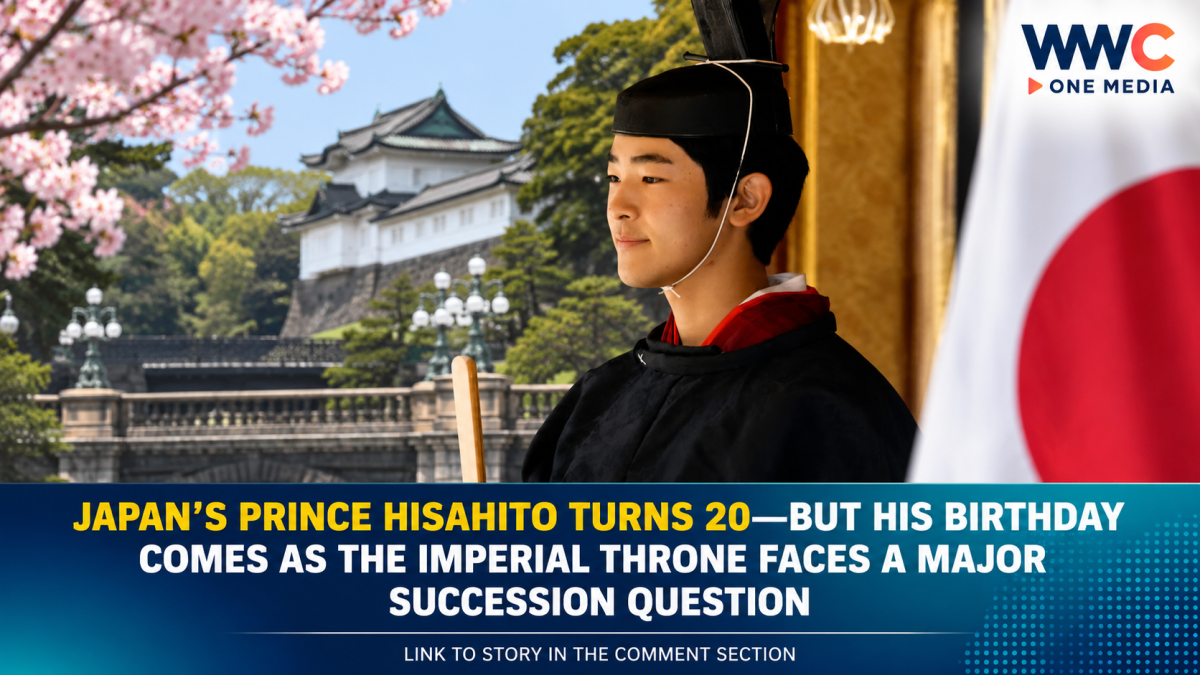
TOKYO — Japan’s Prince Hisahito has reached a major milestone, turning 20 on Sunday, September 6, as attention increasingly focuses on his future role in the country’s centuries-old imperial institution.
The son of Crown Prince Akishino and Crown Princess Kiko, Hisahito is second in line to the Chrysanthemum Throne, behind his father, and is currently the youngest member of Japan’s Imperial Family.
His 20th birthday comes at a particularly significant moment for Japan’s monarchy, as the country continues to grapple with questions surrounding the future of a rapidly shrinking imperial family and its male-only succession system.
From student to young working member of the Imperial Family
Despite his position in the line of succession, Hisahito has largely maintained the life of a university student.
He is a second-year student in the College of Biological Sciences at the University of Tsukuba, where he continues to study biology and participate in lectures, laboratory work and field exercises. The Imperial Household Agency said his studies remain his priority.
His interest in biology is closely connected to his long-standing fascination with insects, particularly dragonflies. Hisahito has previously conducted observations and research involving insects and their natural environments.
He has also become increasingly visible in official activities since reaching adulthood.
Over the past year, he attended major imperial events, including the New Year’s ceremonies and the traditional poetry-reading ceremony, where he submitted a poem inspired by his interest in dragonflies.
In May, he also took part in a palace banquet held for Philippine President Ferdinand Marcos Jr. and First Lady Louise Araneta-Marcos during their state visit to Japan. It marked one of his notable appearances in an official international setting.
A year of growing public responsibilities
Hisahito has spent much of the past year balancing university life with increasing public responsibilities.
According to Japan’s Imperial Household Agency, he visited six prefectures during the year, including Hokkaido, Mie, Kyoto, Osaka, Nara and Hiroshima.
He also participated in activities connected with Japan’s history, culture, international exchanges and sporting events. His official engagements have given him greater exposure to the responsibilities expected of a young adult member of the Imperial Family.
His coming-of-age ceremonies were held in 2025, marking his transition into adulthood within the Imperial Family. Since then, his participation in official events has gradually expanded.
Why Hisahito’s future matters so much
Hisahito’s birthday carries significance far beyond a personal milestone.
Japan’s Imperial House Law currently restricts succession to the throne to male members of the Imperial Family descended through the paternal line. That makes Hisahito particularly important to the future of the monarchy because he is the only male member of his generation currently eligible under the existing succession rules.
His father, Crown Prince Akishino, is first in line after Emperor Naruhito, while Hisahito follows him.
Emperor Naruhito’s daughter, Princess Aiko, is not eligible to inherit the throne under the current law because she is a woman, despite strong public interest in the possibility of female succession.
That has placed an unusual amount of attention on Hisahito as Japan considers how to maintain a functioning Imperial Family while its number of members continues to decline.
Japan’s succession rules remain controversial
The succession issue has become increasingly contentious in Japan.
In July 2026, Japan’s Parliament enacted revisions related to the Imperial Family that maintained the male-only succession framework while introducing measures intended to address the shrinking number of imperial family members.
Among the changes was a provision allowing certain female members of the Imperial Family to retain their status after marrying commoners. The changes also opened the door to the adoption of male members from former imperial branches under specified circumstances.
Supporters have argued that the measures are intended to preserve the Imperial institution, while critics have questioned whether the approach adequately addresses the long-term succession problem.
The debate also highlights the pressure placed on Hisahito and the future of his family.
Hisahito says his focus remains on education
For now, however, Hisahito appears focused on university life rather than the distant possibility of becoming emperor.
At an earlier press conference, he said his priority was his studies and expressed interest in gaining international experience and meeting people from different backgrounds and cultures.
When asked about marriage, he said he had not yet thought about an ideal time or a future partner.
That relatively private approach contrasts with the enormous public significance attached to his position.
At 20, Hisahito is still a young university student. Yet because of Japan’s current succession rules, his future has implications that extend well beyond his own life.
For now, the prince continues his studies, takes on selected official duties and gradually learns what it means to be a working member of Japan’s Imperial Family.
But as Japan’s monarchy confronts a shrinking pool of eligible successors, the young prince’s path from biology student to a potential future emperor is likely to remain under intense public scrutiny.
WWC ONE MEDIA J.M.S




Leave a Reply