
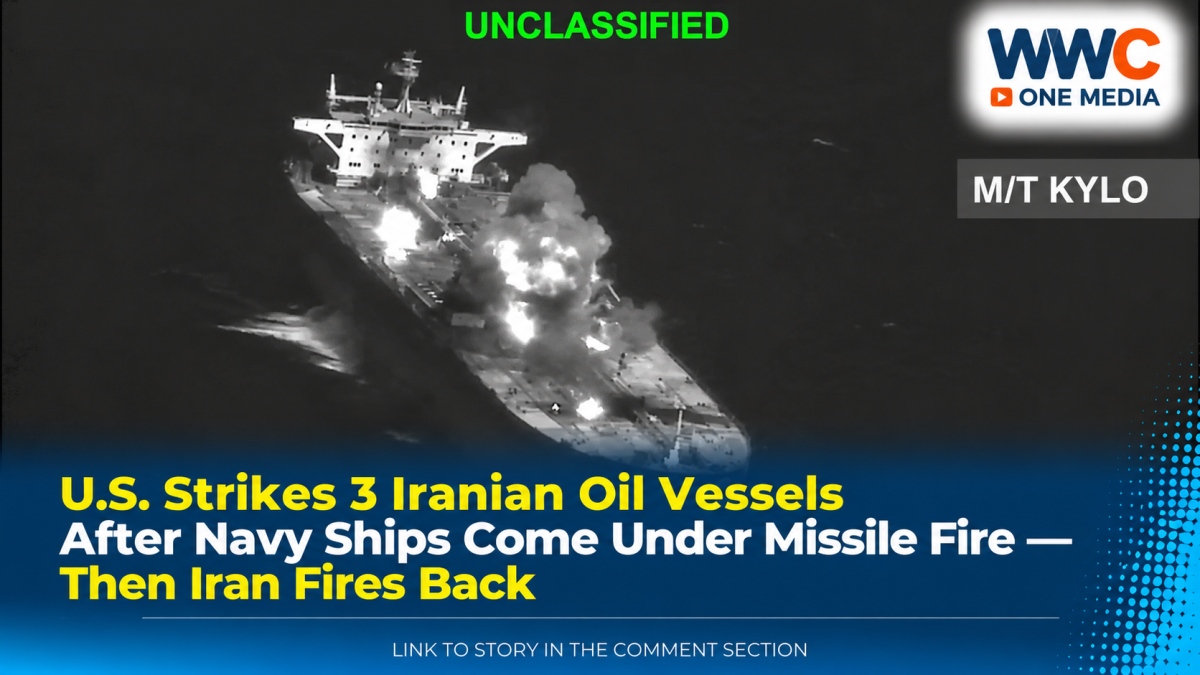
DUBAI — The already volatile confrontation between the United States and Iran has escalated sharply after American and Iranian forces exchanged attacks involving military ships and oil vessels in waters around Iran.
U.S. forces struck three Iranian oil vessels on Saturday, Sept. 5, after Iran’s Islamic Revolutionary Guard Corps allegedly launched ballistic missiles at two U.S. Navy ships, according to U.S. Central Command.
Iran later said it had targeted three tankers travelling through the Strait of Hormuz on what it described as unauthorized routes.
The exchange marked one of the most serious maritime escalations in the latest phase of the U.S.-Iran conflict — and immediately raised fresh concerns about oil supplies and the security of one of the world’s most strategically important shipping routes.
What triggered the latest U.S. strikes?
According to U.S. Central Command, Iranian Revolutionary Guard forces fired ballistic missiles at two American Navy ships.
The U.S. said its forces then struck three Iranian vessels, including one operating off the coast of Kharg Island, Iran’s main oil export hub.
Admiral Brad Cooper, head of U.S. Central Command, said the American response was intended to impose what he described as a greater economic cost on Iran following the alleged attack on U.S. ships.
U.S. authorities said no American personnel were harmed in the Iranian missile attack.
Three Iranian vessels hit
The U.S. military said it struck three Iranian oil vessels in different locations around Iranian waters.
According to the Associated Press, U.S. authorities said two vessels were permanently disabled while a third vessel that was not carrying oil was destroyed.
Washington described the targeted ships as part of a network it alleges helps finance Iran’s Revolutionary Guard and its regional partners.
Iranian sources, meanwhile, disputed elements of the American narrative, and the full extent of damage and casualties could not immediately be independently verified.
That distinction remains important as the conflict continues to produce competing claims from Washington and Tehran.
Iran says it struck tankers in Strait of Hormuz
Iran responded with its own claims of attacks on vessels.
Iranian authorities said they had targeted three tankers moving through the Strait of Hormuz on what they described as unauthorized routes.
The latest reports did not provide complete independent confirmation of all Iranian claims regarding the vessels or the extent of any resulting damage.
Still, the incident underscores how commercial shipping is becoming increasingly exposed to the U.S.-Iran confrontation.
The Strait of Hormuz is a critical maritime chokepoint connecting the Persian Gulf with international waters, and disruptions there can have immediate consequences for global energy markets.
Why Kharg Island matters
One of the U.S. strikes reportedly occurred near Kharg Island, a location of enormous importance to Iran’s oil industry.
Kharg Island serves as Iran’s principal oil export hub.
That means military activity near the island immediately raises concerns about the potential impact on Iranian oil exports and the broader global energy market.
The latest incident also follows days of heightened concern over Kharg Island, with previous reports of explosions and conflicting accounts about military activity in and around the area.
Oil markets react to the conflict
The maritime escalation comes as oil markets remain highly sensitive to developments in the Middle East.
Reuters reported that Brent crude had climbed to $96.28 per barrel amid fears that further attacks could disrupt energy supplies and shipping routes.
Earlier U.S.-Iran military exchanges had already pushed oil prices higher as traders assessed the risks surrounding the Strait of Hormuz and other major regional energy routes.
For countries heavily dependent on imported fuel, any prolonged disruption could eventually translate into higher transportation and energy costs.
The Strait of Hormuz is becoming the center of the conflict
The latest exchange did not happen in isolation.
For months, the Strait of Hormuz has increasingly become one of the central flashpoints in the confrontation between Washington and Tehran.
Iran has expanded restrictions on vessels attempting to pass through the strategic waterway, while the U.S. has intensified military operations aimed at protecting shipping and pressuring Iran’s maritime capabilities.
Reuters reported earlier this week that Iran had added more ships to a blacklist of vessels it said were forbidden from passing through the strait.
That action further disrupted commercial shipping and added pressure to energy markets already shaken by the wider conflict.
A dangerous return after a brief lull
The latest vessel strikes also follow a short period in which direct military exchanges between the United States and Iran had eased.
That lull ended earlier this week when the U.S. resumed strikes against Iranian military and maritime targets, while Iran responded with missile and drone attacks.
The Sept. 5 exchange involving oil vessels and U.S. Navy ships now signals that the confrontation is again moving into a more dangerous phase.
The Associated Press described the renewed exchange as coming after a month-long break in major military action.
Diplomatic efforts to de-escalate tensions have so far failed to produce a lasting agreement.
Commercial ships are increasingly caught in the middle
Perhaps the most worrying development for the global economy is the increasing risk to commercial vessels.
Oil tankers and cargo ships are now operating in a region where:
- U.S. and Iranian forces are exchanging military strikes
- Iran has imposed restrictions on some vessels
- Shipping companies are reassessing routes
- Naval forces are operating near major energy infrastructure
- Oil prices are reacting to fears of supply disruption
The danger is no longer limited to military bases or government facilities.
Commercial shipping itself has become part of the wider confrontation.
And because the Strait of Hormuz is one of the world’s most important energy corridors, even a limited disruption can have consequences far beyond the Middle East.
Competing claims make the situation harder to assess
As with many rapidly developing military incidents, Washington and Tehran have presented sharply different accounts.
The United States says:
- Iranian Revolutionary Guard forces fired ballistic missiles at two U.S. Navy ships.
- No American personnel were harmed.
- U.S. forces retaliated by striking three Iranian oil vessels.
- The vessels were linked to a network allegedly financing the Revolutionary Guard and its regional partners.
Iran says:
- It targeted three tankers travelling through the Strait of Hormuz on unauthorized routes.
- It has maintained restrictions on vessels moving through the strategic waterway.
Some Iranian claims about retaliatory attacks and damage have not yet been independently verified.
As a result, the final sequence of events and the full extent of damage may become clearer only after additional official disclosures and independent reporting.
What happens next?
The immediate concern is whether the Sept. 5 exchange will trigger another cycle of retaliation.
The U.S. has made clear that it is prepared to respond to attacks on its forces.
Iran has also signaled that it will continue challenging what it sees as unauthorized activity in and around the Strait of Hormuz.
That creates a dangerous equation:
More military action could mean more attacks on ships.
More attacks on ships could threaten oil flows.
And any major disruption to the Strait of Hormuz could send global energy markets into another shock.
Diplomatic efforts are continuing in the background, but recent negotiations and attempts to reduce tensions have struggled to produce a breakthrough.
A conflict that is now hitting the world’s energy lifeline
The latest exchange is about more than three Iranian vessels or two American Navy ships.
It is about control, deterrence and one of the most important waterways in the global economy.
Kharg Island sits at the heart of Iran’s oil export system.
The Strait of Hormuz remains critical to international energy shipping.
And now, both areas are increasingly exposed to direct military confrontation.
For now, U.S. forces have struck three Iranian oil vessels.
Iran says it has targeted three tankers.
No American personnel were reported harmed in the missile attack cited by Washington.
But the bigger danger may still lie ahead.
The latest exchange may be over. The risk of escalation is not.
And with oil prices already reacting to fears over supply and shipping, the next strike — or the next attack on a commercial vessel — could have consequences far beyond the waters around Iran.
WWC ONE MEDIA J.M.D




Leave a Reply