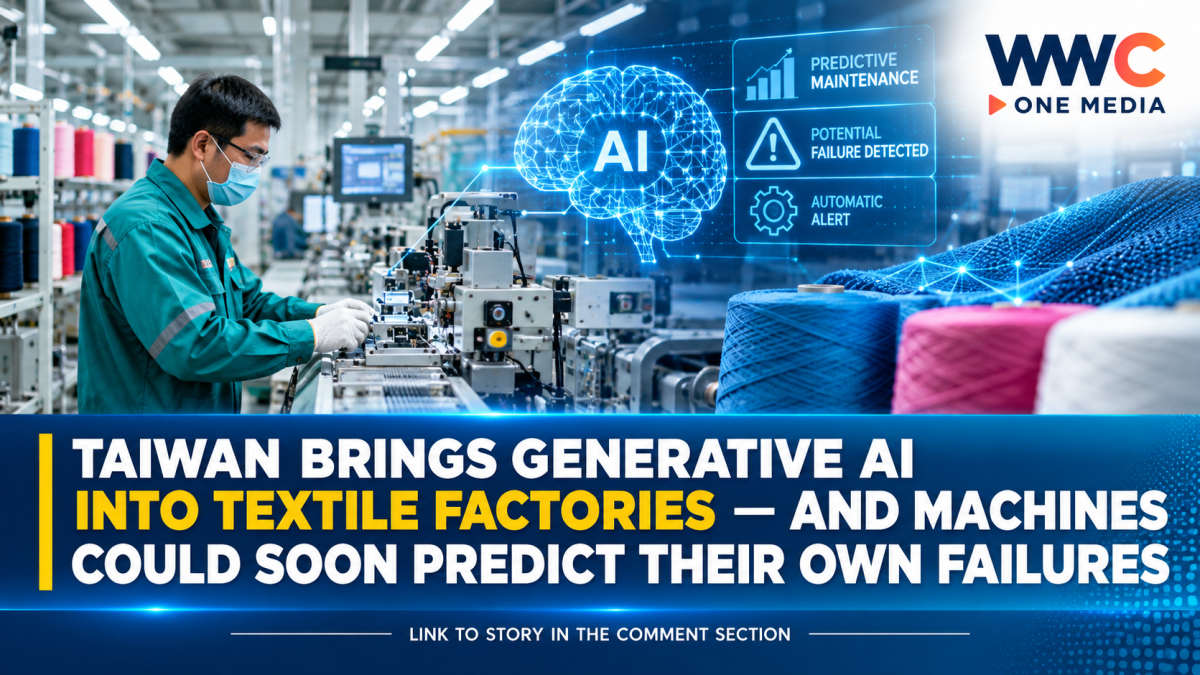
TAIPEI — Taiwan is bringing generative artificial intelligence directly onto the factory floor, with a new AI system designed to help textile manufacturers monitor knitting machines, predict maintenance needs and identify equipment problems before they lead to costly disruptions.
The technology is being developed by Taiwan’s Institute for Information Industry (III) in partnership with systems company Yotoma Technology, targeting long-standing challenges in the textile sector, including skilled-worker shortages, heavy reliance on experienced technicians and unexpected equipment downtime.
Rather than using AI simply as a chatbot, the system is designed to turn live machinery data into information factory workers can actually use.
AI moves from the office to the factory floor
The system collects operating data from knitting machines in real time and uses AI to analyze equipment health.
Workers can then ask questions about a machine’s condition using ordinary language rather than navigating complicated technical interfaces.
According to III, the system was tested with 58 questions in Mandarin and 16 in English, with all questions answered correctly during the reported test. That result comes from the project’s own testing and should not be interpreted as a guarantee of perfect performance in every factory environment.
The goal is to transform large volumes of machine data into actionable information for maintenance teams.
Instead of waiting for a breakdown, AI looks for warning signs
One of the most significant features is predictive maintenance.
The system analyzes equipment data to identify signs that components may be approaching failure, allowing factories to schedule maintenance before a breakdown occurs.
It can also estimate component life, helping manufacturers avoid replacing parts unnecessarily.
That could potentially reduce material waste while limiting unexpected production stoppages. III also says the system can identify abnormal energy consumption, giving factories another way to spot equipment problems and reduce unnecessary electricity use.
For textile manufacturers operating on tight production schedules, the difference between planned maintenance and an unexpected machine failure can be significant.
The AI stays inside the factory
Another feature could be particularly important for manufacturers worried about industrial data security.
Instead of sending factory information to an external cloud service, the generative AI system is deployed locally within the factory network.
That means production and equipment data can remain inside the company’s own environment rather than being routinely uploaded to an outside cloud platform.
The system can also manage equipment across different factory locations while keeping data from individual sites separated.
That gives companies with multiple production facilities a way to monitor operations centrally while maintaining site-level data management.
Taiwan wants AI to solve a manufacturing problem
The technology arrives as traditional manufacturers face a combination of labor shortages, rising efficiency demands and pressure to reduce energy consumption.
III says the value of AI in manufacturing is increasingly moving beyond simply collecting more data. The challenge is interpreting that data quickly enough to help workers make decisions.
The institute’s project attempts to address exactly that problem by combining Internet of Things sensors and data collection, predictive maintenance and generative AI in one manufacturing system.
In practical terms, a worker could ask about a machine’s condition and receive an AI-generated explanation based on the equipment’s available operating data.
The technology could go beyond knitting machines
The project is not limited to textile knitting equipment.
III says the modular technology could eventually be adapted for other textile machinery, including dyeing and finishing equipment.
The same approach could potentially be extended into other areas of precision manufacturing, including machine-tool applications such as tool-life management. The institute also sees potential for the technology to expand into overseas manufacturing markets, including Southeast Asia.
That would turn the project from a textile-specific experiment into a broader industrial AI platform.
The bigger shift: AI becomes part of industrial operations
The development reflects a broader change in how Taiwan is approaching artificial intelligence.
Much of the global AI boom has focused on data centers, semiconductors and consumer-facing applications. But Taiwan’s manufacturing sector is increasingly exploring how AI can operate inside factories themselves.
In this case, the technology is not being presented as a replacement for factory workers. Instead, it is designed to give employees faster access to equipment information and help them make maintenance decisions using data that might otherwise require years of technical experience to interpret.
III and Yotoma are scheduled to demonstrate the technology at ITRI ICT TechDay 2026 in Taipei from September 29-30.
The project is still an industrial technology deployment effort rather than evidence that textile factories are becoming fully autonomous.
But the direction is clear: Taiwan is pushing generative AI out of the chatbot window and deeper into the machines that keep factories running.
WWC ONE MEDIA G,A