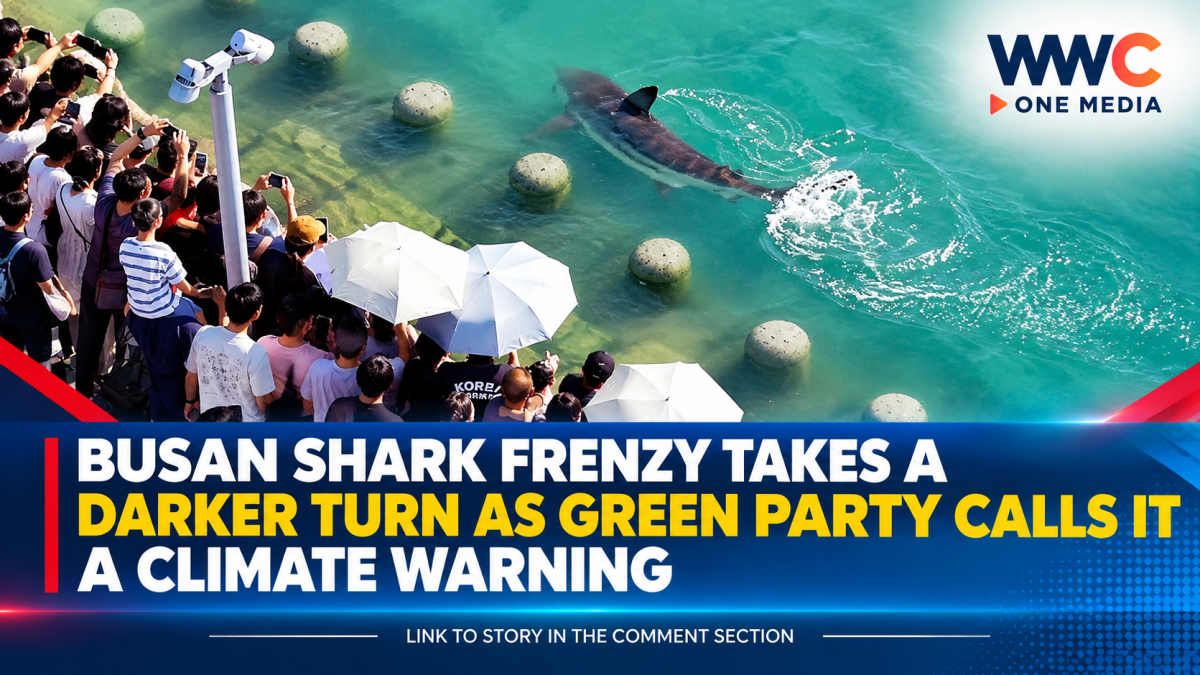
BUSAN, South Korea — A 3.5-meter shark that turned a quiet Busan waterfront into a viral attraction is now at the center of a very different conversation: whether South Korea’s warming seas are changing its marine ecosystem.
The shark was first spotted on September 18 in an artificial waterway at North Port Waterfront Park in Busan’s Dong-gu district. Days later, thousands of people were still gathering along the waterfront to catch a glimpse of the animal, which has been nicknamed “Bukang-i” after North Port.
But South Korea’s Green Party says the fascination is missing the bigger story.
In a statement titled “The Shark Came to Warn Us,” the party argued that the animal’s appearance should be viewed as a warning about rising ocean temperatures and shifting marine ecosystems rather than simply as an unusual tourist attraction.
From viral attraction to climate debate
The shark quickly became a social-media sensation, with visitors photographing it and online users creating memes and nicknames.
Nearly 20,000 people visited the waterfront park over the September 19-20 weekend, several times the park’s normal visitor numbers. Other reports put the broader weekend crowd even higher, reflecting the extraordinary public interest surrounding the animal.
The Green Party, however, said the attention should instead focus on what is happening beneath the surface.
The party cited data indicating that coastal waters around Busan have warmed by approximately 1.2 degrees Celsius since 2000. It also pointed to 73 reported appearances of large sharks along Korea’s East Coast through August 2026, compared with 29 during the same period last year.
Why are sharks appearing closer to Korea’s coast?
Marine researchers have linked the recent increase in shark sightings to changing ocean conditions.
The National Institute of Fisheries Science has said warmer waters can cause prey species such as mackerel and other warm-water fish to move northward. Predators can follow those food sources, potentially bringing large sharks closer to areas where people live and work.
A Seoul Economic Daily report similarly noted that warming seas can alter fish habitats, spawning patterns and food chains, potentially changing where predators are found. However, experts also cautioned that climate change is only one factor: currents, prey distribution and the behavior of individual sharks can also influence sightings.
That distinction matters.
The Busan shark’s presence is consistent with broader changes being observed in Korean waters, but scientists have not established that climate change alone caused this particular animal to enter the North Port waterway.
Authorities face a different problem: getting the shark back to sea
While the climate debate grows, officials are dealing with a practical safety issue.
The Korea Coast Guard initially attempted to guide the shark toward open water. Those efforts were suspended after the National Institute of Fisheries Science warned that forcing the animal through the narrow waterway could cause it to become agitated and potentially create a greater safety risk.
Authorities are now considering more cautious ways of guiding the shark out if it does not leave naturally.
Busan officials, the Busan Port Authority, the Coast Guard and the National Institute of Fisheries Science met to discuss possible measures. One option involves gradually narrowing the shark’s movement area and guiding it toward the waterway’s exit, although officials stressed that any intervention must account for the shallow conditions and the animal’s behavior.
The waterway is only about 3 meters deep, adding another complication to any attempt to move a large, powerful animal.
The shark is drawing crowds — and safety concerns
The sudden surge in visitors has become a separate concern.
Authorities have warned people not to approach the water or lean over barriers while trying to photograph the shark. Nighttime access restrictions were also introduced as crowds grew beyond what the park’s normal security arrangements could comfortably handle.
Experts have also urged people not to provoke or feed the animal.
The shark is a wild animal in an unusual environment, and attempts by spectators to interact with it could create unnecessary risks for both people and the animal.
A viral shark becomes a symbol of a changing sea
For many visitors, “Bukang-i” is an extraordinary sight and an unexpected boost for businesses around North Port.
For environmental advocates, however, the spectacle represents something more serious.
The Green Party argues that increasingly warm waters are changing which species can survive and move along the Korean Peninsula, making unusual sightings a visible reminder of a much larger environmental shift.
Other experts take a more measured position: warming seas may increase the likelihood of sharks appearing closer to Korea’s coast, but individual sightings still have multiple possible causes.
Either way, the Busan shark has turned a normally quiet waterfront into a national talking point — and transformed one unusual animal encounter into a debate over climate change, marine ecosystems and how South Korea is adapting to warmer seas.
WWC ONE MEDIA G,A