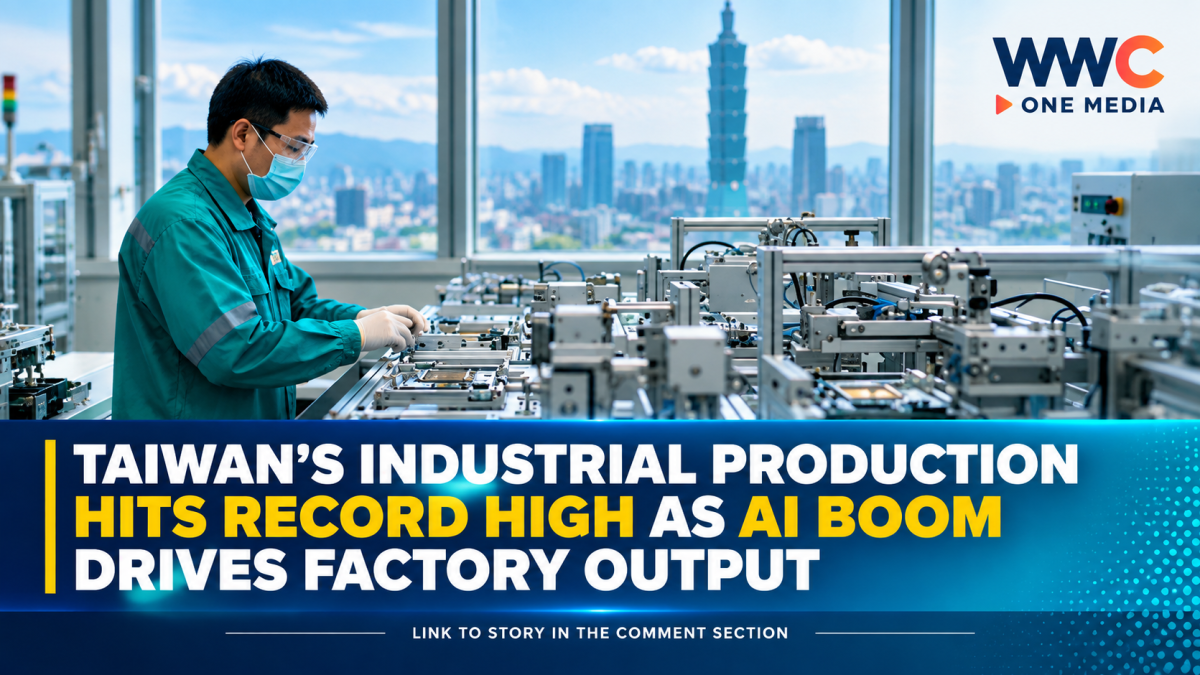
TAIPEI — Taiwan’s industrial engine accelerated again in August, with factory production hitting a new monthly record as surging global demand for artificial intelligence, high-performance computing and cloud infrastructure continued to power the island’s technology sector.
The industrial production index jumped 23.47% year on year to 145.97, according to data released September 23 by Taiwan’s Ministry of Economic Affairs (MOEA). The figure surpassed the previous record of 143.32 set in July.
Manufacturing was even stronger.
The manufacturing production index climbed 24.61% to 148.42, also a record. August marked the 30th consecutive month of year-on-year growth for both overall industrial production and manufacturing output.
AI demand is reshaping Taiwan’s factories
The latest figures underline how deeply Taiwan’s manufacturing sector has become tied to the global AI build-out.
MOEA data showed production in the electronics-components industry rose 21.68% from a year earlier. Integrated-circuit production alone increased 24.24%, supported by demand for high-performance computing and other AI applications.
The computer and optoelectronics sector delivered an even larger jump, with output soaring 95.72% year on year as demand increased for AI servers, network switches, semiconductor inspection equipment and automation systems.
The boom is benefiting a broad range of Taiwanese technology manufacturers, including foundries, memory-chip producers, IC packaging and testing companies and chip designers.
It is not just chips
While semiconductors and AI hardware remain at the heart of the surge, the impact is beginning to spread into other parts of Taiwan’s industrial economy.
Machinery production rose 18.65% in August as semiconductor companies expanded capacity and purchased more equipment to meet global AI demand.
MOEA statistics also indicate that some traditional industries have benefited from spillover demand generated by the technology sector. Officials said the traditional industrial sector has shown more stable improvement since March as technology-related demand creates additional orders for materials used in electronics and other products.
However, the recovery remains uneven.
Production of basic metals declined 0.36% from a year earlier, while chemical-material and fertilizer production fell 5.81%, reflecting weaker demand in parts of the traditional economy.
Taiwan’s eight-month numbers are even more striking
The August results pushed Taiwan’s industrial production growth for the first eight months of 2026 to 20.80% compared with the same period last year.
Manufacturing production increased 22.14% during the January-August period.
The numbers illustrate the extraordinary scale of the current technology cycle. Taiwan is a crucial manufacturing hub for advanced chips, servers, networking equipment and other components needed to build increasingly powerful AI systems around the world.
Another record could be coming
The MOEA expects manufacturing activity to remain strong in September.
The ministry projects the manufacturing production index could reach 146.03 to 150.03, representing year-on-year growth of roughly 22.5% to 25.8%.
Officials nevertheless cautioned that the global economy remains exposed to trade-policy changes and geopolitical uncertainty.
That creates an important balancing act for Taiwan: the AI boom is generating extraordinary demand for its factories, but the same concentration in global technology supply chains means any significant slowdown in AI-related investment could eventually affect production.
For now, however, the numbers tell a striking story.
Taiwan’s factories are not merely benefiting from the AI boom — they are becoming one of the industrial engines powering it.
WWC ONE MEDIA G,A