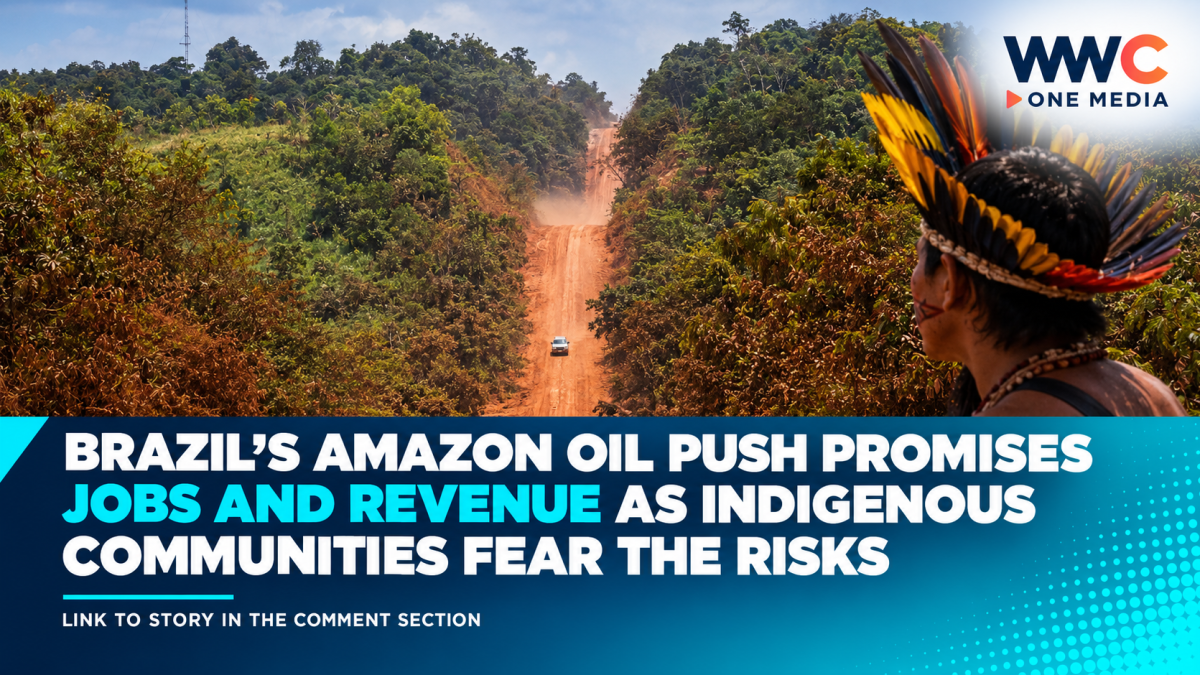
Brazil’s push to explore for oil off the Amazon coast is creating a sharp divide between hopes for new investment and energy revenue and concerns among Indigenous communities and fishermen who fear that an accident could damage their livelihoods and sensitive ecosystems.
The debate has intensified after state-run Petrobras reported signs of oil in a well about 175 kilometers off the coast of Amapá. The discovery has raised expectations in Oiapoque, a relatively poor municipality near the border with French Guiana, where residents and officials see the possibility of new jobs, infrastructure and government revenue.
Petrobras began offshore exploration in the region about a year ago after Brazil’s environmental regulator authorized drilling in the Foz do Amazonas Basin. The company is now preparing to drill three additional wells beginning in January 2027 to determine whether the discovery is commercially viable.
The potential economic gains are substantial for Amapá. A study cited in the report estimates that more than 50,000 jobs could eventually be created, while royalties from future oil production could provide additional revenue for local governments. Petrobras, however, says commercial production would not be expected for another six or seven years.
Oiapoque is already experiencing the effects of increased interest in the region. The mayor estimates the town’s population has grown far beyond the roughly 28,000 people recorded in the 2022 census, while construction and real-estate activity have accelerated. But the influx has also contributed to rising property prices and pressure on housing and public services.
For Indigenous communities along the Curipi River, the potential oil boom carries a different set of concerns. Karipuna Indigenous Chief Wagner Karipuna has warned that an offshore spill could be carried by tides toward the river and affect the community’s fishing and environment.
Petrobras has said its analyses do not indicate that oil would reach the coast in the event of a spill. But former Petrobras chief Jean Paul Prates has noted that offshore exploration cannot carry zero risk, describing the probability as low but the potential consequences as high.
Fishermen are also concerned about the economic consequences of an accident. Joelso Mendonca, vice president of a group representing nearly 400 traditional fishermen, said even fears of contamination could make consumers reluctant to buy local fish. Indigenous residents have also reported disruption from aircraft and helicopter activity associated with exploration. Petrobras says it has maintained dialogue with communities and made adjustments to air operations following consultations.
The environmental questions have already surfaced during the exploration process. In January, about 15,000 liters of synthetic drilling fluid were reported to have leaked from auxiliary lines connected to the drilling operation. Petrobras said the material met permitted toxicity thresholds and posed no environmental or safety risk, while Brazil’s environmental authorities investigated the incident.
The expansion is also facing scrutiny from Brazil’s Federal Public Ministry. In August, prosecutors asked Ibama to explain Petrobras’ request to drill three additional exploratory wells, raising concerns about cumulative environmental impacts and whether the new operations could be authorized simply by changing conditions attached to an existing license.
The oil project has broader significance because Brazil is simultaneously promoting itself as a major player in climate policy. The country’s government has argued that oil revenues can help finance the transition toward cleaner energy, while environmental and Indigenous groups have questioned whether expanding fossil-fuel production is compatible with Brazil’s climate commitments.
The economic argument is particularly important for communities such as Oiapoque, where poverty remains widespread and residents are looking for better jobs and infrastructure. At the same time, rapid growth without adequate housing, health services, sanitation and environmental safeguards could create new problems even if the oil industry succeeds.
The next phase will therefore be closely watched. Petrobras’ additional drilling is intended to establish whether the recent discovery can support commercial production, while regulators and local communities will continue to assess the environmental and social consequences.
For Brazil, the Amazon oil frontier now represents a difficult balancing act between energy development, local economic opportunity, Indigenous rights and environmental protection — with the results of the next round of drilling likely to determine how far the country takes the project.