
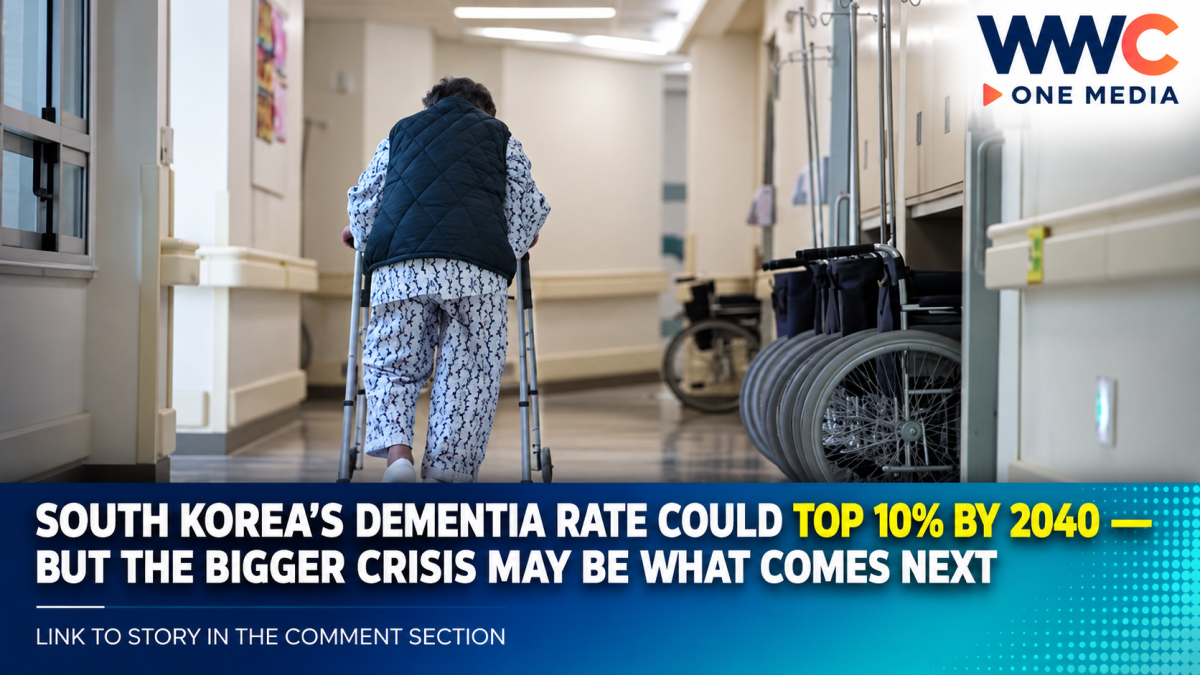
South Korea is facing a rapidly growing dementia challenge, with the government projecting that more than one in 10 people aged 65 and older could be living with dementia by 2040.
The projection, reported by The Korea Herald and based on an analysis by the Ministry of Health and Welfare using national population projections and dementia prevalence data, puts the estimated dementia prevalence among Koreans aged 65 and above at 10.34% in 2040. The rate is projected to rise further to 11.81% by 2050.
That means the issue is no longer simply about treating a growing number of patients. South Korea’s accelerating population aging is also expected to put increasing pressure on healthcare spending, caregivers and social-support systems.
Dementia rate expected to rebound after temporary decline
The Ministry’s analysis shows that dementia prevalence among Koreans aged 65 and older actually edged down from 9.17% in 2020 to 9.09% in 2025.
But that decline is not expected to continue.
Officials project the rate will climb to 10.34% by 2040 and 11.81% by 2050. Based on the projected 2050 population aged 65 and older, that would translate to roughly 2.23 million people living with dementia.
The projection is particularly significant because South Korea has already entered what demographers classify as a “super-aged” society.
South Korea is aging at extraordinary speed
The Korea Herald reported that people aged 65 and older accounted for 20.3% of South Korea’s population in 2025. The country’s senior population is projected to exceed 30% by 2036 and 40% by 2050.
Other demographic data reinforces the scale of the shift. Yonhap reported that more than one in five South Koreans was already 65 or older in 2025, with the senior population exceeding 10.8 million.
This rapid demographic transition is one of the reasons dementia is becoming a major long-term healthcare and social-policy issue.
The financial burden is already climbing
The projected increase in dementia prevalence comes as medical spending associated with the condition has already surged.
According to the National Health Insurance Service’s Health Insurance Research Institute, medical expenses for dementia patients aged 40 and older reached 1.1557 trillion won in 2012.
By 2016, the figure had passed 2 trillion won, and by 2020 it exceeded 3 trillion won.
In 2023, dementia-related medical expenses reached approximately 3.337 trillion won — a 141.4% increase from 2013.
The Health Insurance Research Institute projects that dementia-related medical spending could reach between 3.7 trillion and 4.4 trillion won by 2030, depending on the scenario used.
Older women face a particularly heavy burden
The spending data also reveals a striking gender and age pattern.
In 2023, people aged 80 and above accounted for 52% of dementia-related medical expenses among men.
For women, the proportion was substantially higher: 82% of dementia-related medical expenses came from patients aged 80 and above.
Researchers estimate that women could account for about 65% of dementia patients by 2030, while people aged 80 and above are expected to make up more than half of all patients.
The bigger problem goes beyond hospital bills
South Korea’s aging crisis could affect far more than the healthcare system.
The Bank of Korea has previously warned that spending on pensions and medical care could rise from around 10% of GDP in 2025 to approximately 20% by 2050 if current conditions persist. The central bank linked the increase to rapid population aging and a shrinking workforce.
South Korea’s National Assembly Budget Office has likewise warned that the growing elderly population and declining working-age population will increase demand for government support programs, creating pressure to examine how elderly-care policies are financed and how effectively public spending is used.
The challenge, therefore, is not simply how to treat dementia. It is how families, communities, healthcare providers and the government will provide long-term care as the population ages.
What the numbers really mean
The latest projection does not mean that 10.34% of South Korea’s entire population will have dementia in 2040.
The figure applies specifically to people aged 65 and older.
That distinction is important because dementia prevalence rises sharply with age, while South Korea’s older population is itself expanding rapidly.
The projections also do not mean every person who reaches 65 will develop dementia. They are population-level estimates based on demographic and epidemiological data.
Still, the direction is clear: South Korea is moving toward a substantially older society, and dementia is expected to become an increasingly important healthcare, caregiving and economic issue.
WWC ONE MEDIA M.J.E




Leave a Reply