
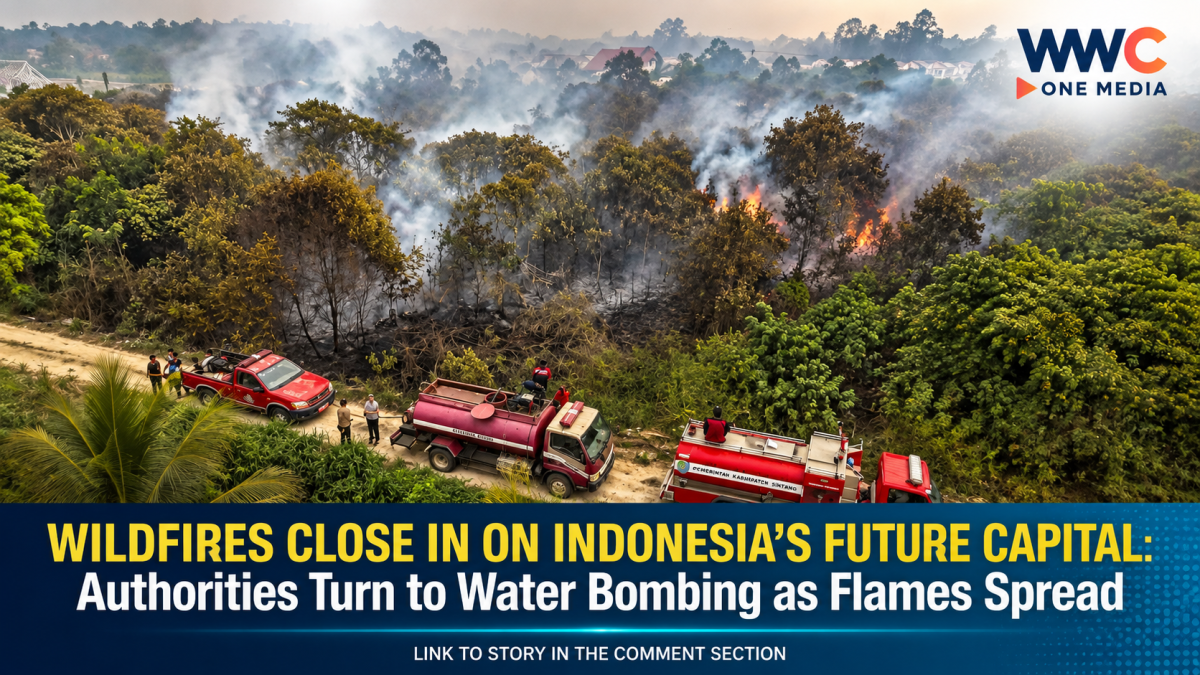
JAKARTA — Indonesia has launched aerial water-bombing operations to help contain wildfires spreading around Nusantara, the country’s planned new capital in East Kalimantan, as authorities confront an increasingly severe forest and land-fire season across the archipelago.
The operation is aimed at stopping fires in areas surrounding Nusantara from advancing toward the core development zone of the under-construction capital.
Nusantara Capital Authority environment and natural resources deputy Myrna Asnawati Safitri said the aerial operation is being used alongside ground firefighting efforts. Water bombing is intended not only to attack active flames but also to cool areas that have already been extinguished on the ground, reducing the risk of fires reigniting.
The operation was initially scheduled to continue through Sunday and could be extended if conditions require it. Officials said that, so far, construction activities inside the main development area have not been disrupted by the fires or haze.
Around 400 hectares burned around Nusantara
The situation has nevertheless raised concern because fires have moved closer to an area Indonesia hopes will eventually become the country’s political center.
Reuters reported that fires had burned approximately 400 hectares around Nusantara as of September 2, with the largest affected area located in the Bukit Suharto forest park, where roughly 300 hectares had burned.
Bukit Suharto is approximately 50 kilometers from Nusantara’s city center, where major government and infrastructure projects are being developed.
Indonesia’s Air Force has also deployed a Caracal helicopter equipped with a water bucket to fight a separate fire near Sukomulyo Village in East Kalimantan.
According to ANTARA, the fire was approximately 44 kilometers from Nusantara and had reignited after earlier firefighting efforts. Around five hectares of land were reported burned at that site before the aerial operation was deployed.
Fires are much larger than the Nusantara area
The threat surrounding Nusantara is part of a much wider wildfire crisis.
Indonesia has been battling fires across Sumatra and Kalimantan, with authorities intensifying operations in six provinces. Reuters reported that fires in those priority areas had reached more than 73,000 hectares, while separate national figures cited by Indonesia’s Forestry Ministry indicated that nearly 286,000 hectares had been scorched nationwide from January through late August.
The prolonged dry season has made conditions particularly dangerous.
Reuters described the current season as one of Indonesia’s most challenging in a decade, with an intense El Niño contributing to hotter and drier conditions that can accelerate the spread of forest and peatland fires.
Peatlands present an additional problem because fires can continue smoldering below the surface even after visible flames are extinguished, making rainfall and sustained ground operations critical to preventing flare-ups.
Water bombing, cloud seeding deployed
Indonesia is using multiple strategies to fight the fires.
Authorities have deployed aircraft for aerial water bombing and are also conducting weather-modification operations, including cloud seeding, when atmospheric conditions allow.
CNA, citing Reuters, reported that Indonesia had 53 aircraft involved in water-bombing and weather-modification activities, while Japan has also provided aircraft and personnel to assist the firefighting response.
ANTARA reported that Indonesia’s Forestry Ministry planned to maximize cloud seeding, aerial water bombing and ground firefighting teams throughout September because seasonal rainfall has been delayed. Officials said forecasts indicated that natural rainfall might not return in some areas until early October.
Haze spreads beyond Indonesia
The fires are also creating a regional environmental concern.
Smoke from fires in Sumatra and Borneo has contributed to haze affecting neighboring parts of Malaysia, Singapore and the Philippines, according to AFP and other regional reports.
The crisis has already had serious consequences in parts of Malaysia. The Associated Press reported that severe smoke affected Sarawak, where nearly 600 schools were temporarily closed and around 200,000 students were affected during periods of hazardous air quality.
Indonesia has also stepped up investigations into suspected causes of the fires. Reuters reported that authorities were inspecting companies whose concession areas contained fires, while Indonesian police had arrested dozens of people suspected of starting forest fires.
What happens to Nusantara now?
The latest reports do not indicate that Nusantara’s central government construction zone has been overtaken by fire or that the capital project has been evacuated.
Instead, authorities are working to prevent fires in surrounding areas from reaching the core development zone.
That distinction is important.
Nusantara is being built in a heavily forested part of eastern Borneo, and the combination of forests, dry conditions and limited water availability has raised questions about the long-term challenges of maintaining a large new urban center in the region.
The capital project itself has also faced delays and budget pressures since President Prabowo Subianto took office in 2024. The move from Jakarta was originally championed by former president Joko Widodo, but the full transfer of the executive, legislative and judicial branches has yet to occur.
For now, Indonesia’s immediate priority is clear: keep the flames away from Nusantara while containing a much broader wildfire crisis across the country.
And with September expected to remain a critical month for firefighting, authorities may need more than helicopters and water bombing if significant rainfall does not arrive soon.
The bigger question now is whether the fires can be contained before the dry season turns the area around Indonesia’s planned new capital into an even larger danger zone.
WWC ONE MEDIA J.M.S

Leave a Reply