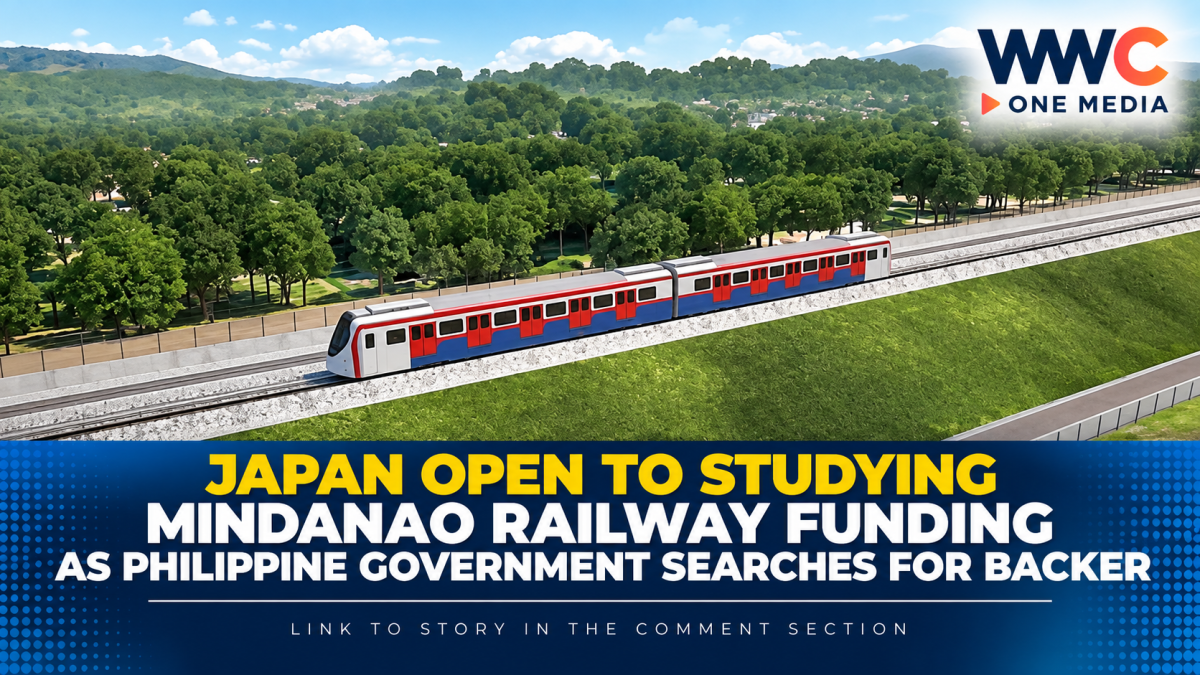
Japan is open to studying possible funding support for the long-delayed Mindanao Railway Project if the Philippine government formally asks for assistance, Japanese Consul General in Davao Hirotaka Ono said.
Ono made the statement during the Japan-Philippines Friendship Kadayawan Matsuri Night in Davao City on September 18, saying Japan was prepared to study a possible role if Manila sought its assistance.
“Of course, we will study if the Philippine government asks for assistance. We are ready to study,” Ono said.
He clarified, however, that there are no funding negotiations at his level and that any formal discussions would be handled through the Japanese Embassy in Manila. The statement therefore signals openness to discussions, not a confirmed Japanese financing package.
The Mindanao Railway remains one of the country’s major infrastructure projects but continues to face uncertainty over financing. The government previously ended efforts to secure Chinese funding, prompting the Department of Transportation (DOTr) to explore alternative sources, including foreign governments, development partners and investors.
The proposed 2027 national budget currently contains no dedicated allocation for the Mindanao Railway. During a House budget hearing, the DOTr said it was still looking for potential investors, while Cagayan de Oro Rep. Rufus Rodriguez proposed an additional P30 billion for transportation projects, including the local counterpart that could be used once foreign financing for the railway is secured.
Phase 1 of the railway is planned as a roughly 100-kilometer corridor connecting Tagum City, Davao City and Digos City. The project is intended to improve passenger mobility and connectivity across the Davao Region, with the government envisioning a major rail network serving broader areas of Mindanao.
The government is also continuing technical preparations. Acting Transportation Secretary Giovanni Lopez told lawmakers that the project was nearing the final stages of its pre-feasibility work and entering its feasibility-study phase while the DOTr searches for a financing partner.
Japan already has a substantial infrastructure presence in Mindanao. Its development assistance has supported projects including the Davao City Bypass Road, flood-control initiatives and Metro Davao planning, while Japan has also maintained a long-standing role in the Mindanao peace process.
Japan is not the only country being considered. President Ferdinand Marcos Jr. met with Indian transport officials in September to explore cooperation on several Philippine railway projects, with the Mindanao Railway identified as the first priority for further study.
Meanwhile, preparations for the Mindanao Railway have already affected communities along its proposed route. At least 159 families in the Davao Region have reportedly been relocated for the project even as a firm construction timetable remains unavailable.
For now, Japan’s position gives the Philippine government another potential avenue as it searches for financing. But any Japanese role would still depend on a formal Philippine request, further project studies and subsequent financing discussions.
The railway remains on the government’s infrastructure agenda — but until a financing partner is secured, its transition from preparation to actual construction remains uncertain.