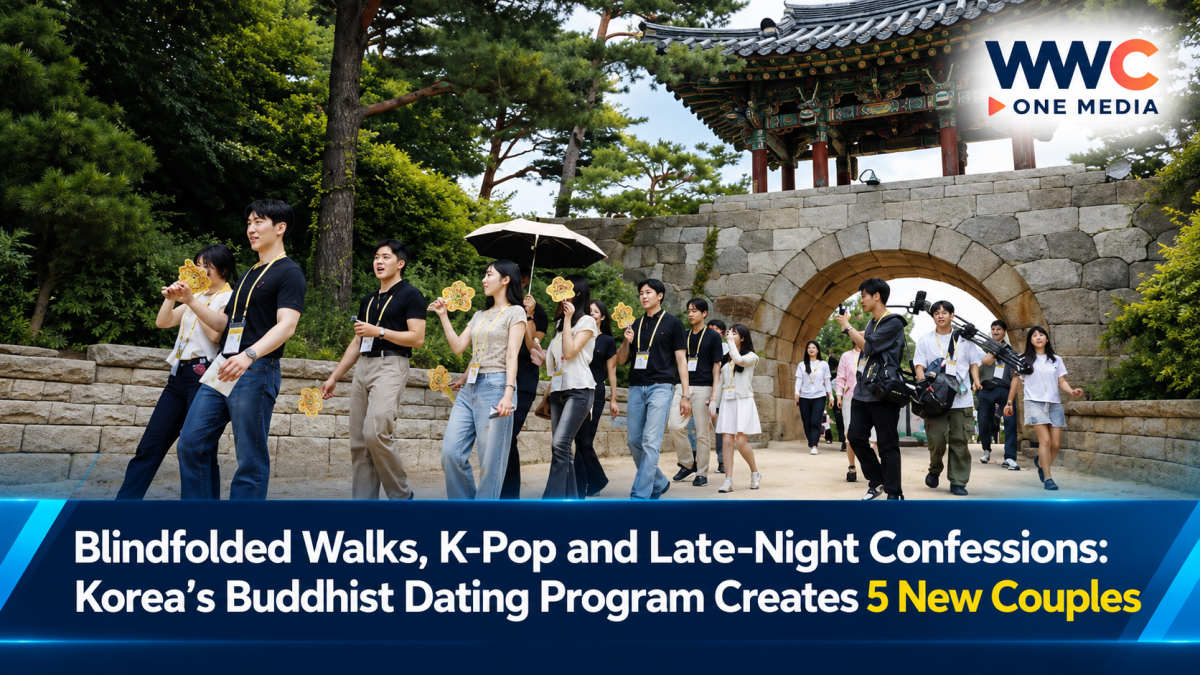
South Korea’s Buddhist matchmaking program is putting a very modern twist on finding love, combining temple-inspired activities with blindfolded walks, tea conversations, K-pop performances and late-night dates.
The latest edition of “I Am Jeollo” (Naneun Jeollo) brought 20 single participants together on Sept. 19 at the Korea Culture Training Center in Gongju, South Chungcheong Province. The program attracted 513 applicants, with just 20 people — 10 men and 10 women — selected to participate.
By the end of the event, five couples had formed, adding another chapter to a matchmaking project operated by the Jogye Order of Korean Buddhism’s Social Welfare Foundation.
Blindfolded Dates Put Trust to the Test
One of the most unusual activities was a blindfolded walking date.
Participants paired up, with one person wearing a blindfold while the other guided them along a walking course. The roles were later reversed, giving both participants an opportunity to experience relying on someone they had only recently met.
The activity was designed around trust and communication rather than simply making a first impression.
The event also included randomly assigned dates, rotating tea conversations and group discussions, giving participants repeated opportunities to meet different people instead of remaining with one partner throughout the program.
K-Pop Brings a Different Energy to Buddhist Matchmaking
The program also showed how contemporary Korean pop culture can be incorporated into an event rooted in Buddhist temple culture.
During a talent segment, one participant performed choreography from girl group RESCENE’s “Love Attack,” while another participant impressed the group with a push-up performance. The activities were intended to give participants a more relaxed way to reveal their personalities.
The unusual combination reflects a wider trend in South Korea in which Buddhist organizations have been experimenting with more contemporary formats to connect with younger generations.
The Korea Herald previously reported that the country’s “hip Buddhism” movement has included pop-up stores, merchandise, music events and other programs designed to make Buddhist culture more approachable to younger audiences.
From Tea Conversations to Midnight Dates
As the day progressed, conversations became more personal.
Participants used evening dates to discuss their views on relationships, while some continued talking after the official program ended. According to Hankook Ilbo, informal dates continued until around 1 a.m., with at least one participant approaching someone he was interested in and asking to spend more time together.
The five couples formed during the Gongju event were not the program’s first successful matches this year.
Hankook Ilbo reported that previous 2026 editions produced six couples at Seonunsa, eight at Donghwasa and five at Naksansa, before the latest five-couple result in Gongju.
Why “I Am Jeollo” Is Drawing Attention
The name “I Am Jeollo” is a play on the popular Korean dating reality show “I Am Solo,” with the Buddhist program replacing the conventional dating-show setting with temple-related experiences.
The initiative has been running in different forms for years. The Korea Times reported in 2025 that the program had been organized by the Jogye Order’s Social Welfare Foundation and was redesigned under the “I Am Jeollo” name in 2023.
Interest has been substantial. A separate Naksansa edition held earlier in 2026 received 4,225 applications for only 20 places, according to Korean agricultural news outlet Nongmin.
That event attracted 1,655 male applicants and 2,570 female applicants, making it the program’s largest applicant pool since its 2023 relaunch.
More Than Just a Dating Event
Organizers say their involvement does not necessarily end when the weekend does.
Hankook Ilbo reported that organizers maintain contact with participants after events, offering relationship and life advice and sometimes helping participants from different program sessions meet. Organizers also consider factors such as age differences and where applicants live when selecting participants.
The program’s growing popularity comes against the backdrop of South Korea’s long-running demographic challenge and efforts by various organizations to encourage young adults to form relationships and families.
But “I Am Jeollo” is also becoming part of a broader transformation in how younger Koreans encounter Buddhism. Recent reporting from the Korea Herald and Korea JoongAng Daily shows Buddhist organizations increasingly using music, design, pop culture and social-media-friendly experiences to reach younger audiences.
For the latest Gongju participants, however, the formula was ultimately less about religion, dating-show drama or elaborate matchmaking — and more about giving 20 strangers enough opportunities to talk, laugh, trust one another and decide whether they wanted to continue meeting after the event.
And this time, five pairs decided to take that next step.
WWC ONE MEDIA G,A