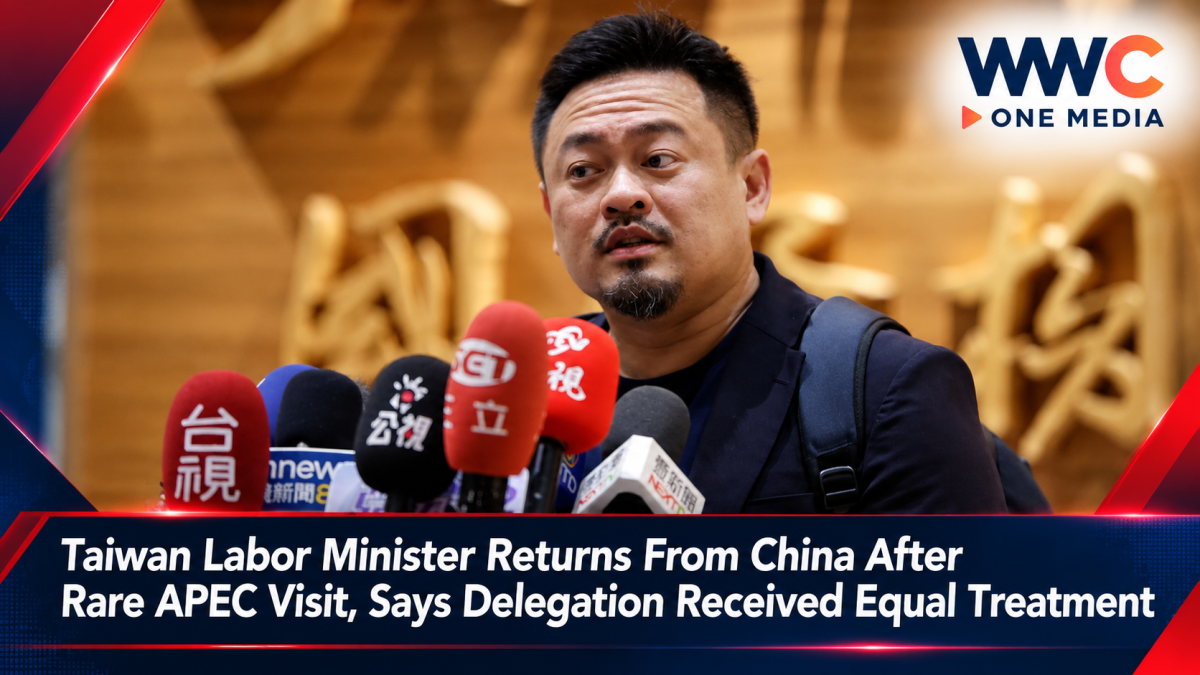
TAIPEI, Taiwan — Taiwan Labor Minister Hung Shen-han has returned from Nanjing after attending an Asia-Pacific Economic Cooperation (APEC) ministerial meeting, marking the first visit to China by a Cabinet-level official under President Lai Ching-te’s administration.
Hung said Taiwan’s delegation was treated in accordance with APEC rules and received the same rights as other participating economies, pushing back against concerns that Taiwan’s participation could be politically downgraded during the meeting.
The three-day trip drew significant attention because cross-strait relations remain politically tense. Reuters reported that Hung was the first senior official from Lai’s administration to travel to China, making his participation one of the rare high-level Taiwan-China interactions in recent years.
Hung says Taiwan was not downgraded
Speaking after returning to Taiwan, Hung said his delegation encountered no situation in which Taiwan was denied the rights normally granted to APEC members.
According to Focus Taiwan/CNA, Hung said the Chinese side provided equal rights under established APEC procedures, with assistance from the APEC Secretariat. He described the arrangement as consistent with Taiwan’s insistence on “reciprocal dignity.”
Taiwan has participated in APEC since 1991 under the name Chinese Taipei, a designation that has remained unchanged across different administrations, according to Taiwan News.
No Taiwan Compatriot Permit used
One of the most closely watched details of Hung’s trip was how he would enter China.
Hung said he did not apply for or use a Taiwan Compatriot Permit, a travel document issued by Chinese authorities to Taiwanese travelers. Instead, he entered China using an APEC invitation and traveled through a dedicated channel arranged for participants, according to Taiwan News and Focus Taiwan/CNA.
Reuters likewise reported that Hung entered China using the official invitation for the APEC meeting rather than the Taiwan Compatriot Permit.
The arrangement allowed the visit to proceed within the framework of Taiwan’s established participation in APEC rather than as a conventional bilateral visit between Taipei and Beijing.
AI and workers’ rights dominate the meeting
While the political significance of the trip attracted attention, the actual APEC meeting focused on labor and workforce issues.
The Human Resources Development Ministerial Meeting in Nanjing examined how artificial intelligence, technological change and demographic shifts are reshaping employment.
Ministers discussed workforce development, vocational training, employment and social-security systems. The meeting concluded with a joint statement supporting cooperation on high-quality employment, investment in people, vocational training and adaptable social protection.
Hung also highlighted the need for worker protections to keep pace with technological development.
Taipei Times reported that he called for stronger protections for platform workers, more flexible work arrangements for people raising children, and responsible AI governance designed to prevent technological advances from undermining workers’ rights.
Hung rejects interpretation of the trip as a thaw
Despite the unprecedented nature of the visit under the Lai administration, Hung said his participation should not automatically be interpreted as evidence of improving cross-strait relations.
He argued that APEC holds ministerial meetings covering numerous areas throughout the year and that attending an international meeting related directly to his responsibilities as labor minister was part of his official duties.
Reuters also reported that Beijing continues to reject repeated offers of dialogue from Lai’s government, while Chinese military and political pressure around Taiwan remains a significant backdrop to cross-strait relations.
The visit therefore occurred within a specific multilateral framework rather than representing the restoration of regular bilateral government exchanges.
Why the visit matters
Hung’s trip is significant because Cabinet-level official travel between Taiwan and mainland China has become rare amid worsening political tensions.
Taipei Times reported that Hung’s visit was the first trip to China by a ministry head since Lai’s administration took office in May 2024. Taiwan News described it as the first minister-level visit to China since former President Tsai Ing-wen took office in 2016.
At the same time, Taiwan has continued participating in APEC activities hosted in China under the organization’s established rules.
Hung said international participation provides Taiwan with opportunities to showcase its experience, particularly on emerging issues such as AI’s impact on employment and workers’ rights.
The episode highlights the delicate balance surrounding Taiwan’s participation in international organizations: Taipei seeks to maintain meaningful international engagement while navigating China’s objections and the broader political tensions across the Taiwan Strait.
For now, Hung’s account of the Nanjing meeting points to a visit conducted under established APEC procedures, while both sides remain divided over the broader political relationship.
WWC ONE MEDIA G,A