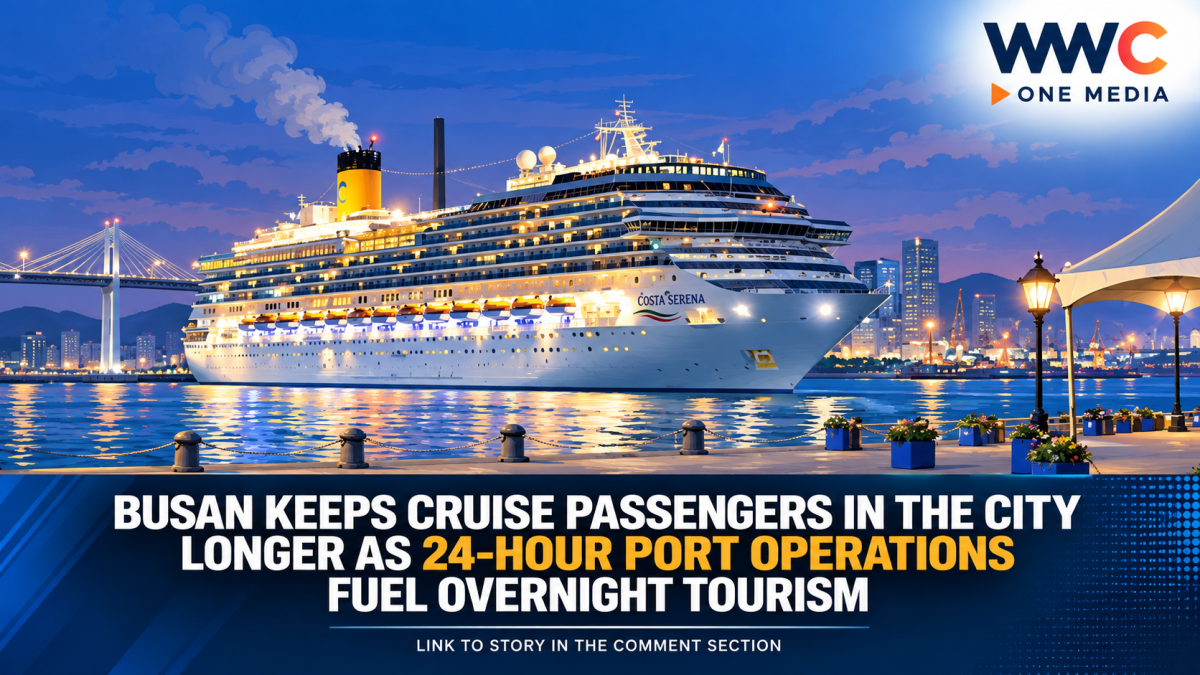
BUSAN, South Korea — Busan is changing the way it welcomes cruise travelers, moving beyond short daytime stopovers and expanding opportunities for passengers to stay out later, explore the city at night and spend more time in local businesses.
The shift follows the introduction of 24-hour operations at Busan’s cruise terminal, which has helped create conditions for more overnight cruise calls. Busan officials say the strategy is designed to connect cruise tourism with nighttime attractions, dining, shopping and cultural experiences across the city.
The latest example arrived on September 18, when the luxury residential cruise ship The World entered Busan Port for a two-night, three-day stay.
According to Busan City, The World is the fifth overnight cruise call to visit Busan this year since the 24-hour terminal operating system was established. Two additional overnight cruise calls are scheduled for September.
From Day Trips to Overnight Stays
For years, cruise passengers visiting Busan were often limited by terminal operating hours, with the previous system requiring passengers to return to their ships by around 10 p.m.
The new 24-hour system removes that operational constraint by maintaining customs, immigration, quarantine, security and facility-management services during nighttime hours. That allows passengers on qualifying overnight itineraries to remain in the city later rather than being forced back onboard because of terminal restrictions.
Busan is now attempting to turn that extra time into greater economic activity.
The city and Busan Tourism Organization are developing programs connecting cruise passengers with nighttime tourism, restaurants, shopping and cultural attractions, while also working with cruise companies to promote longer stays and more overnight calls.
The World Puts the Strategy on Display
The World, a residential luxury cruise ship known for extended stays at destinations, is scheduled to remain in Busan for two nights.
For passengers, the longer stay creates more time to explore beyond the usual daytime sightseeing window.
Busan is providing a tourism information desk onboard and a concierge service to help visitors with transportation, currency exchange, shopping and telecommunications information.
On September 19, the city is also supporting a nighttime tourism program for interested cruise passengers, including an opportunity to watch the Gwangalli drone show.
The goal is straightforward: give visitors more time in Busan and encourage spending to spread beyond the port itself.
Busan Wants Cruise Tourism to Become a Bigger Economic Engine
The overnight strategy is part of a much larger cruise-industry plan.
The Busan Port Authority has set a goal of attracting 1 million cruise tourists annually by 2030, alongside 520 cruise calls. Its strategy calls for a transition from a traditional port-of-call model toward a combination of homeport, semi-homeport and longer-stay cruise operations.
The authority’s 2030 plan includes expanding air-and-rail connections, developing overnight cruise products and improving cruise-terminal infrastructure.
It also plans to expand the North Port cruise terminal’s customs, immigration and quarantine facilities and develop a dedicated terminal capable of handling ships carrying more than 5,000 passengers by 2030.
Luxury Cruise Lines Are Expanding Their Busan Plans
The push is already extending beyond individual overnight visits.
The Busan Port Authority recently signed agreements with European luxury cruise companies PONANT and Silversea aimed at expanding homeport and overnight operations in Busan.
PONANT plans to increase its Busan homeport sailings, while Silversea is expected to raise its Busan calls substantially in 2027 and introduce overnight sailings.
The strategy also includes a Fly-Rail & Cruise concept, allowing international travelers to arrive in South Korea through Incheon, tour Seoul, take the KTX to Busan and then board a cruise.
That model would position Busan not simply as somewhere a cruise ship stops, but as a destination where a longer Korean travel itinerary begins or ends.
Busan’s Cruise Boom Is Already Accelerating
The numbers behind the strategy are significant.
The Busan Port Authority said 203 cruise calls brought about 257,000 cruise tourists in 2025. During the first half of 2026, Busan had already recorded 219 cruise calls and approximately 320,000 visitors, with the full-year total projected at about 420 calls and 700,000 visitors.
The port authority’s longer-term target of 1 million annual cruise tourists therefore represents a substantial expansion from current levels.
Busan’s challenge will be converting those arrivals into longer stays and broader local spending rather than simply increasing the number of ships passing through.
Why the Extra Hours Matter
A cruise passenger who stays only during daylight hours has limited opportunities to experience Busan’s nighttime economy.
An overnight passenger, by contrast, can potentially visit restaurants, evening entertainment, shopping districts and nighttime attractions before returning to the ship.
That is why Busan is linking its 24-hour terminal operations with tourism programming rather than treating extended port hours simply as a logistics upgrade.
The city says it plans to continue developing nighttime tourism and longer-stay programs while promoting Busan’s overnight-port capabilities to international cruise operators.
Busan’s Cruise Ambition Is Getting Bigger
Busan is increasingly positioning itself as a Northeast Asian cruise hub, using its port infrastructure, tourism attractions and transportation links to compete for longer itineraries and homeport operations.
The latest overnight calls suggest the city’s cruise strategy is moving toward a new model: not just getting passengers off the ship, but giving them a reason to stay in Busan after sunset.
If the city can turn its growing cruise arrivals into longer visits, more overnight calls and greater local spending, Busan’s port could become an increasingly important gateway for cruise tourism in Northeast Asia.