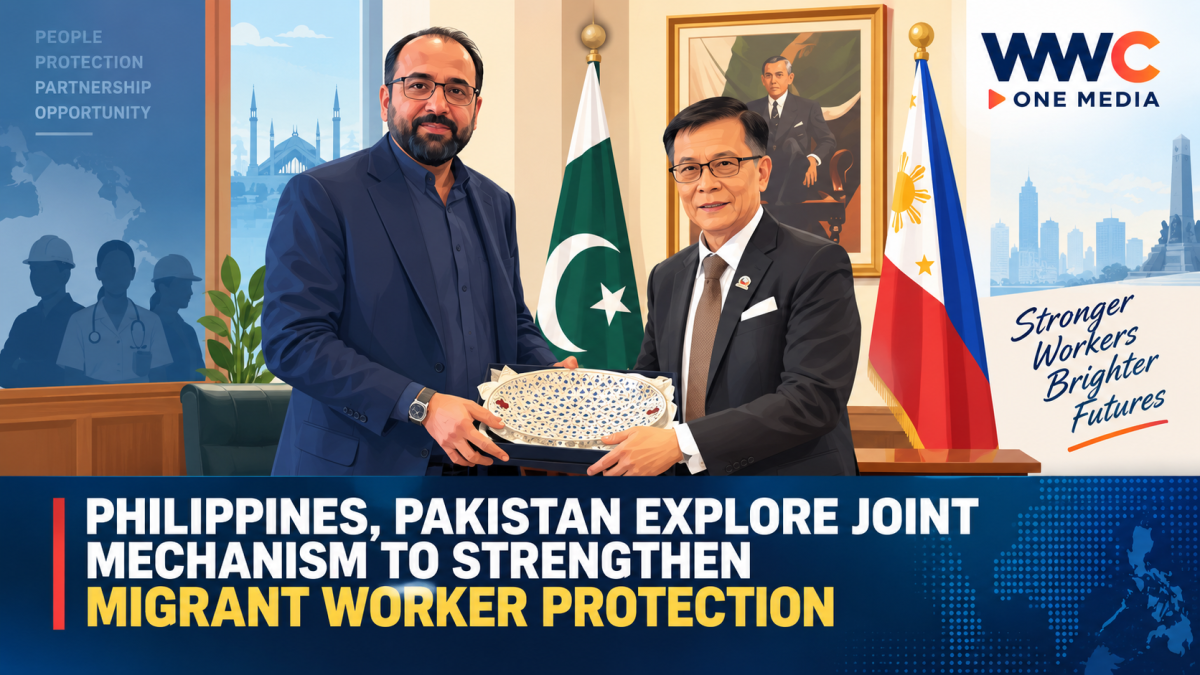
MANILA — The Philippines and Pakistan are exploring a new joint mechanism aimed at strengthening protection for migrant workers, signaling closer cooperation between the two countries as both seek to improve labor-migration systems and safeguards for workers abroad.
The initiative was discussed during a meeting between Philippine and Pakistani officials, with both sides looking at ways to improve cooperation on worker protection, recruitment processes, skills development, documentation and other labor-migration concerns.
The discussions are significant for two countries with long-standing experience in sending workers overseas, particularly as governments face growing pressure to ensure that migrant workers are properly recruited, trained and protected throughout the migration process.
Manila and Islamabad Look to Build a Formal Framework
The proposed mechanism would provide a channel for Philippine and Pakistani authorities to coordinate more closely on issues affecting migrant workers.
Rather than dealing with individual concerns only after problems arise, closer institutional cooperation could allow the two governments to exchange information and develop more consistent approaches to recruitment, worker preparation and protection.
The Philippine government has emphasized the importance of strengthening systems that support workers before departure, during overseas employment and when they return home.
Pakistan has likewise been working to strengthen its institutions responsible for overseas employment and migrant-worker welfare.
Earlier Talks Already Covered Training and Social Protection
The latest discussions build on a meeting held in February 2026 on the sidelines of the Abu Dhabi Dialogue.
At that meeting, Pakistan’s Federal Minister for Overseas Pakistanis and Human Resource Development Chaudhry Salik Hussain met Philippine Department of Migrant Workers Secretary Hans Leo J. Cacdac.
Officials exchanged information on their respective migrant-worker systems, including social security, pension arrangements, pre-departure training, vocational skills development, registration and reintegration.
The Philippine delegation also shared its experience with comprehensive pre-departure training, while Pakistan presented information about institutions including its Bureau of Emigration and Overseas Employment, Overseas Pakistanis Foundation and National Vocational and Technical Training Commission.
Both sides agreed to continue exchanging information and examining each other’s systems.
Why Migrant Protection Is Becoming a Bigger Priority
For migrant workers, protection begins well before they board a plane.
Recruitment costs, employment contracts, skills requirements, documentation, pre-departure orientation and access to social protection can all affect a worker’s experience overseas.
A stronger government-to-government mechanism could give authorities a more direct avenue for addressing emerging issues and sharing information about regulations and worker-support systems.
However, the proposed mechanism should not be interpreted as a finalized bilateral labor agreement. The governments are still exploring the framework, and details on its final structure, scope and implementation have yet to be established.
Philippines and Pakistan Already Have Broader Bilateral Ties
Labor migration is only one part of the broader Philippines-Pakistan relationship.
Pakistan’s Foreign Ministry says the two countries have existing institutional mechanisms including Bilateral Policy Consultation Talks and the Philippines-Pakistan Joint Economic Commission.
The countries have also concluded numerous bilateral agreements covering areas including consular affairs, air services, culture, investment protection and parliamentary cooperation. Their latest Joint Economic Commission meeting was held in Manila in February 2026.
The broader diplomatic framework provides an existing channel that could support deeper cooperation on migration and labor issues.
What Could Come Next
If Manila and Islamabad agree on a formal mechanism, future cooperation could cover areas such as:
- migrant-worker registration and documentation;
- recruitment and employment procedures;
- pre-departure training;
- skills and vocational development;
- social-security and welfare systems;
- worker reintegration after returning home; and
- information-sharing between relevant government agencies.
Some of these areas were already identified during the February discussions, although the precise scope of the proposed new mechanism has not yet been finalized.
The Philippines’ Department of Migrant Workers also maintains specific policies governing the deployment of Filipino workers to Pakistan, demonstrating that migration to the country already falls within an established regulatory framework.
A Potential New Chapter for Worker Protection
The emerging Philippines-Pakistan initiative reflects a broader shift toward government-to-government cooperation on migrant-worker protection, rather than focusing solely on overseas employment opportunities.
For workers, the effectiveness of any eventual mechanism will depend on how clearly responsibilities are defined, how agencies coordinate and whether protections can be implemented in practice.
For now, Manila and Islamabad are still in the exploratory stage — but the discussions could lay the groundwork for a more structured approach to protecting migrant workers from recruitment through employment and eventual return home.