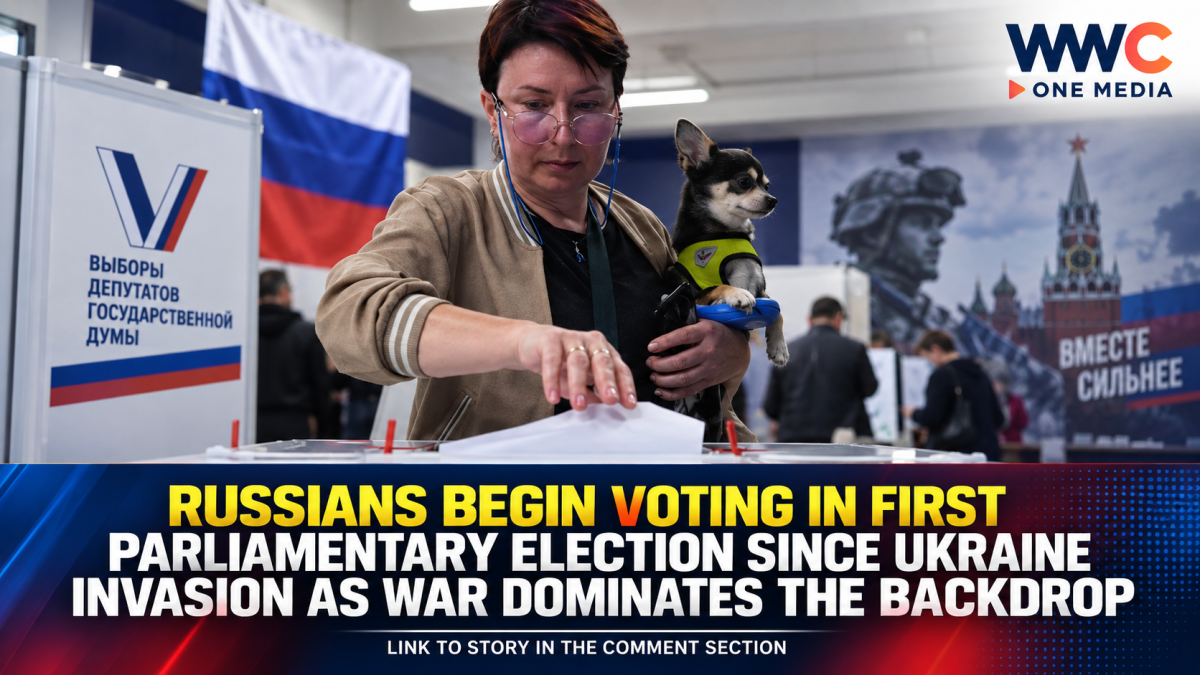
MOSCOW — Russians began voting Friday in a three-day parliamentary election that will determine all 450 seats in the State Duma, the first nationwide parliamentary vote since Moscow launched its full-scale invasion of Ukraine in February 2022. Voting runs from September 18 to 20.
The election is taking place under tight political controls, with the war, economic pressures and the limited presence of openly anti-war opposition shaping the environment surrounding the vote. Reuters describes the contest as the first parliamentary election since the start of the full-scale war, while RFE/RL reports that the conflict and a slowing economy are major issues in the background.
450 Seats Are Up for Grabs
Russian voters are choosing all 450 members of the State Duma for five-year terms.
Half of the seats are being allocated through a nationwide party-list vote, while the remaining 225 seats are contested in single-member districts.
The ruling United Russia party currently holds 310 seats in the Duma, giving it a constitutional supermajority. Reuters reports that the size of the party’s eventual majority is one of the key figures to watch during the election.
A late-August survey by state pollster VTsIOM put United Russia at 37% among respondents, compared with 11.6% for the Communist Party. Those figures are polling measurements, not election results.
First Parliamentary Vote Since the Full-Scale War Began
The election is taking place more than four years after Russia launched its full-scale invasion of Ukraine.
That makes the vote significant as a measure of the political environment surrounding the war, although election results alone cannot establish public attitudes toward the conflict.
President Vladimir Putin has urged Russians to participate, describing turnout as an important indicator of support for the country. Reuters reported that Putin recently framed participation as a barometer of support for Russia amid the continuing war.
The conflict has also become part of the election campaign through the prominence of military veterans among candidates.
Nearly 200 War Veterans Are Running
According to the Associated Press, election officials say nearly 200 parliamentary candidates have served in Ukraine.
The Kremlin has promoted veterans as part of a “new elite,” with several candidates receiving prominent positions on party lists and in campaign events.
One prominent example is United Russia candidate Vladislav Golovin, a veteran of fighting in Mariupol who has appeared at events with Putin.
Other candidates with military backgrounds include figures associated with United Russia and other parliamentary parties.
The emphasis on veterans has been interpreted differently. AP cited analysts who see the campaign as partly designed to demonstrate that military service can lead to social and political advancement, potentially encouraging further recruitment.
That interpretation is an analysis of the campaign strategy, rather than an official explanation from the Kremlin.
Anti-War Opposition Faces Major Restrictions
The election is also taking place amid extensive restrictions on political opposition.
Reuters reported that openly anti-war candidates have largely been excluded from the parliamentary contest. RFE/RL similarly described the political system as increasingly restrictive during the war.
Reuters reported that Polina Lermant, an anti-war candidate, has campaigned on a platform calling for peace despite the risks associated with publicly challenging the prevailing political environment.
The Yabloko party, which has opposed the war, is not participating in the State Duma election after being barred from the ballot, according to Reuters and other reporting.
The parties that remain represented in parliament include United Russia, the Communist Party, the Liberal Democratic Party of Russia and A Just Russia — For Truth.
Voting Extends Into Russian-Controlled Parts of Ukraine
The election is also being conducted in areas of Ukraine that Russia controls.
Ukraine has rejected Russia’s organization of elections in occupied Ukrainian territory, saying such voting is illegal and that any results there would be invalid under international law.
The Institute for the Study of War reported that early voting had already taken place in Russian-occupied areas and described the process as occurring under heavily militarized conditions. Those are ISW’s assessments; Russia presents the voting process differently.
The participation of occupied Ukrainian territories is therefore one of the most disputed aspects of the election.
War Fatigue and Economic Pressure
The parliamentary vote is also taking place against economic challenges inside Russia.
Reuters reported that persistent inflation, high borrowing costs, slowing economic activity and fuel shortages are affecting daily life ahead of the election.
The war has entered its fifth year, placing sustained pressure on Russia’s economy, labor market and government finances.
Reuters reported that businesses in some Russian regions continue to face labor shortages, while high interest rates and inflation remain concerns.
At the same time, the Kremlin continues to present Russia as capable of sustaining its military campaign and managing the economy despite Western sanctions.
What the Election Could Show
Because the political environment is tightly controlled and openly anti-war forces have faced restrictions, the election will not provide a simple measure of Russian public opinion on the war.
Instead, observers are watching several indicators: voter turnout, United Russia’s final seat total, the performance of other parliamentary parties and any signs of dissatisfaction reflected through voting patterns.
Reuters reported that United Russia needs at least 300 of the 450 seats to retain its constitutional supermajority.
The results will therefore determine the composition of Russia’s legislature for the next five years while the war in Ukraine continues.
A Wartime Election With High Political Stakes
Polling stations opened first in Russia’s Far East before voting expanded across the country’s multiple time zones.
The election is being conducted as Russian forces continue fighting in Ukraine and as Ukrainian cities remain under missile and drone attacks. On September 17, Ukrainian authorities reported casualties following Russian strikes on Kyiv and other regions.
For the Kremlin, the vote provides an opportunity to demonstrate political continuity during wartime.
For observers, the central questions are how turnout develops, how large United Russia’s majority will be and whether the results reveal any meaningful shifts in a political system where opposition activity has become increasingly restricted.
The ballots are being cast over three days—but the political consequences will extend well beyond Sunday, as Russia’s parliament prepares to serve another five-year term during a war that remains unresolved.