
ULSAN, South Korea — South Korea’s industrial heartland is preparing for an ambitious experiment: taking artificial intelligence beyond chatbots and software and putting it directly onto factory floors, production lines and industrial equipment.
SK and the Ulsan Chamber of Commerce and Industry are set to bring manufacturers, policymakers, academics, AI companies and local leaders together on September 11 for the 2026 Ulsan Forum, where one of the central questions will be how quickly artificial intelligence can reshape one of Korea’s most important manufacturing regions.
The fifth annual forum, held at the Ulsan Exhibition & Convention Center, or UECO, will operate under the theme “Leading AX, Smart Life Ulsan.” About 300 participants are expected, including representatives from industry, universities, government and the local community. The event will also be streamed online.
But behind the conference language is a much bigger economic question.
Ulsan is home to some of South Korea’s most important automotive, shipbuilding, petrochemical and heavy-industry operations. If artificial intelligence can meaningfully improve productivity, maintenance, safety and decision-making there, Ulsan could become a showcase for what Korea calls AX — AI Transformation — in manufacturing.
If the technology remains concentrated among large corporations, however, the transformation could be far more limited.
From Generative AI to Machines That Act
The forum’s first major session, “Physical AI Wave, Manufacturing AX Transformation,” will examine the deployment of artificial intelligence in the physical world — including factories, robotics and automated industrial processes.
Government officials are expected to outline Korea’s manufacturing-AI strategy, while participants in the country’s M.AX Alliance, launched in September 2025, will present examples of AI being deployed across industrial sectors.
The second session expands the discussion beyond factories, focusing on how AI could be used in everyday life and to address regional challenges.
That distinction is important. Korea’s industrial AI strategy increasingly involves more than installing software on production lines. Policymakers are looking at AI for production planning, supply-chain management, inventory, robotics, equipment maintenance and eventually increasingly autonomous factories.
Korea Says Its Factory AI Projects Are Already Producing Results
The government’s M.AX initiative has grown rapidly.
South Korea’s Ministry of Trade, Industry and Resources says the M.AX Alliance expanded from roughly 1,000 participating organizations when it launched in September 2025 to about 1,500 companies and institutions, covering 11 major industrial-AI divisions including AI factories, semiconductors and robotics.
And the government says measurable gains are beginning to appear.
More than 170 manufacturing sites have received support through the AI Factory Flagship Project. Among 42 relatively early participants where measurable results were available, average productivity reportedly increased 30.1%, while average defect rates fell 15.5%, according to the ministry.
Those figures should not be interpreted as results across all Korean factories. They represent a smaller group of early participating sites reviewed under the government program.
Still, individual cases illustrate why Seoul sees industrial AI as strategically important.
The ministry says one semiconductor-equipment company cut inspection time by 33%, an automotive supplier reduced EV-battery inspection time by 90%, and an AI-based welding and inspection project at HD Hyundai Samho increased productivity by 50%.
The next challenge is reproducing those gains at scale.
SK Wants to Show What Its AI Supply Chain Looks Like Inside a Factory
The Ulsan Forum will take place alongside WAVE 2026, the World Advanced Vision Expo, scheduled at UECO from September 10 through September 12. The exhibition brings together technologies spanning AI, mobility, shipbuilding, defense, advanced materials and clean energy.
SK Innovation’s Ulsan complex is using the exhibition to demonstrate how AI capabilities developed across SK’s semiconductor, telecommunications and data-center businesses could be applied to actual manufacturing.
Yonhap reported that SK’s exhibition will center on what the company calls its “Dual Brain” concept — combining human experience with AI systems to improve sensing, decision-making, production optimization, predictive maintenance and workplace safety.
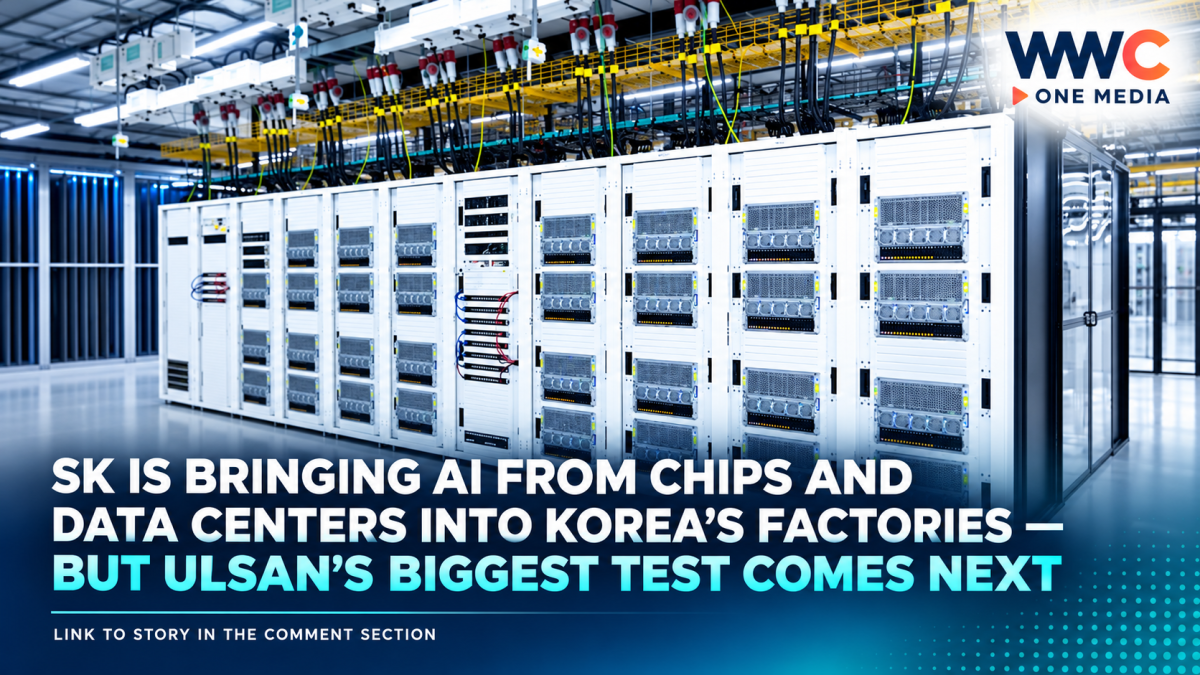
The exhibition will also highlight the SK AI data center being developed in Ulsan and show how computing infrastructure could connect with industrial AI applications.
In other words, SK is trying to demonstrate an entire chain: computing infrastructure and AI technology at one end, factory operations at the other.
But Ulsan’s Smaller Manufacturers Face a Different Reality
This may be where the most important story begins.
Industry experts involved in discussions ahead of the Ulsan Forum have warned that AI readiness differs sharply between major companies and small manufacturers.
In an Ulsan Maeil forum involving representatives from UNIST, Korea Zinc and industrial AI company InterX, participants identified several barriers holding back wider adoption: high initial investment costs, poorly standardized manufacturing data, limited computing infrastructure, cybersecurity concerns and shortages of specialists who understand both industrial processes and data science.
One participant estimated large manufacturers were significantly further ahead in AI development and testing than smaller companies, many of which still lack adequately structured data, funding or technical personnel.
That gap matters because modern industrial supply chains do not operate factory by factory.
A major automaker, shipbuilder or petrochemical producer may deploy advanced AI systems, but those gains can be constrained if hundreds of suppliers operate incompatible databases, equipment and information systems.
Experts therefore argue that common data standards, shared GPU infrastructure, industrial testing facilities and clearer security rules may be just as important as increasingly powerful AI models.
Why Ulsan Could Become Korea’s Industrial AI Laboratory
South Korea faces broader pressures that make automation increasingly urgent.
The Industry Ministry points to a shrinking working-age population, an aging skilled workforce and slowing labor-productivity growth as structural challenges for Korean manufacturing.
Physical AI could address parts of that problem by assigning dangerous, repetitive or highly predictable industrial tasks to robots and automated systems while preserving experienced workers’ knowledge digitally.
Government-supported projects already include AI-enabled industrial robotics as well as humanoid systems being developed for jobs such as monitoring fires in shipyards, handling equipment in toxic-gas environments and performing repetitive logistics work.
For Ulsan, that creates an unusually important opportunity.
The city already possesses something AI developers cannot easily recreate in a laboratory: enormous amounts of real industrial experience, machinery, production data and engineering knowledge across automotive, shipbuilding, chemicals and other heavy industries.
Connecting those assets with AI companies, universities, computing infrastructure and government-backed testing programs could turn Ulsan into one of Korea’s most important industrial-AI test beds.
The Real Test Comes After the Forum
The September 11 gathering will produce speeches, demonstrations and policy discussions.
Whether it produces a true manufacturing transformation will depend on what happens afterward.
Korea has already shown that AI can cut inspection times, predict equipment problems and improve production at selected factories. The harder challenge is getting thousands of smaller manufacturers and suppliers onto compatible systems without imposing costs they cannot afford or exposing sensitive industrial data.
That makes the Ulsan Forum more than another AI conference.
It is part of a much larger attempt to determine whether South Korea can convert its traditional manufacturing strength — cars, ships, chemicals, semiconductors and heavy industry — into an advantage in the emerging era of physical AI.
The technology is advancing quickly.
The question now is whether the rest of the factory ecosystem can advance with it.
WWC ONE MEDIA M.J.E




Leave a Reply